











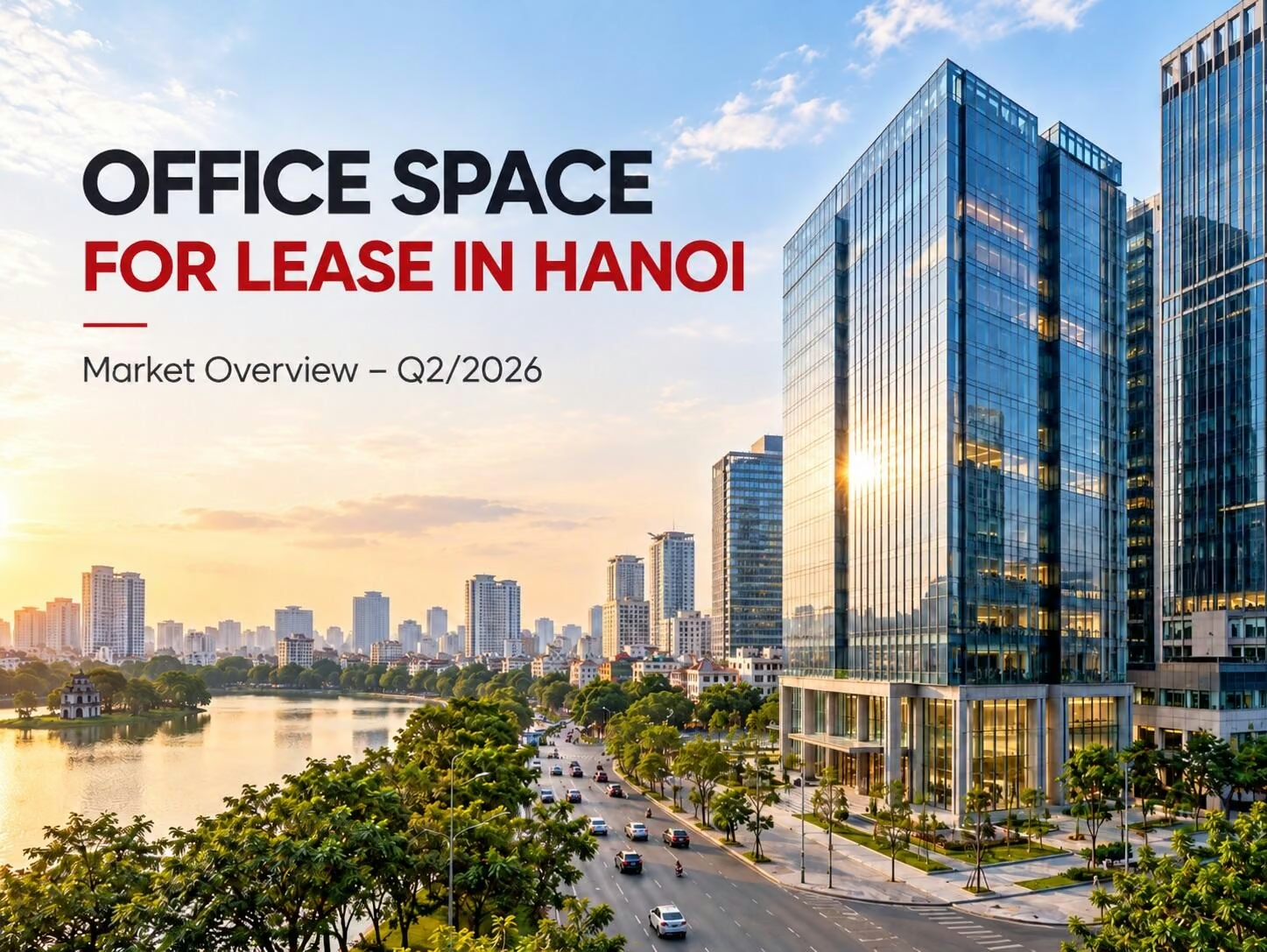
Hanoi Office Leasing Market Overview – Q2 2026
As of Q2 2026, Hanoi has approximately 2.3 million m² of net leasable area (NLA) across 190 projects, a slight increase from the previous quarter. Market-wide occupancy reached 86%, stable quarter-on-quarter and up 3 percentage points year-on-year. Average rents were flat quarter-on-quarter but up 2% year-on-year, reflecting a steady recovery in leasing demand following a period of supply adjustment. Between 2026 and 2028, the market will welcome around 370,000m² of new office space, concentrated mainly in the western area of the city. This new supply is reshaping Hanoi’s office map into a multi-polar structure, gradually reducing reliance on the traditional central area.
| Indicator | Figure |
|---|---|
| Total supply | ~2.3 million m² NLA (190 projects) |
| Market-wide occupancy rate | 86% |
| Average rent | Flat quarter-on-quarter, up 2% year-on-year |
| New supply through 2028 | ~370,000 m² |
| Area leading new supply | West (accounting for 76%) |
Office Supply by Area
The western area, including Cau Giay, Nam Tu Liem and Tay Ho Tay (Starlake), leads new office supply in Hanoi, while the traditional CBD of Hoan Kiem and Ba Dinh has limited Grade A supply due to constrained land availability. Between 2026 and 2028, around 370,000m² of office space is expected to enter the market, of which the western area accounts for 76%. In Q2 2026 alone, CBRE recorded two new Grade A buildings in Hanoi with more than 73,000m² of NLA, further consolidating the office cluster in Tay Ho Tay. Oriental Square and IFC Hanoi are the first two Grade A projects to become operational in Starlake CBD. The number of new Grade A projects in Hoan Kiem and Ba Dinh remains limited, and the market is taking shape as multi-polar rather than centered on a single core area.
| Area | Supply characteristics |
|---|---|
| CBD (Hoan Kiem, Ba Dinh) | Limited Grade A supply due to constrained land bank; retains its role as the traditional financial-commercial center |
| West (Cau Giay, Nam Tu Liem, Tay Ho Tay) | Accounts for 76% of new supply in 2026–2028, led by the Starlake cluster with Oriental Square and IFC Hanoi |
| Market-wide 2026–2028 | Around 370,000m² of new office space entering the market; market taking shape as multi-polar |
Occupancy and Leasing Demand
Market-wide occupancy in Hanoi’s office market reached 86% in Q2 2026, stable quarter-on-quarter. Grade A offices in the CBD area hold the highest occupancy, at around 95%, higher than the 81% recorded outside the CBD. Grade B occupancy fell to around 83%, down 1.1% quarter-on-quarter, as three new projects handed over in late 2025 and early 2026 increased available supply. The majority of Grade A transactions in Q1 2026 came from relocation and upgrade demand for existing offices, reflecting a corporate flight-to-quality trend. Businesses are increasingly prioritizing a move from Grade B and C offices to Grade A buildings that meet higher operational and amenity standards.
| Grade / Area | Occupancy rate |
|---|---|
| Grade A in the CBD | ~95% |
| Grade A outside the CBD | ~81% |
| Grade B | ~83% (down 1.1% quarter-on-quarter) |
Office Tenant Composition
The two main tenant groups in the Hanoi office market are banking-finance-insurance and information technology, with growing participation from FDI enterprises. Technology companies are the most active tenant group, continuously expanding their footprint to support headcount growth and product development, while prioritizing modern buildings with strong technology infrastructure. Financial institutions, banks and insurers continue to maintain steady demand for Grade A office space in the central area and in newly formed business hubs.
- Banking, finance and insurance: prioritize Grade A office space in the central area and in newly formed business hubs
- Information technology: the most active tenant group, expanding space in line with headcount growth, prioritizing modern technology infrastructure
Impact of Administrative Merger on the Hanoi Office Market
The merger and streamlining of the administrative apparatus does not create a mandatory obligation for businesses currently leasing office space in Hanoi to change their business registration address, helping to limit direct disruption to existing leasing demand. Businesses can continue using their issued business registration certificates and only need to update their address when there is a need to do so or when carrying out other change procedures. The reorganization of administrative units mainly affects the location of administrative centers and regional management agencies, while commercial office leasing demand continues to operate according to ordinary market factors such as location, rent and building amenities.
How Much Does Office Rent Cost in Hanoi?
Office rents in Hanoi in 2026 commonly range from USD 8–60/m²/month depending on building grade, area and handover condition. Grade A office space had an average asking rent of around USD 32.2/m²/month in Q2 2026, considerably higher than the USD 21.4/m²/month recorded for Grade B. The price gap between grades reflects differences in location, construction quality and operational standards. Businesses need to compare this pricing against their budget and required area to determine the appropriate segment before conducting site visits.
| Grade | Average rent (USD/m²/month) |
|---|---|
| Grade A | ~32.2 |
| Grade B | ~21.4 |
Rent by Office Grade (A/B/C)
Grade A office rent in Hanoi is the highest in the market, averaging around USD 32.2/m²/month in Q2 2026, up slightly 0.1% quarter-on-quarter and 0.5% year-on-year. Grade B rent stood at around USD 21.4/m²/month, up 0.2% quarter-on-quarter and 0.5% year-on-year, indicating a fairly even pace of rent growth between the two grades. Grade C has the lowest rent in the market, suited to small businesses and startups prioritizing cost optimization.
| Grade | Average rent | Quarter-on-quarter change | Year-on-year change |
|---|---|---|---|
| Grade A | ~USD 32.2/m²/month | +0.1% | +0.5% |
| Grade B | ~USD 21.4/m²/month | +0.2% | +0.5% |
Rent by Area
Grade A office rent in the CBD area (Hoan Kiem, Ba Dinh) is considerably higher than in areas outside the CBD, but this gap is gradually narrowing as the quality of new projects improves. The CBD leads with an average Grade A rent of USD 34.8/m²/month, up 4.82% year-on-year. Areas outside the CBD reached around USD 26/m²/month, up 6.12% year-on-year, reflecting a clear upgrade in the quality of new projects in Cau Giay, Nam Tu Liem and Tay Ho. The price gap between the two areas remains large but is gradually narrowing as more projects outside the center reach standards comparable to the core area.
| Area | Average rent | Year-on-year change |
| CBD (Hoan Kiem, Ba Dinh) | ~USD 34.8/m²/month | +4.82% |
| Outside the CBD (Cau Giay, Nam Tu Liem, Tay Ho) | ~USD 26/m²/month | +6.12% |
Costs Beyond Base Rent
Beyond the per-m² rent, businesses need to factor in service charges, VAT, parking fees, out-of-hours air conditioning and a security deposit to determine the actual budget. Service charges typically range from USD 2–4/m²/month, depending on the scope of services and the building’s operational standards. Comparing only the per-m² rent without factoring in service charges, VAT, parking fees and air conditioning easily leads to budget discrepancies when a business finalizes a contract.
- Service charge (USD 2–4/m²/month)
- VAT
- Parking fees
- Out-of-hours air conditioning
- Security deposit
- Initial fit-out costs
Classification of Office Space for Lease in Hanoi
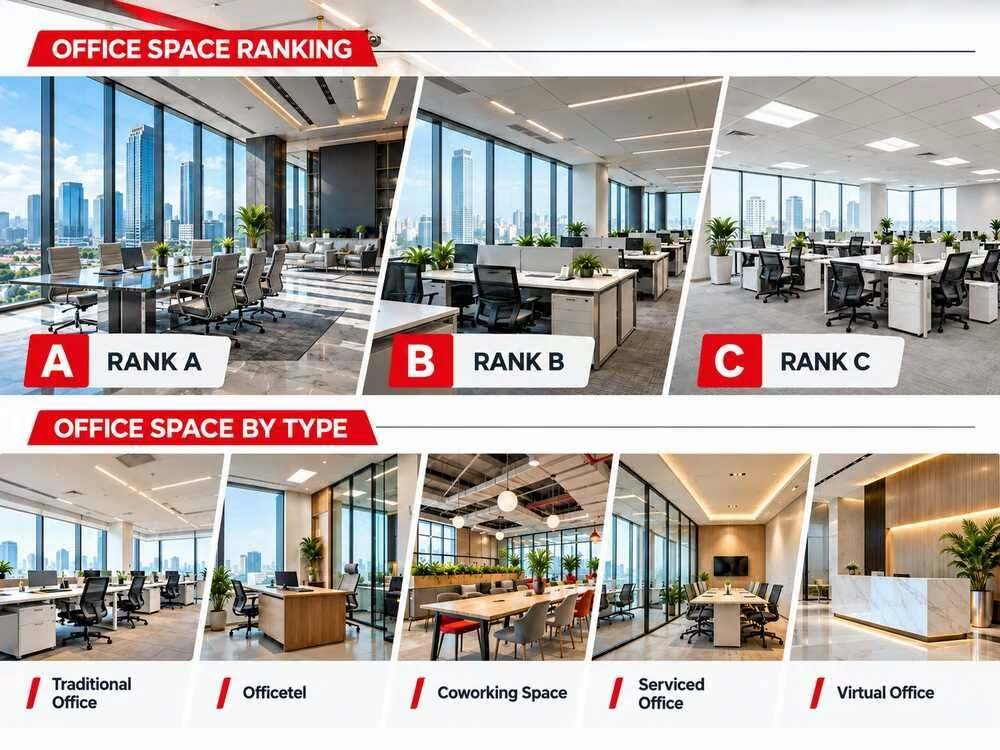
Office space for lease in Hanoi is classified according to three main criteria: by grade (A/B/C), by leased area, and by type (traditional, officetel, coworking, serviced or managed office). Each criterion fits a different need and budget for businesses.
Classification by Grade
Grade A, B and C offices are distinguished mainly by location, construction quality, the managing operator and rent levels, with Grade A having the highest technical and service standards, while Grade C suits cost-conscious budgets. Grade A offices are concentrated in major cities with high technical and operational standards; notable buildings in Hanoi include Keangnam Landmark 72, Thai Holdings and Corner Stone. Grade B offices offer fairly good quality at lower rents than Grade A, with notable buildings such as Handiresco Tower and Geleximco 36. Grade C offices have the lowest rents, suited to startups and cost-conscious companies, but face growing competition from the flex office model.
| Grade | Key characteristics | Suitable tenant profile |
| Grade A | Highest technical and operational standards; examples include Keangnam Landmark 72, Thai Holdings, Corner Stone | Large corporations, FDI enterprises, financial institutions |
| Grade B | Fairly good quality, lower rent than Grade A; examples include Handiresco Tower, Geleximco 36 | Small and medium-sized businesses seeking cost efficiency |
| Grade C | Lowest rents in the market, facing competition from flex office | Startups, cost-conscious companies |
Classification by Area
Office space for lease in Hanoi is highly diverse in size, ranging from a few dozen m² for small businesses to thousands of m² for large corporations, depending on headcount and operational needs.
Classification by Type (Traditional, Officetel, Serviced Office)
Alongside traditional offices, the Hanoi market also has officetels, coworking spaces, serviced (packaged) offices and virtual offices — models that are more flexible in terms of area, cost and lease term.
Traditional offices are the most common type, with the largest supply and demand in the market, classified by Grade A, B and C.
Officetel combines Office and Hotel, an apartment-style unit used for both living and working, with an area from 30–50m² and above, suited to small companies of 4–10 people.
Coworking space is an open working environment with shared infrastructure and amenities, where tenants can choose flexible seating within the shared space.
Serviced or packaged office (serviced office) varies in area and rent, comes with modern amenities built in, and suits businesses that need to operate quickly without needing to invest in initial fit-out.
Virtual office is a solution that minimizes costs to the greatest extent, suited to businesses that do not need a frequent physical presence.
Flex office (flexible space) is increasingly favored by startups, technology companies and distributed teams, as it is easy to change area and location according to operational circumstances.
Classification of Office Space for Lease in Hanoi
Office space for lease in Hanoi is classified according to three main criteria: by grade (A/B/C), by leased area, and by type (traditional, officetel, coworking, serviced or packaged office, virtual office). Each criterion fits a different need and budget for businesses.
Classification by Grade
Grade A, B and C offices are distinguished mainly by location, construction quality, the managing operator and rent levels, with Grade A having the highest technical and service standards, while Grade C suits cost-conscious budgets.
| Grade | Location and quality | Managing operator | Suitable tenant profile | Example buildings |
|---|---|---|---|---|
| Grade A | Prime location, highest technical and operational standards, often green-certified | Professional management, often with an international element | Large corporations, FDI enterprises, financial institutions | Keangnam Landmark 72, Thai Holdings, Corner Stone |
| Grade B | Fairly good quality, convenient location, lower rent than Grade A | Domestic or international management | Small and medium-sized businesses seeking cost efficiency | Handiresco Tower, Geleximco 36 |
| Grade C | Lowest rents in the market, basic amenities | Self-operated by the developer | Startups, cost-conscious companies | IC Building, HDI Tay Ho |
Grade C currently faces growing competition from the flex office model, as cost-conscious tenants have more flexible options in terms of area and contract term.
Classification by Area
Office space for lease in Hanoi is highly diverse in size, ranging from a few dozen m² for small businesses to thousands of m² for large corporations, depending on headcount and operational needs. The market is typically divided into the following four common area groups:
| Area group | Reference area | Suitable headcount | Common type |
|---|---|---|---|
| Small | Under 100m² | 5–15 people | Serviced office, coworking, officetel |
| Medium | 100–500m² | 15–50 people | Traditional Grade B, C office |
| Large | 500–1,500m² | 50–150 people | Traditional Grade A, B office |
| Extra large | Over 1,500m² | Over 150 people or multiple departments | Whole floor or multiple floors in a Grade A building |
Businesses leasing small areas tend to prioritize flexible models to avoid long-term commitments when headcount is not yet stable. Conversely, businesses leasing large and extra-large areas typically sign long-term contracts at traditional Grade A offices to ensure stability, while also being able to negotiate favorable terms such as an initial rent-free period or fit-out cost support.
Classification by Type
Alongside traditional offices, the Hanoi market also has officetels, coworking spaces, serviced (packaged) offices and virtual offices – models that are more flexible in terms of area, cost and lease term.
Traditional office
Traditional office is the most common type, with the largest supply and demand in the market, classified by Grade A, B and C. Businesses lease the entire floor or part of the floor area and invest in their own fit-out and operational infrastructure according to their specific needs. This type suits businesses with long-term operating plans and stable headcount.
Officetel
Officetel combines Office and Hotel, an apartment-style unit used for both living and working, with an area from 30–50m² and above. This type suits small companies of 4–10 people or individual business owners who need a business registration address at a lower initial investment cost than a traditional office.
Coworking space
Coworking space is an open working environment with shared infrastructure and amenities such as internet, meeting rooms and reception areas. Tenants can choose flexible seating within the shared space, suiting freelancers, small teams or businesses that want to test the market before committing to fixed space.
Serviced or packaged office (serviced office)
Serviced office varies in area and rent, comes with modern amenities already built in such as furniture, reception, security and technology infrastructure. This type suits businesses that need to operate quickly without needing to invest in initial fit-out, particularly useful for companies opening a new branch or FDI businesses newly entering the market.
Virtual office
Virtual office is a solution that minimizes costs to the greatest extent, providing a legal business registration address without requiring a frequent physical presence. This type suits businesses operating remotely, small consulting firms or units that only need an official transaction address.
Flex office in general — including coworking, serviced office and virtual office — is increasingly favored by startups, technology companies and distributed teams, as it is easy to change area and location according to operational circumstances.
Areas Concentrated with Office Space for Lease in Hanoi
Office space for lease in Hanoi is concentrated mainly in 5 areas: Hoan Kiem (traditional CBD), Ba Dinh (administrative center), Dong Da – Cau Giay (fast-developing Grade A/B area), Nam Tu Liem – My Dinh (new urban area) and Tay Ho (premium office area, led by Starlake). Each area has a different tenant positioning and price level.
Hoan Kiem – Traditional CBD Center
Hoan Kiem is Hanoi’s oldest economic, financial and commercial center, home to many banks, financial institutions, law firms and large corporations, even though new office supply is not as abundant as in the western areas. This area concentrates many banks, large corporations, financial institutions, law firms, consulting companies and upscale hotels, offering particular value in terms of branding and corporate image. Hoan Kiem’s office market does not have as abundant supply as Cau Giay or Nam Tu Liem but still maintains its appeal thanks to its central location. Many buildings here were built during the French colonial period in European architectural style, with lower floor-to-ceiling heights than newer buildings in other areas.
Ba Dinh – Administrative Center Area
Ba Dinh is the national administrative-political center, home to the headquarters of the highest leadership bodies of the Party, the State, the National Assembly, the Government, and many international diplomatic organizations. This area is designated as the national administrative-political center, concentrating the highest leadership bodies of the Party, the State, the National Assembly and the Government, while also serving as a diplomatic and foreign affairs center with the headquarters of many international organizations and foreign embassies. Businesses leasing office space in Ba Dinh have easy access to government agencies, embassies and international organizations, which is convenient for foreign affairs activities and administrative procedures. Rents within the area are segmented by sub-zone: Kim Ma – Lieu Giai concentrates many Grade A buildings with the highest rents, Doi Can – Ngoc Khanh has many Grade B offices at average rents, while Thanh Cong has many Grade C offices with the lowest rents.
Dong Da and Cau Giay – Developing Grade A/B Office Area
Cau Giay is Hanoi’s fastest-developing office market, concentrating many technology and finance companies, while Dong Da serves as a transitional area between the traditional CBD and the developing western area. Cau Giay is described as one of Hanoi’s fastest-developing office markets, holding around 30% of the city’s total office supply for lease, concentrating many technology companies and financial services firms. Notable buildings in this area include FPT Tower, CMC Tower and Keangnam Landmark Tower. Dong Da is located at the center of the capital, bordering Ba Dinh, Hoan Kiem and Cau Giay, with a well-connected transport network via Le Duan, Giai Phong, Truong Chinh and Lang roads; notable buildings include Peakview Tower (Tan Hoang Cau) and Tecos Building.
Nam Tu Liem (My Dinh) – New Urban Area
Nam Tu Liem is a fast-developing new urban area, home to many modern developments and well-connected transport infrastructure, suited to businesses needing large spaces at a more reasonable cost than the central area. This is a district with many modern and important architectural works such as the National Convention Center, My Dinh National Stadium, Keangnam Hanoi Landmark Tower and the Hanoi Museum. The area’s transport infrastructure connects via Ring Road 3 and Thang Long Boulevard, two important transport corridors of Hanoi. From a sparsely populated area with slow urbanization, Nam Tu Liem has now become a strongly developing real estate location, particularly in the mid-to-high-end apartment segment.
Tay Ho – Premium Office Area
Tay Ho, led by the Starlake Tay Ho Tay urban area, is Hanoi’s emerging premium office area with Grade A projects meeting international standards, attracting financial, technology and multinational corporate tenants. Starlake Tay Ho Tay is a 100% Korean-invested premium urban area, developed by T.H.T Development Co., Ltd., designed by the Hanoi Institute for Construction Planning together with Korean architectural consultants. Notable Grade A buildings here include IFC Hanoi, Oriental Square (LEED Gold certified) and Parc Hanoi. This area suits financial, technology, consulting, education and professional services businesses, as well as companies seeking premium office space in a newly developing area.
Criteria for Choosing a Suitable Office for Lease
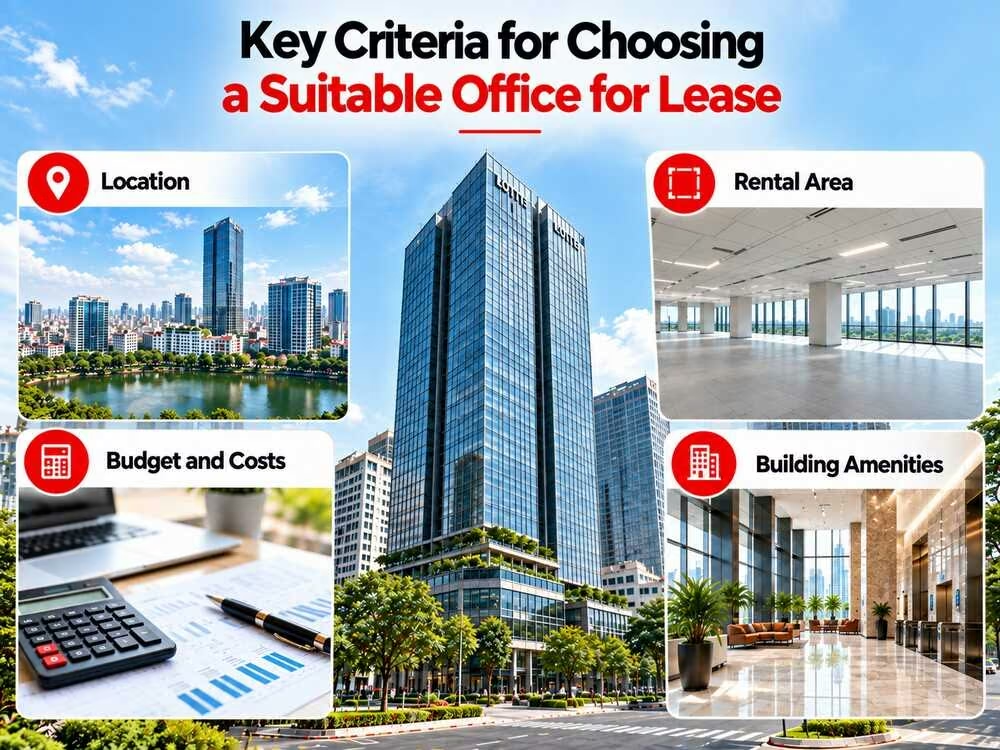
Choosing a suitable office requires comprehensive consideration of 4 main criteria: location, leased area, budget and costs, and building amenities, based on the actual needs of a business regarding headcount, budget and lease term.
Office Location
Office location should prioritize convenient commuting for staff and clients, proximity to main transport routes and surrounding public amenities. Businesses need to consider a location that is easy to reach for staff and clients, close to main transport routes, public amenities and a vibrant business area. Convenient location is one of the top priority criteria when screening a shortlist of potential offices, along with area and rent.
Leased Area
The leased area should be determined based on current headcount and expansion plans, avoiding under-leasing that causes crowding or over-leasing that wastes budget. The first step in determining area is to clarify usage needs: identifying the required area, headcount and desired lease term before searching for an office. An area that meets actual needs is one of the top priority criteria in the initial screening, along with rent and location.
Budget and Leasing Costs
The office leasing budget needs to be calculated based on the total actual cost, not just the per-m² rent, to avoid discrepancies when adding service charges and other incidental costs. Businesses can easily misjudge the actual budget if they only look at the per-m² rate, since the total leasing cost also includes service charges, VAT, parking, air conditioning, deposit and fit-out costs. Service charges are usually calculated separately, so the scope of services, calculation method and adjustment schedule need to be clearly checked; some contracts may bundle these together, but businesses should request details in writing.
Items to check before finalizing the budget:
- Rent per m² and the chargeable area (carpet area or wall-to-wall area)
- Service charge, calculation method and adjustment schedule
- VAT, parking fees, out-of-hours air conditioning
- Security deposit and initial fit-out costs
Building Amenities
Building amenities — from internet systems, meeting rooms, reception to security and parking — directly affect day-to-day operational efficiency and need to be carefully checked before signing a contract. Businesses need to look into available services such as internet, meeting rooms, reception, security, cleaning, parking and other support items. Many businesses tend to prioritize buildings with green certification, that are environmentally friendly and energy-efficient, suiting a younger workforce.
Amenities to check:
- Internet, meeting rooms, reception
- Security, cleaning, parking
- Green certification (LEED, LOTUS) if the business prioritizes sustainable development
- The building’s legal status (avoiding a building under dispute)
Trends in Office Leasing in Hanoi
Hanoi’s office market is shifting toward a flight-to-quality trend, with three main strands: flexible workspace, green offices with international certification, and smart buildings applying operational technology.
Flexible Workspace
Demand for offices flexible in area and lease term is rising strongly, particularly from startups and technology companies that prioritize the ability to expand quickly in line with headcount growth. The number of clients seeking flexible offices, small offices that can change area according to short- or medium-term needs, has increased strongly in recent quarters, particularly among startups and technology companies. Flexible workspace is forecast to grow strongly, expected to account for 5–6% of the Asian office market share by 2027. The hybrid working trend is also leading businesses to prioritize buildings with easily customizable space designs.
Green Offices Certified LEED, LOTUS
Offices with green certification such as LEED and LOTUS are becoming increasingly common in Hanoi, particularly in the Grade A segment, and are becoming an important competitive criterion among developers. Around 41% of Grade A buildings and 4% of Grade B buildings in Hanoi currently hold green certification, with 3 more Grade A projects expected to achieve LEED certification in the near future. Green-certified buildings help reduce environmental impact, improve employee health and productivity, while also enhancing a business’s reputation and image. LEED-certified buildings or those applying sustainable development standards are attracting many multinational businesses, particularly in technology, finance and professional services.
| Grade | Share of buildings with green certification |
|---|---|
| Grade A | ~41% |
| Grade B | ~4% |
Smart Buildings
Smart buildings applying automated operational management technology are becoming a new standard, no longer an added value but a default expectation of tenants. Smart building management systems use automatic sensors to adjust lighting and temperature according to occupancy, together with app-based booking systems for meeting rooms and workstations. User experience has become the deciding factor in tenant choices in 2026, rather than just comparing location and price as before.
Common smart building features:
- Automatic sensors adjusting lighting and temperature
- App-based booking system for meeting rooms and workstations
- Access control and security management system integrated with technology
List of Notable Office Buildings for Lease in Hanoi
Hanoi has many notable Grade A office buildings in the CBD area as well as projects with international green certification, meeting the diverse needs of domestic and foreign businesses.
Grade A Buildings in the CBD Area
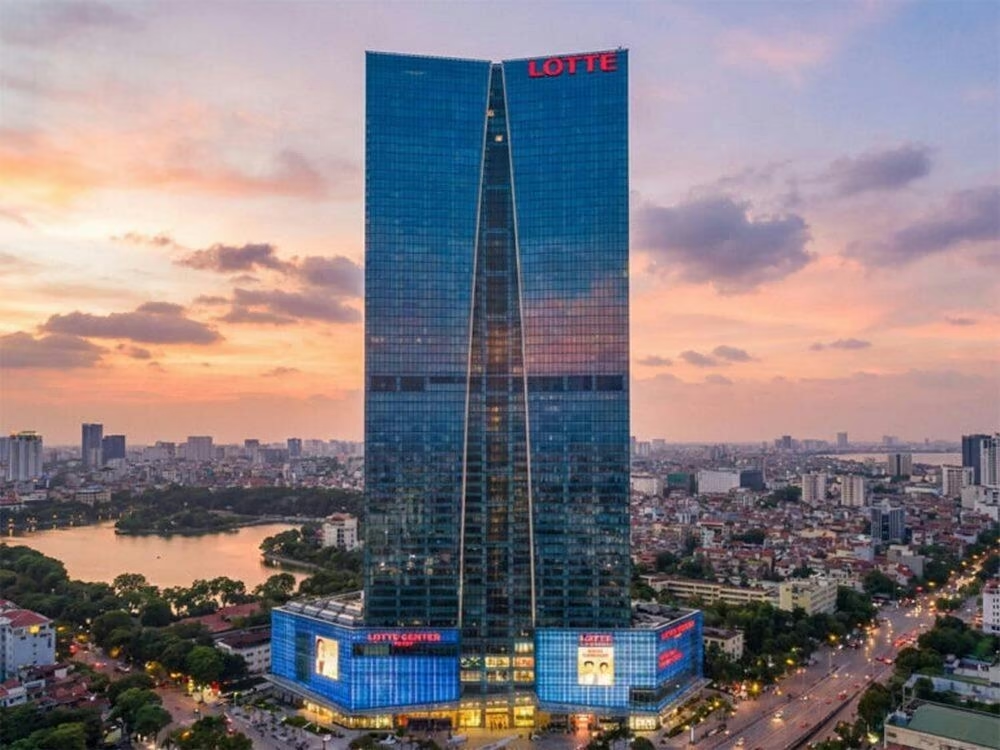
Notable Grade A buildings in Hanoi’s CBD area include Lotte Center Hanoi, Keangnam Hanoi Landmark Tower and Capital Place, all of which are landmark developments with international operational standards. Lotte Center Hanoi is located at 54 Lieu Giai (Ba Dinh), with architecture inspired by the Vietnamese ao dai, designed by Callison (USA), with a total leasable floor area of around 78,376m², with flexible floor plates from 50m² for traditional offices. Keangnam Hanoi Landmark Tower is a 72-story tower invested by Keangnam Group (Korea), with a Grade A office zone from floors 12–46, integrating the Parkson shopping center and the Intercontinental hotel. Capital Place is a Grade A office project holding 2 LEED certifications in the new CBD area, comprising 2 twin 37-story office towers.
| Building name | Address – area | Notable features |
|---|---|---|
| Lotte Center Hanoi | 54 Lieu Giai, Ba Dinh | Architecture inspired by the ao dai, designed by Callison (USA), ~78,376m² of leasable floor area |
| Keangnam Hanoi Landmark Tower | Nam Tu Liem | 72-story tower, Grade A office from floors 12–46, integrating Parkson and the Intercontinental hotel |
| Capital Place | Ba Dinh | 2 twin 37-story office towers, holding 2 LEED certifications |
Notable Green Office Buildings
Oriental Square and Capital Place are two notable green office buildings in Hanoi, both LEED Gold certified, representing the market’s sustainable development trend. Oriental Square is a Grade A office building in Starlake, LEED Gold certified, with column-free floor architecture and energy-efficient Double Low-E glazing. Capital Place is a landmark building and the first LEED Gold certified building in Hanoi with international operational standards. The Marc 88, located in Cau Giay, is built to LEED Silver standard.
| Building name | Green certification | Area |
|---|---|---|
| Oriental Square | LEED Gold | Tay Ho Tay (Starlake) |
| Capital Place | LEED Gold | Ba Dinh |
| The Marc 88 | LEED Silver | Cau Giay |
How to Lease a Suitable Office in Hanoi?
The office leasing process in Hanoi consists of 5 main steps: identifying needs, determining budget, searching and shortlisting, conducting site visits, and negotiating and signing the contract.
- Identify needs: businesses clarify the required area, headcount, desired lease term and mandatory amenities before searching for an office.
- Determine budget: businesses calculate the total actual cost including rent, service charges, VAT and other incidental costs, rather than relying only on the per-m² rate.
- Search and shortlist: businesses search through professional brokerage firms, partner networks or industry associations, then screen by area, rent, location and handover condition.
- Conduct site visits: businesses check the legal status of the building, immediately eliminating any options under dispute before proceeding to the negotiation stage.
- Negotiate and sign the contract: businesses clarify deposit terms, lease term, early termination clauses and the annual rent escalation rate, typically ranging from 5–10%/year.
RSQUARE – Office Leasing Advisory Firm in Hanoi
RSQUARE is an office leasing advisory firm in Hanoi with a database of more than 55,000 properties and a one-stop advisory service, completely free for tenants.
A Database of More Than 55,000 Properties
RSQUARE holds a database of more than 55,000 office, industrial and commercial properties in Hanoi and Ho Chi Minh City, helping tenants quickly access options suited to their needs.
A One-Stop, Free Advisory Service
RSQUARE provides a completely free one-stop advisory service for tenants, from finding space and conducting site visits to supporting contract negotiations with building owners.
- Advising on and proposing buildings suited to needs and budget
- Arranging site visits
- Supporting lease term negotiations with building owners
- 100% free service for tenants
Frequently Asked Questions About Leasing Office Space in Hanoi
What is the minimum office area?
Traditional offices usually have no fixed minimum area, depending on the building; whereas serviced or coworking offices can be leased from 1 seat or a small room of a few m².
What is the typical office lease term?
Traditional offices typically have a minimum lease term of 2 years, commonly ranging from 2–5 years; serviced offices are more flexible and can be leased for under 1 year.
How many months of rent is the security deposit?
The typical security deposit ranges from 2–3 months’ rent, which can be negotiated down if the building still has significant vacant space; some building owners require an additional deposit covering the management fee.
Should you lease an office through a brokerage firm?
It is advisable to lease through a professional brokerage firm, as tenants usually do not have to pay a fee (the building owner covers it), while also receiving support in searching, conducting site visits and negotiating contract terms.
