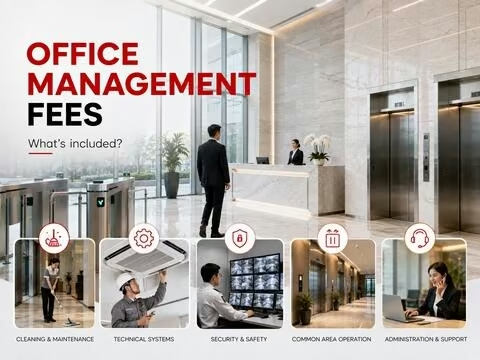
Many businesses, when budgeting for office rental, only factor in the listed price per m², resulting in actual costs that far exceed initial estimates. Office rental costs in practice consist of four categories: monthly fixed costs, variable costs based on usage, one-time costs, and VAT applied to rent and service fees. This article analyzes each cost category in detail, explains how to calculate the true total rental cost, outlines strategies for budget optimization, and highlights common mistakes businesses make when estimating office rental expenses.
What are office rental costs?
Office rental costs refer to the total amount a business must pay to occupy an office space — encompassing not just the listed rental rate but numerous additional line items that arise throughout the leasing and operational period.
The listed price per m² is only one component of the true total cost. Businesses that lack a full picture of all cost items frequently find their budgets ballooning after the contract is signed, disrupting long-term financial plans. Understanding the full cost structure from the outset allows businesses to compare options accurately and to negotiate more favorable lease terms.
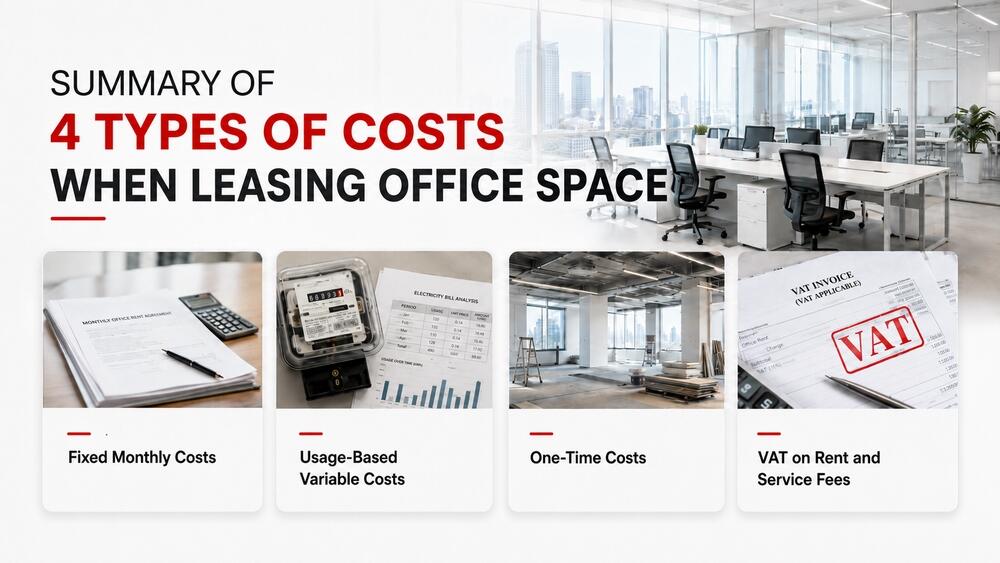
Four cost categories to understand
- Monthly fixed costs — rent and management fees, which remain constant throughout the lease term
- Variable costs based on usage — electricity, parking fees, and overtime usage charges, which fluctuate with actual consumption
- One-time costs — security deposit, fit-out and interior construction costs, and reinstatement costs at lease end
- VAT — applied to rent and service fees in accordance with current tax regulations
4 Types of office rental costs payable to the building
The four cost categories below make up the total amount a business pays to the building throughout the lease period — from recurring monthly items to costs that arise only once.
Monthly fixed costs
Monthly fixed costs are line items that businesses pay on a regular monthly basis at the rates agreed upon in the lease contract, regardless of actual usage levels. Monthly fixed cost consists of the following 2 main fees:
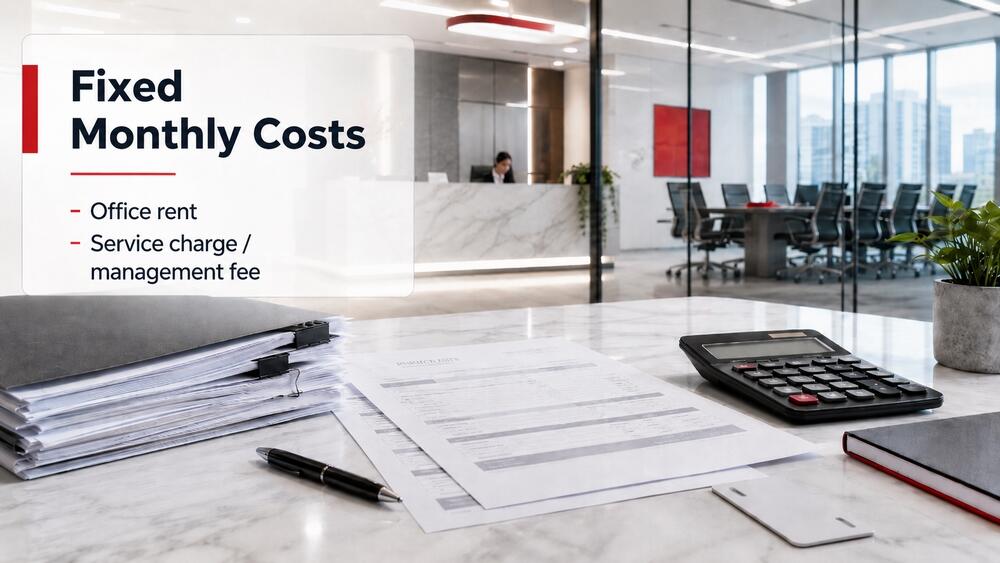
- Rent: the largest cost item, calculated as the USD/m²/month or VND/m²/month rate multiplied by the leased area
- Service fee / management fee: covers the operating costs of common building areas such as elevators, security, and cleaning; typically billed separately from rent and varies by building grade
Both items remain constant throughout the lease term, unless the contract includes pre-agreed periodic escalation clauses.
Variable costs based on usage
Variable costs are line items that change according to the business’s actual level of consumption or frequency of use, and are not fixed month to month. Variable costs include the following 3 main fees:
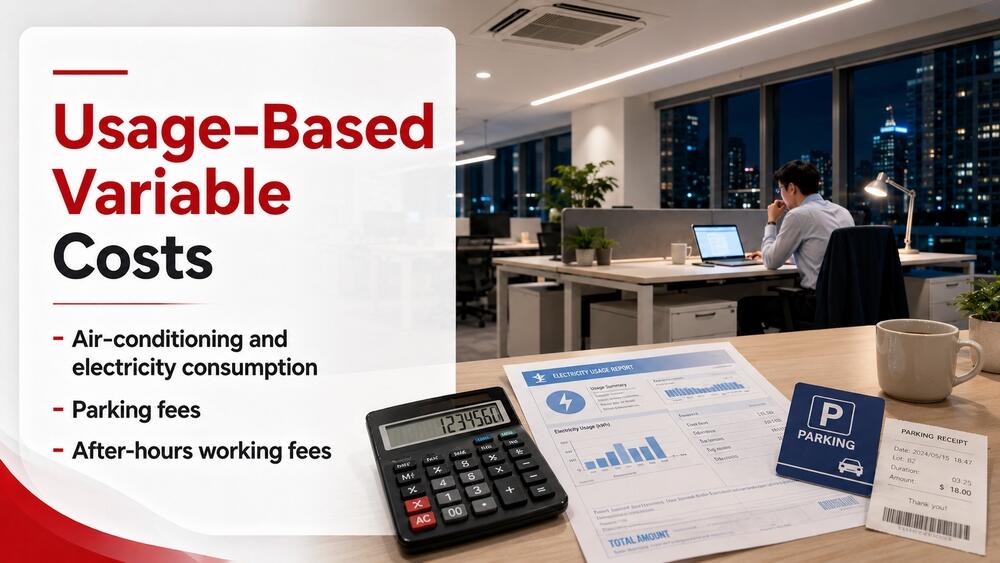
- Air-conditioning and electricity: billed based on actual consumption, typically measured by individual meters for each tenant unit
- Parking fees: applicable to cars and motorcycles; may be charged per entry or as a fixed monthly package depending on the building’s policy
- Overtime usage charges: incurred when a business needs to use air-conditioning or other utilities outside the building’s standard operating hours
Businesses should budget for these costs with greater flexibility than fixed costs, particularly if overtime work is a regular occurrence.
One-time costs
One-time costs are payments made at specific points during the lease period that do not recur monthly. One-time costs typically include the following four fees:
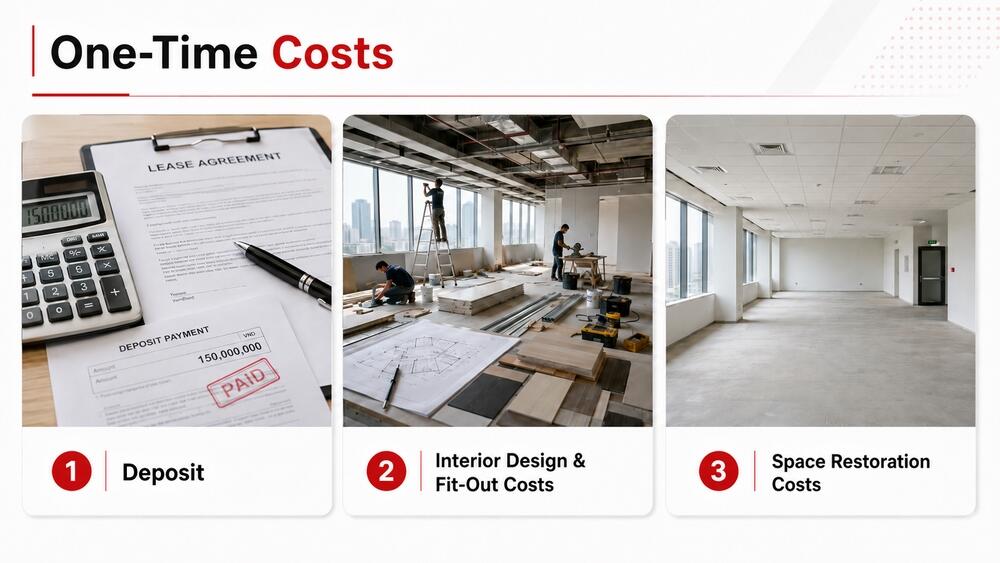
- Security deposit: typically equivalent to 3–6 months’ rent, payable upon signing the lease contract
- Fit-out and interior construction costs: includes partitioning, electrical systems, and internal network infrastructure, incurred when the business customizes its workspace
- Reinstatement costs: incurred at lease end, relating to restoring the space to its original condition
- Office insurance (if applicable): some contracts require the tenant to obtain insurance covering assets or liability within the leased space
VAT on rent and service fees
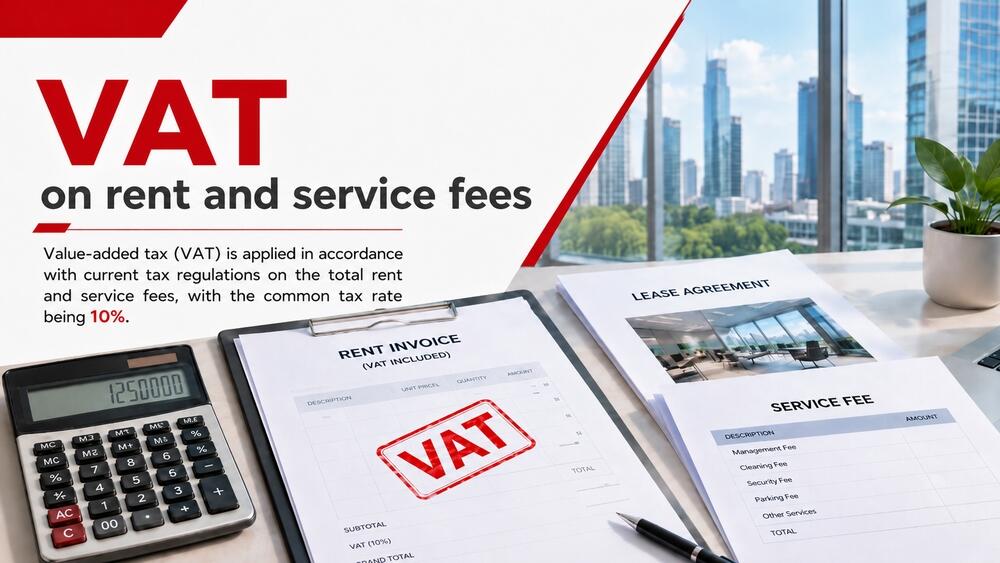
Value-added tax (VAT) is applied in accordance with current tax regulations on the total rent and service fees, with the common tax rate being 10%. VAT applies also to service fees and management fees.
For leases priced in USD, businesses should clarify whether VAT is calculated on the VND or USD equivalent — since the applicable exchange rate can affect the actual tax amount payable each billing cycle.
How to calculate the total office rental cost
The true total office rental cost represents all funds a business must spend over a specific lease period — including fixed costs, variable costs, taxes, and one-time costs — not merely the listed rate multiplied by the leased area. Many businesses compare office options solely on the basis of the listed price, leading to inaccurate assessments of actual monthly expenditure.
- Formula for calculating total monthly rental cost
Total monthly rental cost = (Rental rate × Area) + Management fee + VAT + Estimated variable costs (electricity, parking, overtime)
This formula applies to costs incurred on a recurring monthly basis throughout the lease term. Businesses should request a detailed breakdown from the landlord, clarifying which items include VAT and which do not, before consolidating figures into the budget.
- Illustrative example
A business leases 300 m² of Grade B office space at a rental rate of 22 USD/m²/month, a management fee of 5 USD/m²/month, VAT at 10%, and estimated variable costs (electricity, parking) of approximately 300 USD/month.
| Line Item | Calculation | Amount (USD) |
|---|---|---|
| Base rent | 22 × 300 | 6,600 |
| Management fee | 5 × 300 | 1,500 |
| Subtotal before tax | 6,600 + 1,500 | 8,100 |
| VAT (10%) | 8,100 × 10% | 810 |
| Estimated variable costs | — | 300 |
| Total monthly rental cost | — | 9,210 |
In this example, the initial listed rate is 22 USD/m², yet the business’s true monthly cost works out to approximately 30.7 USD/m² once management fees, taxes, and variable costs are included — a difference of nearly 40% compared to the listed figure. This is why businesses should never rely on the rental rate alone when comparing options.
- Estimating total first-year costs
In addition to monthly costs, the first year of an office lease typically involves several one-time items that must be added to the overall budget. These costs do not recur in subsequent years but can represent a significant share of initial cash outflow.
| Line Item | Calculation | Estimated Amount (USD) |
|---|---|---|
| Monthly rental cost | 9,210 × 12 months | 110,520 |
| Security deposit | Equivalent to 3 months’ base rent (6,600 × 3) | 19,800 |
| Estimated first-year total (excl. fit-out) | 110,520 + 19,800 | ~130,320 |
In addition to the above, businesses should budget separately for fit-out and network installation costs — both of which vary significantly depending on the leased area, the desired level of finish, and the condition of the space as handed over (bare shell or partially fitted).
- How to use this estimation framework in practice
When comparing multiple office options, businesses should prepare a similar table for each candidate, separating three distinct groups: annual rental costs (fixed + variable + taxes), security deposit (recoverable at lease end if no breach occurs), and upfront investment such as fit-out (non-recoverable). This grouping gives businesses a clear view of which costs are one-time “sunk” expenses and which are recurring operational costs — enabling a more accurate comparison between a fully fitted office and a bare-shell space requiring self-funded fit-out.
Businesses should also note that the security deposit, while not a cost that is “lost,” still has a direct impact on available cash flow in the early stages — a consideration that is especially important for newly established businesses or those in a growth phase managing multiple simultaneous investments.
How to optimize office rental costs?
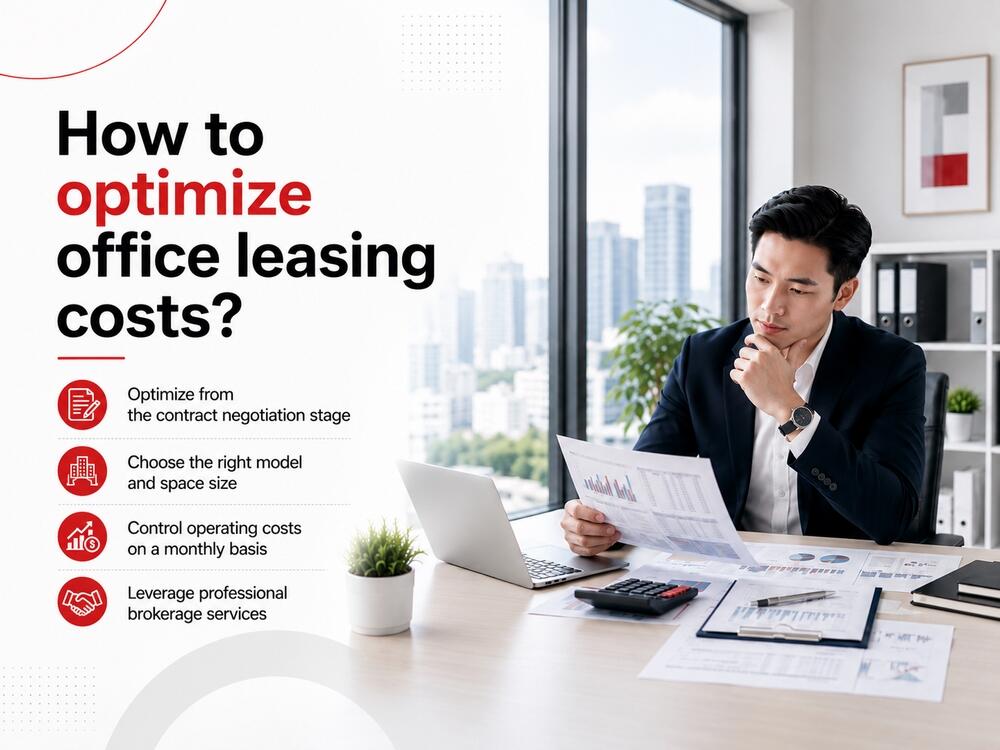
Businesses can optimize office rental costs through four main approaches: negotiating favorable terms at the contract stage, selecting the right model and size, managing ongoing monthly operating costs, and leveraging professional brokerage services.
Optimization during contract negotiation
The negotiation stage largely determines the total budget over the entire lease term, as the agreed terms will apply on a fixed basis for multiple years.
- Negotiate a longer fit-out period than the building initially proposes, particularly for long-term leases or large floor areas
- Negotiate the actual rental rate rather than accepting the listed price, using market data on comparable buildings in the area as a reference
- Propose a cap on rental escalation for subsequent years within the contract, to avoid unexpected price adjustments at renewal
- Negotiate complimentary parking slots or discounted monthly passes for employees
Selecting the right model and size
Workspace layout and working model directly affect the amount of space required, and therefore the total monthly fixed cost.
- Adopting a hybrid working model or hot-desking reduces the floor area needed compared to a 100% fixed-seat arrangement
- Serviced offices are worth considering for smaller teams, as they eliminate the need for upfront fit-out investment
- Optimizing the floor layout and minimizing unnecessary dedicated rooms improves overall space efficiency
Controlling monthly operating costs
Operating costs, though smaller than base rent, can accumulate significantly over time and affect annual budgets.
- Control overtime air-conditioning costs by consolidating employees working late into a smaller area, rather than running the entire floor’s HVAC system
- Consider installing a standalone air-conditioning unit if overtime work is frequent, reducing reliance on central HVAC charges
- Apply energy-saving measures such as LED lighting and automatic sensors to power down equipment when not in use
Leveraging professional brokerage services
A brokerage firm with strong market knowledge can help businesses negotiate better rates and lease terms than they would achieve negotiating directly with the landlord, drawing on accurate rental data across comparable buildings in the area. This service is typically free of charge to the tenant, as the commission is paid by the landlord upon successful transaction.
The core principle of cost optimization is to calculate the true total cost of occupancy over the entire lease term, rather than comparing listed rental rates alone. Businesses should also begin their office search well in advance to avoid being pressured into decisions — time constraints typically weaken a tenant’s negotiating position.
Reinstatement costs at lease end
When a lease expires, businesses should be aware of three key cost and condition areas related to returning the space to the landlord.
- Reinstatement and removal of partitions: most lease contracts require the tenant to return the space to its original condition before handover, including removing partitions and repairing any damage caused during the tenancy
- Conditions for deposit return or forfeiture: the security deposit is typically returned after the landlord confirms that the space has been reinstated in accordance with the contract terms; if handover conditions are not met or notice is not given within the required timeframe, the tenant may forfeit part or all of the deposit
- Early termination penalties: applicable when a business vacates before the committed end date; the specific penalty amount should be agreed upon and documented clearly at the time of signing to avoid future disputes
Businesses should thoroughly review and clarify these terms during initial negotiations, rather than focusing solely on the rental rate — as reinstatement costs and deposit forfeiture risks can arise unexpectedly if not addressed upfront.
Common mistakes when estimating office rental costs
Plenty of businesses still end up over budget even after carefully planning their office rental costs. The reason usually comes down to four common mistakes in cost calculation — mistakes that cause businesses to overlook hidden office rental fees.
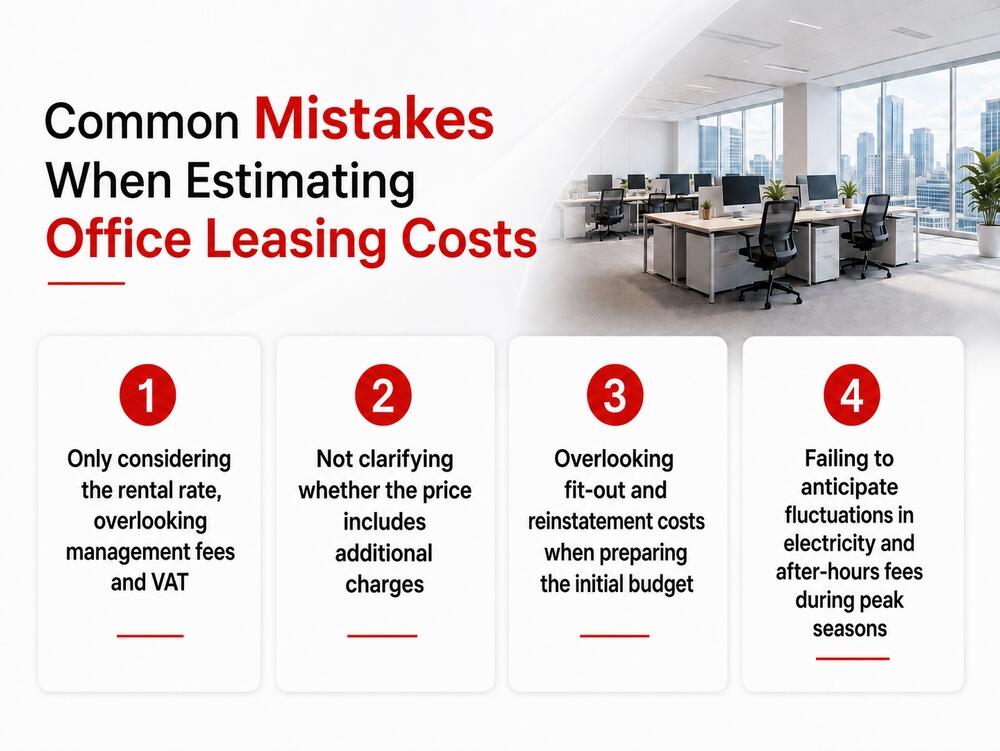
Calculating only the rental rate, overlooking management fees and VAT
Businesses frequently compare office options based solely on the listed rental rate per m², while management fees and VAT can add a further 15–20% to total monthly costs. This approach leads to inaccurate comparisons between buildings with different fee structures — a building with a lower base rent but higher management fees is not necessarily more cost-effective than one with a higher rent that already bundles more services into the management fee.
Failing to clarify whether the quoted price includes additional charges
Some quotations do not clearly state whether the listed rate includes VAT, management fees, or other charges, causing businesses to misread comparisons between options. Businesses should request a fully itemized breakdown from the landlord, clearly indicating which items are tax-inclusive and which are not, before incorporating figures into the official budget.
Omitting fit-out costs and reinstatement costs from the initial budget
Fit-out and interior construction costs at the start of a lease, and reinstatement costs at the end, are two items frequently overlooked during the planning phase — because they arise at opposite ends of the contract timeline and do not appear in the standard monthly cost breakdown. Businesses should account for both from the outset when building the overall budget for the full lease term.
Not accounting for seasonal spikes in electricity and overtime charges
Electricity and overtime HVAC costs can increase substantially during peak heat months or periods when the business requires frequent overtime work — such as the end of the financial year. If variable costs are estimated solely on a full-year average without accounting for seasonal fluctuations, businesses may find actual costs exceeding the monthly budget during certain periods.
Frequently asked questions about office rental costs
How many months’ rent is the typical office security deposit?
Office security deposits are typically equivalent to 3–6 months’ rent, depending on the agreement between the parties and the lease term. Long-term leases or larger floor areas may require a higher deposit to secure the tenant’s commitment. Businesses should clarify the conditions for deposit return at lease end during the negotiation phase, to avoid future disputes.
Are management fees and parking fees subject to VAT?
Management fees and parking fees are generally subject to VAT, in the same way as office rent. Businesses should require the landlord to clearly state in the contract and quotation whether these fees are VAT-inclusive or VAT-exclusive, to avoid confusion when comparing options on a pre-tax versus post-tax basis.
Is central air-conditioning billed separately or included in the management fee?
The treatment of central air-conditioning costs varies by building — some buildings include it within the fixed monthly management fee, while others bill it separately based on actual consumption or hours of use outside standard operating hours. Businesses should ask the landlord for the specific billing method before signing the contract. Overtime HVAC charges are typically billed separately and carry a significantly higher rate than during standard business hours.
Do office rental costs increase or decrease from year to year?
Office rental costs typically escalate on a periodic basis throughout the lease term, commonly on an annual basis or every 2–3 years. The specific escalation rate must be agreed upon and documented in the contract from the outset, to prevent unexpected price adjustments in later years. Businesses should proactively negotiate a cap on maximum annual rent increases when signing long-term leases, in order to maintain better control over the rental budget throughout the lease term.
The true cost of renting office space always exceeds the initially quoted rental rate — encompassing monthly fixed costs, variable costs based on usage, one-time costs, and VAT. A thorough understanding of all four cost categories, together with a clear method for calculating total occupancy costs, enables businesses to avoid budget overruns and to negotiate more favorable lease terms from the start.
If your business needs support calculating detailed office rental costs that fit your budget and actual needs, RSQUARE offers free consulting for office leasing in Hanoi and office leasing in Ho Chi Minh City, helping businesses choose the optimal option in terms of both location and long-term operating costs.