When a business should start looking for a new office depends on the leased area, contiguous-floor requirements, handover condition, supply in the target area, headcount growth plans, internal approval process, and the term of the current lease. The larger the area and the stricter the contiguous-floor requirement, the longer the lead time needs to be, since suitable supply is limited. This article lays out 6 steps that work backward from the date the new office needs to be operational – through fit-out and construction, contract negotiation, market survey, cross-check against the current lease, and buffer time – to pinpoint the exact date to start the search. Starting too late leads to operational disruption, overlapping rental costs, and a weaker negotiating position.

What factors determine when to start looking for a new office?
The timing for starting a new office search depends on 6 factors: leased area and contiguous-floor requirements, handover condition, location – budget – supply, headcount growth plans, internal approval process, and the term of the current lease. The more complex a factor is, the earlier a business needs to start in order to have enough time to handle the related steps.
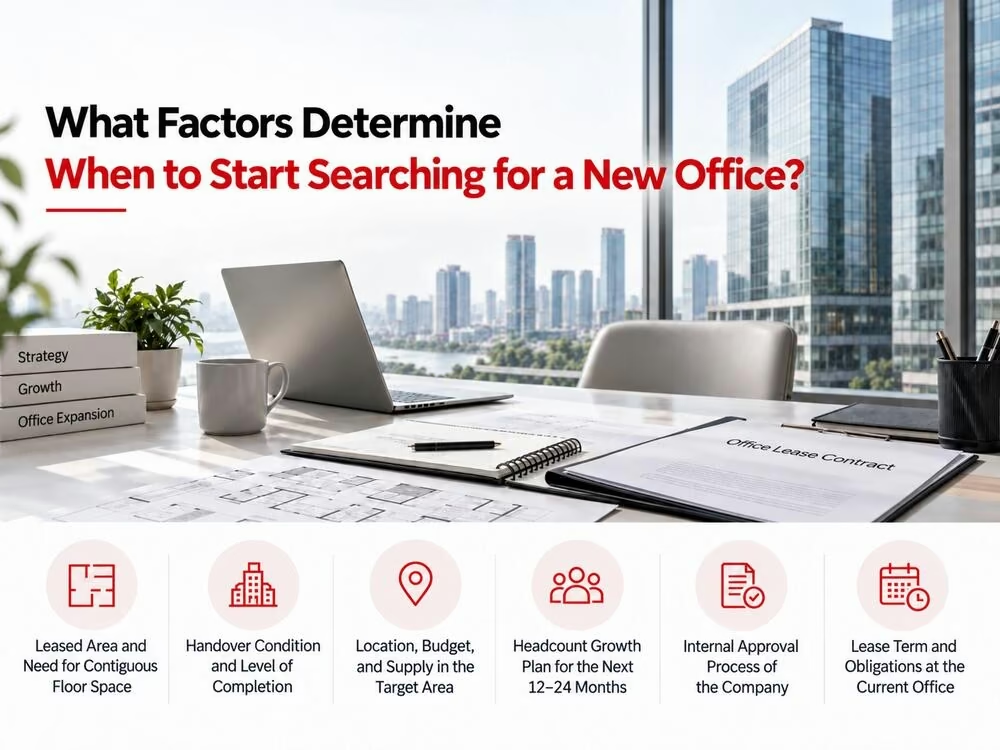
Leased area and contiguous-floor requirements
The larger the contiguous floor area required, the earlier the search needs to start, because the number of floors that can meet this requirement is limited by the building’s design. Demand for a single contiguous floor has significantly fewer options than a plan that accepts splitting across multiple floors, even when the building’s total vacant area is the same – these two demand groups do not face the same level of supply scarcity. Functional requirements such as meeting rooms, management offices, and training areas need to be checked against an actual layout plan, not just vacant-area figures, since a floor plate with enough total area may still be unable to fit all of these functional zones.
Handover condition and level of completion
A fully fitted-out space needs less preparation time than one that requires a full renovation, so the handover condition directly affects when the search should start. From the survey stage, a business needs to determine right away whether the existing ceiling, flooring, meeting rooms, electrical systems, or furniture can be reused – this level of reuse determines the construction timeline and renovation budget. A space that requires adjustments to the M&E, air-conditioning, or fire-protection systems needs extra time for design and approval before construction can begin, extending the total preparation time compared to a fully fitted-out space.
Location, budget, and supply in the target area
The more criteria are narrowed down – a single area, a single grade, a fixed budget – the longer the search takes, since the business has to wait for the right matching supply to appear. If one option falls through, a business with criteria that were already narrow from the start will struggle to quickly find an equivalent replacement. Supply should be checked against two time points:
- Supply currently vacant at the time of the survey – reflecting options available to lease immediately.
- Supply expected to be handed over by the move-in date – including space that is currently occupied but scheduled to be returned, which may still fit a plan set 6-9 months out.
Headcount growth plans for the next 12-24 months
The leased area should be determined based on the projected headcount over the entire lease term, not just the current headcount, in order to avoid running out of workspace or having to lease additional area partway through the term. The area calculation needs to include functional zones such as meeting rooms, management offices, reception areas, and support spaces, not just the seat count – overlooking these zones results in a leased area that falls short of actual operational needs once headcount grows.
The business’s internal approval process
Internal approval time needs to be built into the plan from the start, since a transaction may have to pass through the administration, finance, and legal departments, the board, or the parent company before signing, even after commercial terms have already been agreed with the building owner. A business should identify early who has approval authority and what documentation needs to be submitted at each stage. The leasing criteria should be finalized before the survey stage – adding new requirements after several rounds of site visits can force the shortlist to be rebuilt from scratch.
The term and obligations at the current office
The current lease may force a business to make decisions earlier than expected, based on the expiry date, the notice period, renewal conditions, and handover obligations. The notice period typically falls before the lease’s end date, so a business cannot wait until close to the expiry date to act. For transactions that require significant lead time, a business should start evaluating renewal or relocation options as early as the annual budgeting stage, rather than waiting until close to the expiry date. The point at which the actual site survey begins can come later than this strategic evaluation stage, depending on the scale and leasing requirements.
How far in advance should a business start looking for an office?
The lead time a business needs for an office search depends on the leased area and contiguous-floor requirements. The larger the area, the scarcer the matching supply and the more complex the approval process, so the longer the preparation time needs to be.
| Area scale | Level of preparation needed |
| Under 300m² | Short – supply is diverse and approval is usually simple |
| 300 – 1,000m² | Moderate – needs to account for contiguous-floor requirements and multi-level approval time |
| Over 1,000m² | Long – contiguous-floor supply is limited, approval and construction are more complex |
6 steps to determine when to start looking for a new office
A business determines the start date by taking the target date for the new office to become operational as the anchor point, then working backward through each required block of time. The total of these blocks, plus a buffer, is what determines the date the search needs to begin.
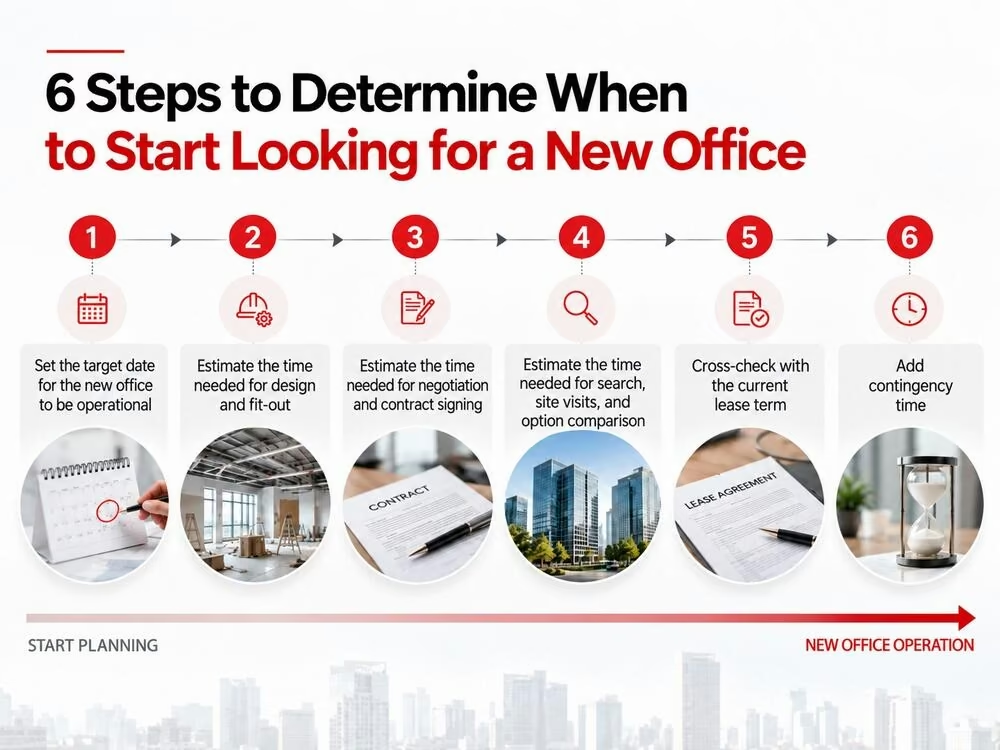
Step 1: Determine the date the new office needs to become operational
A business should use the target date for the new office to become operational as the anchor point for working backward through the entire timeline, rather than relying solely on the current lease’s expiry date. This anchor point should be tied to a specific business plan – a product launch, headcount expansion, an organizational restructuring – rather than chosen arbitrarily. The clearer the anchor point, the more precisely the subsequent backward-planning steps can be calculated, instead of relying on rough estimates.
Step 2: Calculate the design and fit-out construction time
Construction time depends directly on the handover condition – a bare-shell space or one that requires adjustments to M&E, air-conditioning, or fire-protection systems will take considerably longer to build out than a fully fitted-out space. A business should separate the design time (drawings, fire-protection approval if required) from the actual construction time, since these two stages usually run sequentially rather than in parallel – this is a point that is easy to overlook when estimating the overall timeline.
Step 3: Calculate the negotiation and contract-signing time
Negotiation and signing time consists of two separate parts: the time to finalize commercial terms with the building owner and the time to route the contract through internal approval levels for signature. For a business with a parent company overseas or a multi-layered approval structure, the internal sign-off stage is often longer than the commercial negotiation stage itself – these two milestones should be calculated separately rather than combined into a single estimate.
Step 4: Calculate the time for search, site surveys, and comparing options
Search time depends on how specific the leasing criteria are – the more fixed the area, grade, budget, and large contiguous-floor requirement, the narrower the matching supply and the longer the process of comparing options takes. A business should allow enough time for on-site surveys, not just reviewing information on paper. For large contiguous-floor requirements, the number of options meeting the criteria at any given time is typically limited, so this time block should be estimated with more buffer than the initial estimate.
Step 5: Cross-check against the term of the current lease
After adding up the four time blocks above to derive the required start date, a business needs to cross-check this result against the notice period and expiry date of the current lease – this is a cross-check step, not the anchor point for the backward calculation. If the calculated start date falls earlier than the allowed notice period, a business has two options: shorten some of the steps above by running negotiations in parallel, or accept a period of overlapping rent. Cross-checking early helps surface this conflict before being caught off guard in the final stage, rather than only working backward in one direction from the desired operational date.
Step 6: Add buffer time
Buffer time should be added to the overall timeline to handle situations that arise outside the plan, rather than calculating each milestone too tightly. Common situations include an initial option falling through, construction falling behind schedule due to added work items, or internal approval taking longer than expected. The buffer level should increase with the complexity of the transaction rather than applying a fixed ratio to every case.
What are the consequences of relocating too late?
Starting the office search too late causes a business to lose control over the timing of the transition. Four common consequences are operational disruption, overlapping rental costs, a narrower pool of suitable options, and reduced negotiating time.
Operational disruption and workforce planning
Starting the office search too late means a business cannot finish construction or system installation before the date it needs to be operational, leading to work disruption or having to operate temporarily under unfinished conditions. Hiring or staffing plans tied to the new office are also affected if the actual move-in date is delayed – new hires may have to work from a temporary location or share space in shifts, reducing productivity during the transition period.
Overlapping rental costs
When the time needed to prepare the new office exceeds the remaining term of the old lease, a business is forced into a short-term extension at the current office or has to accept paying rent on both locations at once. Short-term extensions typically don’t come with the pricing benefits of a long-term lease, making rental costs during the transition period higher than normal. A business may also incur additional costs from maintaining two locations at the same time, including service fees, utilities, and security.
A narrower pool of suitable options on the market
Supply matching a set of criteria changes over time, so starting the search late means a business has to choose from whatever options remain at that particular moment, rather than being able to fully compare the options available on the market. For large contiguous-floor requirements or specific criteria, the number of options meeting all conditions at any given time is already limited – starting late further reduces the chance of finding an option that is optimal on both location and budget.
Reduced negotiating and space-preparation time
When the time remaining before the required move date is insufficient, a business loses negotiating leverage because the building owner is aware the tenant is under time pressure. This pressure can push a business into accepting less favorable terms on rent, rent-free periods, or renovation responsibilities. The time available to prepare the space – design, construction, handover inspection – is also shortened, increasing the risk of errors or delays to the actual operational date.
Information to prepare before starting an office search
Before starting an office search, a business should have the following information ready in order to shorten the survey process and avoid having to adjust criteria midway.
- Required leased area and contiguous-floor requirements – determined based on projected headcount over the full lease term, not just current headcount.
- Maximum rental budget – including rent, service fees, and expected renovation costs, not just the listed rental price.
- Preferred area and building grade – a backup option should be in place in case the primary area has limited matching supply.
- Handover condition requirements – determine in advance the acceptable level of completion in order to correctly estimate construction time.
- The person with approval authority and the documentation to be submitted – agreed on in advance to avoid extending the signing stage.
- The notice period and conditions under the current lease – checked in order to know the latest deadline by which negotiations must be completed.
Frequently asked questions
Is starting the office search 12 months in advance too early?
Not too early if a business is leasing a large area, requires a contiguous floor, or has a multi-level internal approval process. For a small area and flexible criteria, a 12-month lead time may be more than the actual need requires.
If there are only 2-3 months left before the move date, is that still enough time?
It can still be enough for a small area and a fully fitted-out space, but the business will have to accept fewer options and reduced negotiating power. For a large area or a space that requires significant renovation, 2-3 months is usually not enough for all four time blocks covered in the backward-planning section.
Should the timeline be calculated from the move-in date or the lease expiry date?
It should be calculated from the target move-in date for the new office, not from the current lease’s expiry date. The lease expiry date should only be used at the final cross-check step to check for conflicts, not as the anchor point for the backward calculation.
Is buffer time needed between the old and new office?
Yes, a business should leave a buffer period between the two offices to handle situations that arise outside the plan. This buffer also helps avoid moving into the new office before construction or handover inspection has been completed.
Does a serviced office need the same timeline calculation as above?
No, the full backward-planning process above does not need to be fully applied, since a serviced office is typically already fitted out with furniture and infrastructure, significantly shortening the preparation time. A business should still allow time for contract negotiation and internal approval, but can skip most of the design and construction time.
Determining the right time to start looking for office space helps businesses stay on schedule, keep negotiating leverage, and avoid unplanned costs from overlapping leases. With continuously updated office space for rent in Hanoi and office space for rent in Ho Chi Minh City supply data, RSQUARE helps businesses pinpoint the right timeline based on specific area, budget, and operational requirements – from the initial survey stage through to finalizing the lease contract.