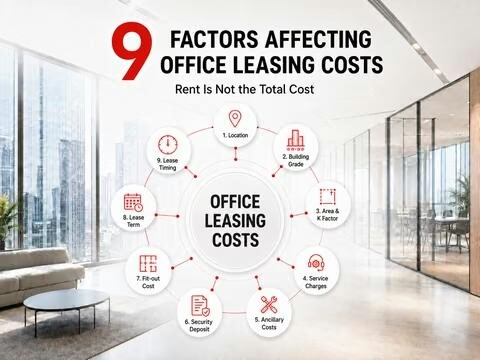
Building management fees for office leases (also known as service charges) are costs businesses pay to the management board to operate and maintain shared areas and services of a building, separate from the listed rent. These fees typically cover five categories: technical operations and maintenance, cleaning and landscaping, security and reception, utilities for common areas, and the management and administrative team. This article clarifies what management fees include and exclude, how they are calculated with worked examples, the factors that determine fee levels, negotiation possibilities, and what to check before signing a lease.
What are building management fees for office leases?
Building management fees for office leases are costs businesses pay to the management board or developer to maintain and operate shared areas and services of the building. These fees are also referred to as service charges, and in practice the two terms are used interchangeably.
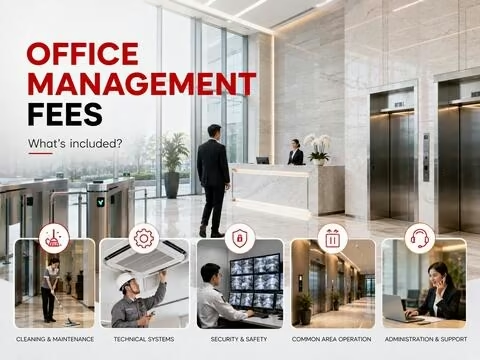
Management fees cover the activities that keep a building running smoothly every day:
- Cleaning of common areas, care of grounds and greenery
- Security, guard services, and lobby reception
- Maintenance of technical systems such as elevators, air conditioning, electrical systems, and fire protection
- Operation of shared areas: lobby, corridors, elevators
Management fees are entirely separate from the listed rent (net rent). Rent is what a business pays to use its office space, while management fees cover the upkeep of shared parts of the building. In a traditional office lease, the two items are listed as separate line items, both calculated per m² per month. Businesses need to add both together to arrive at the true monthly cost, rather than looking at the listed rent alone.
How management fees are applied differs between office types. Serviced offices and coworking spaces typically bundle management fees into the rent, so businesses pay a single all-in rate. Traditional offices separate management fees from rent, requiring businesses to read the lease carefully to understand all monthly obligations.
What do management fees include?
Office management fees cover all operational activities, technical system maintenance, and upkeep of shared-area amenities, typically divided into five main categories: technical operations, cleaning and landscaping, security and reception, utilities for common areas, and the management team.
Technical operations and maintenance
This category keeps the building’s technical systems running continuously and safely.
- Elevators: regular operation and maintenance
- Backup power generators
- Fire protection systems
- Air conditioning for common areas
Cleaning and landscaping
This category maintains the appearance and hygiene of shared spaces.
- Daily cleaning of common areas
- Periodic cleaning: external glass washing, pest control
- Care of greenery and grounds
Security and reception
This category ensures safety and access control throughout the building.
- 24/7 security guards
- Lobby reception staff
- Security cameras and access control systems
Utilities for common areas
This category covers energy and water for shared parts of the building, excluding consumption within individual offices.
- Lighting and ventilation electricity for common areas
- Water supply for common areas
Management and administration team
This category covers staffing and operational management.
- Salaries and insurance for management and technical staff
- Administrative costs and tenant record management
The scope of fees may vary between buildings. Some premium Grade A buildings include central air conditioning electricity during business hours within the management fee, while others charge this separately. Businesses should request a detailed fee breakdown from the landlord rather than assuming the scope is the same across buildings.
What do management fees exclude?
Office management fees typically exclude costs arising within the leased area, costs outside business hours, and separately itemized taxes and insurance. These are amounts businesses need to budget for on top of the fixed monthly management fee, as they are easily overlooked when estimating rental costs.
Quick summary of common additional charges:
| Cost item | Billing basis |
|---|---|
| Electricity used within the office | Sub-metered separately |
| Air conditioning (private units or after hours) | Based on actual consumption |
| Motorcycle and car parking | Monthly or per-visit |
| After-hours operations | Per hour of operation |
Energy and utilities consumed within the leased space
- Electricity consumed within the office
- Air conditioning electricity if not included in management fees
- Water used privately at the pantry or internal bathroom
After-hours fees
- Air conditioning outside business hours
- Elevator, generator, and related system operation after hours
Parking fees
- Monthly motorcycle and car parking for staff
- Per-visit parking for visitors
Cleaning and maintenance within the office
- Cleaning of the private leased area
- Repair and maintenance of equipment and furniture provided by the business
Telecommunications infrastructure and fit-out costs
- Internet, telephone, and telecommunications services
- Construction and interior fit-out works
- Fit-out supervision fees and construction deposits
Taxes and insurance
- VAT applied on top of the listed fee if not already included
- Insurance for assets, equipment, and liabilities within the leased area
How are office management fees calculated?
Office management fees are calculated by multiplying the chargeable area by the unit rate per m² per month, then adding VAT. The formula is straightforward, but the result depends on three variables businesses must verify in the lease: the type of area used, the unit rate and applicable exchange rate, and the VAT rate.
Formula:
- Management fee (excl. VAT) = Chargeable area (m²) × Unit rate (VND or USD/m²/month)
- Total payment = Management fee (excl. VAT) × (1 + VAT rate)
Three variables to confirm:
- Chargeable area (Net or Gross): Net area is the usable space inside the office; Gross area includes Net plus an allocated share of common areas such as corridors, shared bathrooms, and elevator lobbies, typically 10–20% larger than Net. Businesses must check whether the lease applies the fee to Net or Gross area, as this difference directly affects the amount payable.
- Unit rate and exchange rate: If the listed unit rate references USD, the lease must specify the VND conversion rate to apply, typically the selling rate of a commercial bank on the invoice date. Under foreign exchange regulations, domestic transactions are settled in VND, with USD serving only as a reference unit.
- VAT: Management fees are subject to VAT. Office leasing falls under the real estate business category, which is not eligible for the 2% reduction and therefore remains at 10%, while many other goods and services have been reduced to 8% through 31 December 2026. Service fees invoiced separately by an independent management company may be subject to a different rate; businesses should confirm with the landlord.
Worked example:
Assume a business leases 150 m² Net area, unit rate USD 4/m²/month, exchange rate VND 25,400/USD, VAT 10%.
- Base management fee: 150 × 4 = USD 600/month
- Convert to VND (excl. VAT): 600 × 25,400 = VND 15,240,000
- VAT (10%): 15,240,000 × 10% = VND 1,524,000
- Total payable: 15,240,000 + 1,524,000 = VND 16,764,000/month
In the formula, the management fee unit rate per m² is the single most decisive variable for total cost. So what drives the difference in unit rates between buildings?
What factors affect office management fee levels?
Management fee differences between buildings are driven by four main factors: building grade and standards, the management operator, location and district, and building scale and leased area. Understanding these four factors helps businesses assess whether the fee in a quotation is reasonable or inflated relative to the market. The four factors below are listed in descending order of impact.
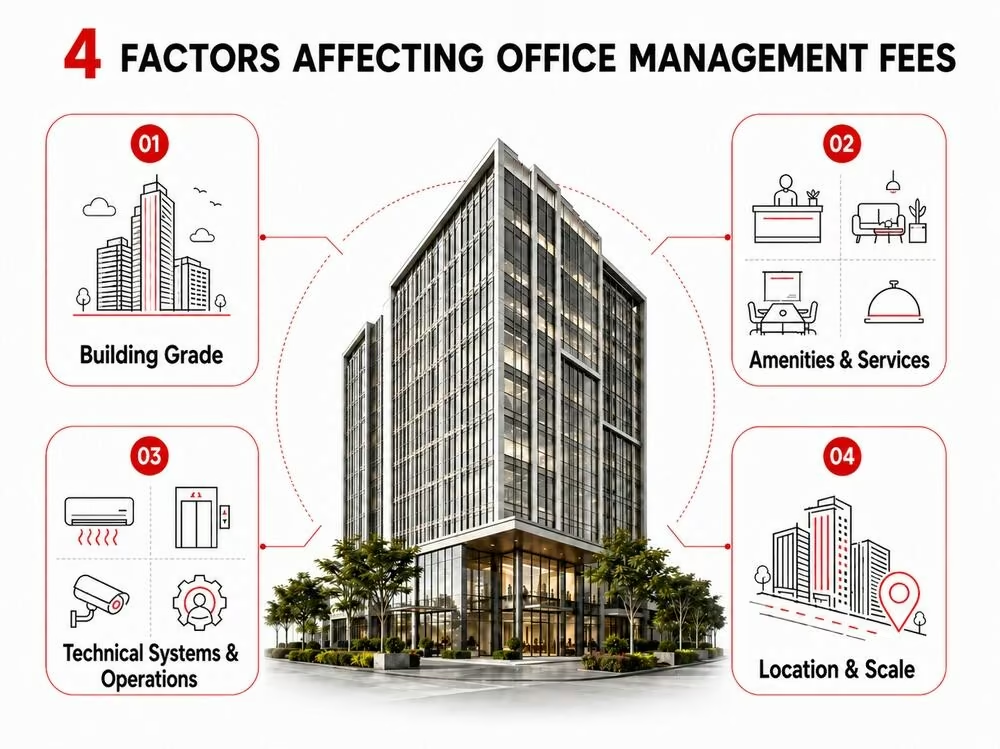
Building grade and standards
Building grade has the greatest impact on management fees – the higher the grade, the higher the fee. Grade A and A+ buildings are equipped with advanced technical systems such as central air conditioning, high-speed elevators, building management systems (BMS), and multi-layer security, operated to international standards and often certified green under LEED, LOTUS, or Green Mark. These standards carry higher maintenance, staffing, and energy costs. Grade B and C buildings offer more basic amenities, so fees are significantly lower.
Management operator
The management operator determines both service quality and fee structure. International firms such as CBRE, Savills, JLL, Colliers, and Cushman & Wakefield apply standardized processes, professional teams, and transparent reporting, so fees tend to be higher but come with clear service commitments. Developer self-management or domestic operators typically have lower fees, though quality varies depending on each operator’s capabilities.
Location and district
A building’s location affects management fees through labour costs, security requirements, and district-level service standards. Buildings in central areas such as District 1 in Ho Chi Minh City or Hoan Kiem District in Hanoi face higher staffing and security costs, while tenants expect service quality commensurate with the prime address. Buildings outside the city centre typically have lower management fees at the same grade.
Building scale and leased area
Building scale and leased area affect fees through the principle of economies of scale. Larger buildings spread fixed costs such as security, technical staff, and management overhead across a greater floor area, so the unit rate per m² tends to be more efficient than in smaller buildings. On the tenant side, a larger leased area can sometimes open negotiating room on fees. Conversely, smaller buildings concentrate fixed costs across less area, resulting in a higher unit rate per m².
Can management fees be negotiated for office leases?
Yes, but the negotiating room is more limited than for rent. Management fees reflect the building’s actual operating costs, so the margin for reducing the unit rate is typically narrow. Negotiating leverage lies more in the surrounding terms than in the per-m² rate itself.
Businesses have negotiating advantage when several conditions are met:
- Large leased area: creates leverage with the landlord
- Long lease term: exchanges long-term commitment for fee concessions
- High vacancy market: landlords are more flexible to retain tenants
- Package negotiation: waiving management fees during fit-out, capping annual fee increases, or fixing the adjustment ceiling
The outcomes typically achieved are not a lower unit rate but rather an annual fee increase cap, the start date for fee billing, and the scope of items bundled into the fee. So in what order should businesses check and negotiate these matters before signing?
How to check and negotiate management fees before signing a lease
Before signing a lease, businesses should carefully examine the management fee components and proactively negotiate terms in a clear sequence to avoid unexpected costs.
Pre-signing checklist:
- Request a detailed fee breakdown: understand exactly which line items the fee covers
- Confirm what is included and excluded: especially central air conditioning during business hours
- Verify the chargeable area basis: Net or Gross, since the 10–20% difference directly affects the amount payable
- Clarify the fee escalation clause: the cap, adjustment cycle, and basis for increases
- Clarify after-hours fees: unit rates for air conditioning and elevators outside business hours
- Benchmark against the local market: compare buildings of the same grade and district to identify any unreasonable levels
Points worth negotiating:
- Annual fee increase cap, fixed at no more than a specified percentage
- Fee waiver or reduction during the fit-out period
- Fixed unit rate locked for the full lease term
- Bundling of certain after-hours costs into the fixed fee
Finally, all agreed fee terms must be recorded as explicit clauses in the lease. Verbal commitments on fee levels, fee-free periods, or increase caps carry no binding force if not written into the contract – and this is precisely the line between a transparent cost and an opaque future liability.
Frequently asked questions about office management fees
Below are the five most common questions about office management fees, answering practical concerns about fee scope, tax, payment obligations, and billing timing.
Do management fees include electricity and water?
Only electricity and water for common areas – not consumption within the office. Corridor lighting and water for shared bathrooms are included in the management fee. Electricity for equipment, air conditioning, and water used privately within the leased area are billed separately via sub-meters.
Are management fees subject to VAT?
Yes, management fees are subject to VAT. For office leasing under the real estate business category, the applicable rate is 10%, which is not eligible for the reduction to 8% through 31 December 2026. Businesses should confirm the invoicing approach with the landlord to understand the exact tax rate.
Do businesses have to pay management fees if they are not using the office?
Yes, management fees are still payable even when the office is not in use. Management fees are tied to the leased area under the contract, not to actual frequency of use. For as long as the lease remains in effect, the business is obligated to pay the full fee each month.
Do management fees increase over the lease term?
They may increase, depending on the lease terms. Many buildings provide for periodic fee adjustments, typically annually or at each renewal, in line with operating costs and inflation. Businesses should negotiate an increase cap from the outset to control long-term costs.
When are management fees billed under the lease?
Billed monthly, typically on the same cycle as rent. Some buildings bill quarterly. The start date for fee billing is usually the date of handover, so businesses should clarify whether the fit-out period is exempt from management fees.
Management fees are one of the fixed costs businesses need to carefully factor in before signing an office lease, as this fee directly affects the total monthly leasing cost alongside the base rental rate. Understanding how it’s calculated, what it typically covers, and how it varies between buildings will help businesses negotiate more effectively and choose an office that fits their budget.
If your business is looking for office space for rent in Hanoi or office space for rent in Ho Chi Minh City with transparent management fees suited to your scale and budget, RSQUARE’s advisory team is ready to help survey options, compare costs across buildings, and support you throughout the lease negotiation process.