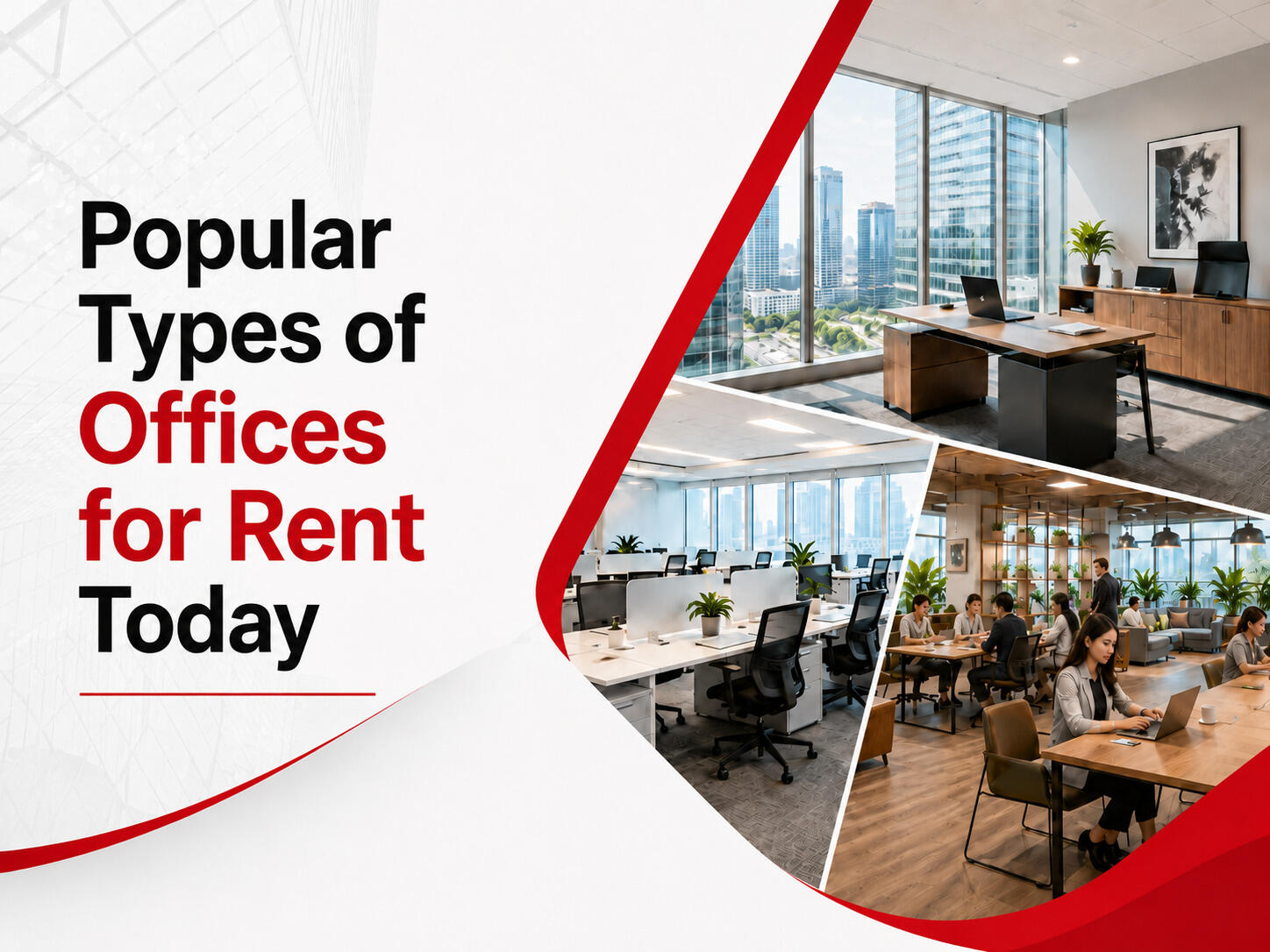
Office rentals today are classified by three main criteria: building grade (A, B, C), property type (high-rise office floor, Officetel, shophouse), and operating model (traditional, serviced, coworking space, virtual office). Each classification reflects a different perspective — from construction quality and ownership characteristics to management model and flexibility of use. This article analyzes each type in detail across all three criteria, introduces two emerging office trends shaping the market — green offices and smart offices — and offers guidance on the right choice for each type of business.
Office Rental Classification by Building Grade
Office rentals are graded A, B, and C based on construction quality, location, technical systems, and the level of professionalism in operations management. This is the most widely used classification in the market, helping businesses quickly gauge the corresponding price range and quality before researching specific buildings in detail. Grade A, B, C classification is not a mandatory legal standard but a market convention in commercial real estate — as there is no unified authority overseeing the grading system, the degree to which buildings within the same grade meet the criteria can still vary.
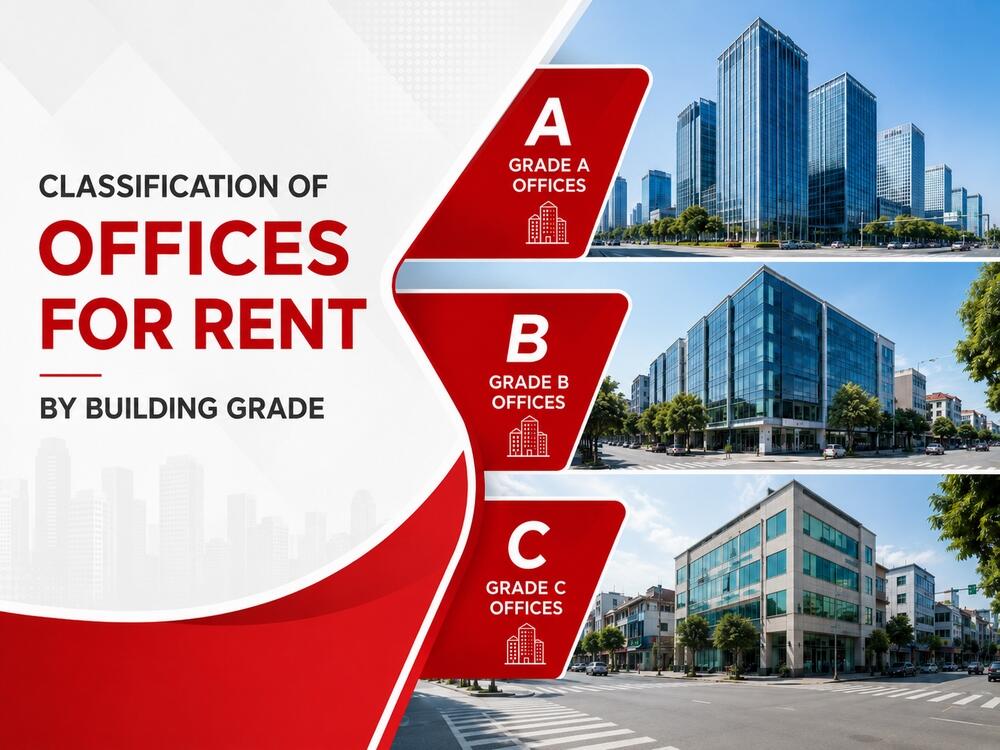
Grade A Office
Location: concentrated in the central business district (CBD), fronting major arterial roads, with convenient access to key transport corridors and public infrastructure such as metro stations and bus stops
Technical systems: VRV/VRF central air conditioning with zone-level temperature control, high-speed elevators with optimized service capacity, certified automatic fire protection systems, backup generators with sufficient capacity to power the entire building during outages, multi-carrier telecommunications infrastructure allowing tenants to choose their service provider
Operations management: professional property management with extensive experience, 24/7 reception and security with card-access control, on-call technical team for rapid incident response
Additional standards: the majority hold international green certifications (LEED, LOTUS) or are in the process of obtaining them; the K-factor (ratio of rentable area to net usable area) is typically disclosed transparently
Suitable for: businesses that need to build a premium brand image and regularly host international partners and clients — common in finance, banking, law, management consulting, and multinational corporations establishing representative offices or regional headquarters
Grade B Office
Location: near-central areas or districts with good transport infrastructure, not necessarily located on the most prominent main roads
Technical systems: central or split-type air conditioning depending on the building, elevators meeting standard usage requirements, backup generators typically sufficient only for lighting and elevator loads — not guaranteed to run air conditioning at full capacity
Operations management: mid-scale property management, which may be an in-house team operated by the developer; security and cleaning operate during extended business hours rather than full 24/7
Additional standards: some buildings hold green certifications but this is not a mandatory requirement; the K-factor may not be disclosed as clearly as in Grade A buildings
Suitable for: small and medium-sized enterprises that need to balance budget with operational quality, without placing heavy emphasis on premium brand image but still requiring a professional, stable working environment
Grade C Office
Location: mostly located in peripheral areas or districts adjacent to the center, with heavy reliance on personal vehicles for commuting
Technical systems: split-type air conditioning (wall-mounted or ceiling cassette units in individual rooms), minimal elevator provision or none in some low-rise buildings, limited or no backup power generation
Operations management: self-managed by the building owner or without a dedicated management team; security and cleaning at minimum levels; technical incident response may be slower due to the absence of an on-call crew
Additional standards: green certifications are virtually absent; the K-factor is generally not calculated transparently or not applied due to small scale
Suitable for: businesses prioritizing cost optimization, with small headcounts and limited or no need to receive clients at the office — well-suited for early-stage startups, small representative offices, or internal operations departments
How to identify building grade through on-site observation
Beyond the grade name self-declared by the leasing party, businesses can quickly cross-check against a few directly observable indicators: elevator speed and the number of lifts operating simultaneously during peak hours, quality of the main lobby and reception area, presence of uniformed security personnel on duty at all times, and the maintenance condition of shared fixtures such as lighting and common restrooms. This is a quick verification method to compare against the advertised grade and avoid situations where a building claims a higher grade than it actually delivers.
Office Rental Classification by Property Type
The three most common property types used for office rental are high-rise office floors, Officetel units, and shophouses or standalone houses converted for office use. Each type differs in legal standing, space design flexibility, and level of professionalism, directly influencing a business’s leasing decision based on its scale and operational objectives.
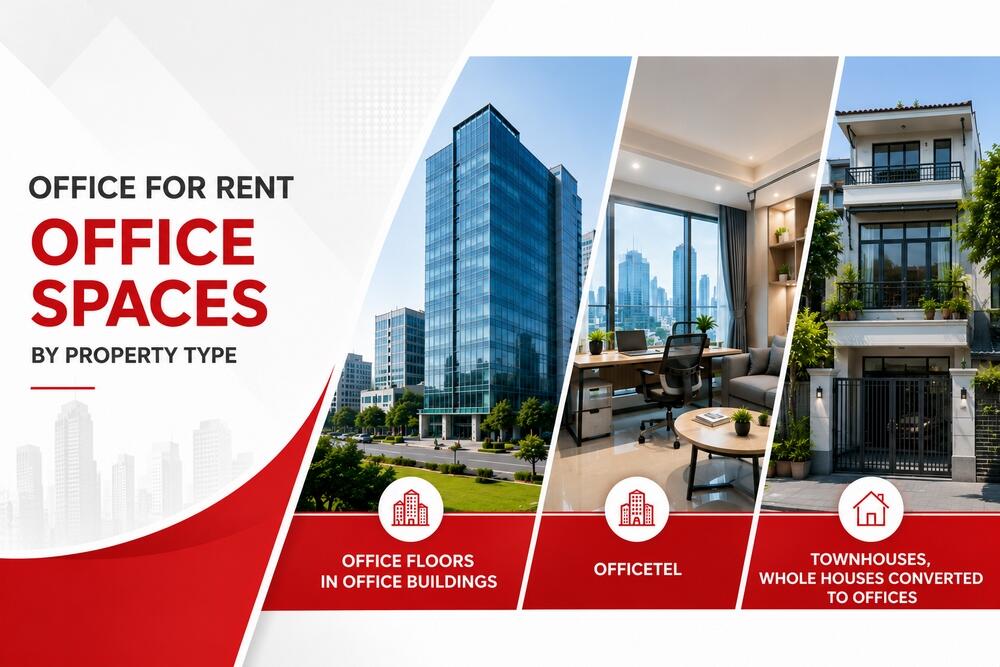
High-Rise Office Floor
A high-rise office floor is the most common property type, purpose-built for office use from the ground up, with integrated elevator systems, central air conditioning, security, and shared amenities.
Advantages:
- Professional working environment suitable for brand image building
- Easy to expand floor area as the business grows, since buildings typically have multiple floors and flexible available space
- Technical infrastructure is designed as an integrated system, reducing upfront investment compared to retrofitting other building types
Limitations:
- Rental costs are generally higher than shophouses or Officetel units in the same area
- Tenants must comply with building-wide regulations on operating hours, interior fit-out, and mandatory technical standards
Suitable for: businesses that require a professional workspace, plan to scale headcount in the future, or need a headquarters address that builds credibility with partners
Officetel
An Officetel is a combined residential-office unit, typically located within mixed-use developments or apartment complexes, with each unit generally much smaller than a traditional office floor.
Advantages:
- Lower rental costs compared to high-rise office floors in the same area
- Flexible location, with many projects situated near residential zones, making commuting convenient for staff
- Access to some shared building amenities such as elevators, security, and parking
Limitations:
- Limited floor area, making it difficult to scale up significantly or accommodate multiple functional rooms
- Legal standing requires careful verification — not all Officetel projects are licensed for business operations; confirmation from the developer is necessary before signing the lease
- Technical infrastructure may not be optimally designed for office-grade requirements compared to purpose-built office buildings
Suitable for: small businesses, startups, or freelancers that need low rental costs and flexible locations without requiring large floor areas or a premium brand presence
Shophouse or Standalone House Converted to Office
A shophouse or standalone house converted to office use involves leasing an entire shophouse or residential building and repurposing it for office functions.
Advantages:
- Exclusive use of a separate space with no shared amenities with other tenants
- Easy to design and renovate in line with the company’s own brand identity
- In some cases, rental costs are more competitive than high-rise office floors, particularly on streets outside the busiest central corridors
Limitations:
- Legal standing regarding land use purpose and construction permits must be carefully verified before signing
- Technical systems typically do not meet purpose-built office building standards; the business may need to invest in upgrades during renovation
- Lacks shared amenities such as building security, a common reception, or large-scale parking facilities
Suitable for: businesses that need an independent space and want the freedom to design according to their own brand identity, or specialized industries requiring flexible space layouts such as showroom-office combinations or creative agencies
Office Rental Classification by Operating Model
The four common operating models for office rental — traditional, serviced, coworking space, and virtual office — essentially represent four different trade-off positions between upfront investment cost, degree of space control, and contract flexibility. Understanding this trade-off logic helps businesses select the right model for each stage of development, rather than comparing solely on monthly rental cost.
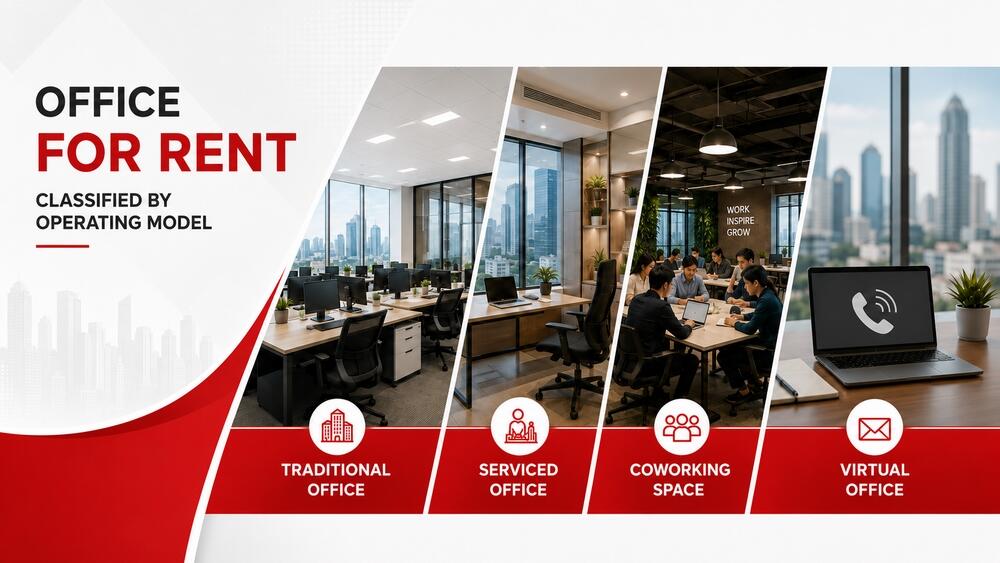
Traditional Office
A traditional office is a model in which the business leases a bare shell or basic handover space, taking full responsibility for interior design, fit-out, and all aspects of operations management.
Pricing model: calculated per m²/month based on the actual leased area; fit-out and operational costs are entirely separate from the rent — the business directly controls each line of expenditure
Commitment & control: long-term lease, typically 3–5 years; full control over design, layout, and the option to sublease part of the space if permitted under the contract
Optimal headcount threshold: generally 20 or more staff, as the upfront investment is only economically efficient when amortized across sufficient floor area and duration of use
Flexibility: difficult to transition quickly to another model mid-lease due to fixed investment in interior fit-out; expansion or contraction of space depends on the ability to renegotiate with the building owner
Advantages: lowest cost per m² over the long term; full freedom to build brand identity through the workspace
Limitations: long lead time before the space is operational; high cash flow risk in the early stage due to simultaneous obligations for security deposit, fit-out costs, and rent
Suitable for: businesses with stable headcount, strong cash flow, and long-term plans to operate from a fixed location
Serviced Office
A serviced office is a fully fitted space furnished to the operator’s standard, with reception, cleaning, maintenance, and shared amenities included.
Pricing model: calculated per room/seat/month, with most operational costs bundled into a single all-inclusive rate — making budget forecasting easier but limiting visibility into individual cost components
Commitment & control: flexible lease terms, typically 6 months to 2 years; tenants cannot alter the structural layout or fixed design of the space, with customization limited to light decoration
Optimal headcount threshold: best suited for teams of 5–30 people — below this threshold, coworking is usually more cost-efficient; above it, the per-person cost begins to significantly exceed that of a traditional office for the same headcount
Flexibility: more flexible than traditional offices — many operators run multi-location networks, allowing businesses to move to a larger room or a different branch as needed
Advantages: near-immediate move-in with no significant upfront investment; easy to scale up or down in response to actual headcount changes
Limitations: higher cost per m² or per person than traditional offices over the long term; space customization to reflect the company’s own brand identity is limited
Suitable for: businesses that need to start operations quickly, are testing expansion into a new market or area, or are uncertain about long-term headcount requirements
Coworking Space
A coworking space is a shared working environment where individuals and businesses share infrastructure, amenities, and some open working areas.
Pricing model: calculated per seat/day or seat/month, with flexible packages including hot-desks (unassigned seating), dedicated desks (fixed assigned seating), and small private rooms within the shared space
Commitment & control: the most flexible model; contracts can be daily, monthly, or long-term with preferential rates; tenants have virtually no control over the space beyond their registered area
Optimal headcount threshold: most efficient for teams under 10 people — above this threshold, the cumulative per-person cost typically exceeds that of a serviced office for the same headcount
Flexibility: highest among the four models — the number of seats can be increased or decreased month by month without long-term contract obligations
Advantages: lowest cost for small-scale operations; no additional investment required; creates opportunities to network with other businesses and potential partners within the same space
Limitations: limited privacy and information security; not suitable for roles that regularly require formal client meetings or handling sensitive data; difficult to build a distinct brand identity
Suitable for: early-stage startups, freelancers, small teams, or short-term projects requiring maximum working flexibility
Virtual Office
A virtual office is a model in which a business leases only a registered business address and associated support services, with no fixed physical workspace.
Pricing model: fixed monthly or annual fee; the lowest cost among the four models as it does not include the cost of a regularly used physical space
Commitment & control: short-term, flexible contracts; businesses have no need to control a physical space as the model does not involve fixed premises
Optimal headcount threshold: suitable for any headcount as long as the team operates remotely or in a distributed manner — there is no headcount limit since the model is not tied to a physical space
Flexibility: easy to upgrade to a coworking space or serviced office when the business requires an actual workspace
Advantages: minimal operating costs; provides a legally valid business address for registration; well-suited to fully remote working models
Limitations: no workspace for staff; some industries with specific requirements around a physical place of business may not be eligible or may be unable to obtain the necessary permits
Suitable for: fully remote businesses, newly established companies that need a valid registered address at minimal cost, or foreign enterprises requiring a legal presence in Vietnam ahead of opening a formal office
Comparative summary of the 4 operating models
| Criteria | Traditional | Serviced | Coworking | Virtual |
|---|---|---|---|---|
| Upfront investment cost | High | Low | Very low | Lowest |
| Degree of space control | Full control | Limited | Very limited | Not applicable |
| Time to move in | Slow | Fast | Very fast | Immediate |
| Optimal headcount threshold | 20+ people | 5–30 people | Under 10 people | No limit |
| Contract commitment level | Long-term | Medium-term | Short-term | Short-term |
Emerging Office Rental Trends
The two emerging office rental trends currently shaping the market are green offices and smart offices, both tied to requirements around sustainable development and digital transformation. These two trends do not replace the existing classification systems by building grade, property type, or operating model — they represent an additional layer of criteria. A Grade A building can simultaneously be a green office or integrate smart technology.
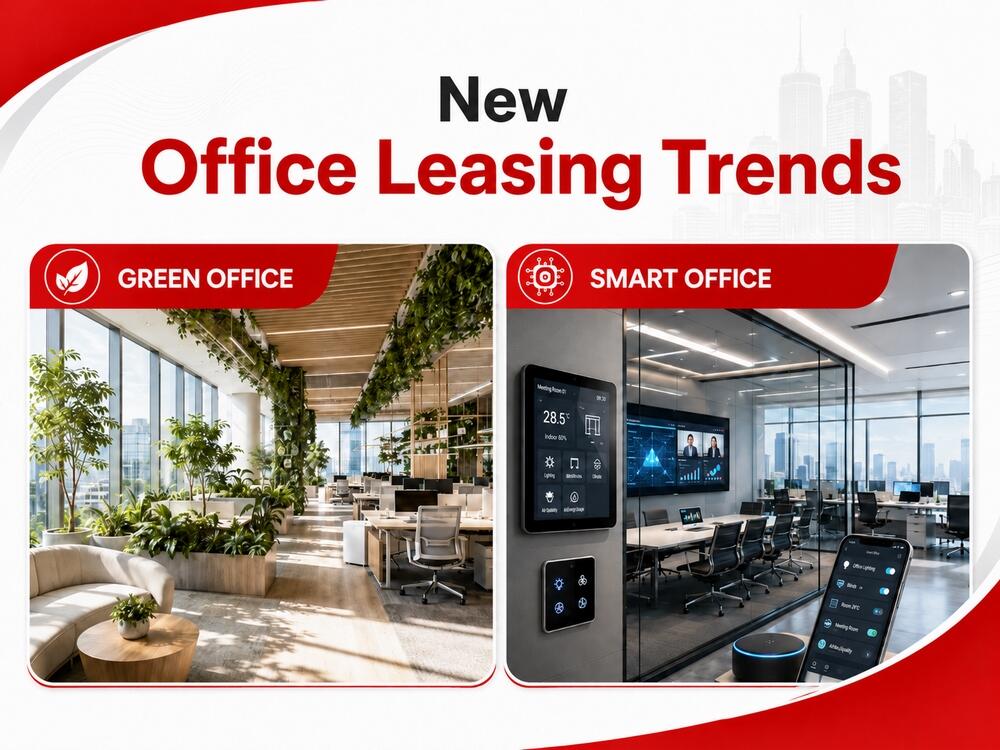
Green Office
A green office is a workspace designed, built, and operated in accordance with standards that minimize environmental impact — optimizing energy use, utilizing eco-friendly materials, and improving air quality and natural lighting within the working environment.
Common certifications in Vietnam: LEED (Leadership in Energy and Environmental Design) issued by the U.S. Green Building Council; LOTUS issued by the Vietnam Green Building Council (VGBC); and EDGE (Excellence in Design for Greater Efficiencies) issued by IFC. These certifications assess buildings based on energy, water, and construction material efficiency.
Benefits for tenant businesses:
- Reduced long-term operating costs through energy-efficient air conditioning and lighting systems
- Improved staff health and productivity through better air quality and natural light
- Supports ESG (Environmental, Social, Governance) objectives — particularly important for multinational corporations or listed companies that need to report on sustainability
Note: green office rental costs are typically higher than standard buildings of the same grade; businesses should weigh upfront rental costs against long-term operational savings to assess overall cost-effectiveness.
Smart Office
A smart office integrates technology into daily operations — from automated access control systems and sensors that adjust lighting and temperature based on occupancy, to platforms for managing meeting room or seat bookings via mobile apps.
Common technology applications:
- Access control via key cards, facial recognition, or QR codes replacing traditional keys
- IoT (Internet of Things) sensors that automatically adjust lighting and air conditioning based on actual occupancy in each zone
- Meeting room booking and hot-desking management platforms via mobile app, suited to hybrid working models
Benefits for tenant businesses:
- Optimized operating costs through automated energy adjustment based on real usage
- Supports flexible (hybrid) working models, helping businesses efficiently manage space when staff do not come to the office every day
- Enhanced security and real-time operations monitoring
Note when considering: the level of “intelligence” varies significantly across buildings and there is currently no unified standard for evaluation; businesses should ask the leasing party or broker to describe the specific technology features actually in operation, rather than relying solely on the “smart office” label in marketing materials.
Which type of office should your business choose?
There is no single “best” office type that applies to every business — the right choice depends on the combination of headcount, budget, stage of development, and the degree to which brand image matters. Businesses should evaluate all three layers of criteria simultaneously — building grade, property type, and operating model — rather than relying on any single factor.
Recommended options by situation
| Business situation | Recommended office type |
|---|---|
| Newly established startup, 1–5 people, limited budget | Virtual office or coworking space |
| Small team of 5–20 people, need to start operations quickly | Serviced office |
| Established business, 20+ people, needs brand building | Traditional office in a high-rise building, Grade A or B depending on budget |
| Business prioritizing cost optimization, minimal client visits | Traditional Grade C office or Officetel |
| Needs independent space, freedom to design to own brand identity | Shophouse or standalone house converted to office |
| FDI enterprise or multinational corporation with ESG priorities | Grade A office with green certification (LEED, LOTUS) |
| Hybrid working model, needs flexible seat management | Smart office with integrated booking systems |
Three factors businesses should weigh simultaneously when making a decision: stage of development — newly established businesses should prioritize flexibility over long-term commitment; actual budget — accounting not just for monthly rent but also upfront investment if choosing a traditional office; and brand image objectives — industries that regularly host partners such as finance and law should prioritize a higher building grade compared to industries operating primarily internally.
Businesses also do not need to commit to a single office type throughout their entire lifecycle — gradually transitioning from a flexible model to a more permanent one as headcount grows is a common pattern in the market. If a business is still undecided between multiple options, consulting an experienced advisory or brokerage firm will help accurately match actual requirements against the available options in the market.
Frequently Asked Questions About Office Rental Types
Can a virtual office be used to register a business license?
A virtual office can be used to register a business headquarters address, provided that address has full legal standing and is not prohibited from business registration under applicable regulations. Businesses should note that certain industries have specific requirements around a physical place of operations — for example, requiring warehouse space, a production facility, or a client-facing venue — and may not be eligible to register using a virtual office address. It is advisable to confirm the legal validity of the address with the service provider before proceeding with registration.
Can an Officetel be used as a company office?
An Officetel can be used as a company office, but not all Officetel projects are licensed for this purpose — legal eligibility depends on the zoning and permits specific to each project. Before signing a lease, businesses must confirm with the developer or building management whether the unit is permitted for business registration and office operations, as some projects are only licensed for residential or limited mixed-use purposes.
What is the difference between a Coworking Space and a Serviced Office?
A coworking space is a shared working environment where multiple individuals and businesses share an open working area; a serviced office provides a separate, enclosed space for each business, even though it sits within the same building as other tenants.
| Criteria | Coworking Space | Serviced Office |
|---|---|---|
| Workspace | Shared, open working area | Private, enclosed |
| Privacy | Low | High |
| Pricing basis | Per seat | Per room |
| Cost | Lower | Higher |
| Included services | Basic (Wi-Fi, common areas) | More comprehensive (dedicated reception, priority meeting rooms) |
| Best suited for | Freelancers, small teams, flexible needs | Businesses requiring confidentiality and formal client meetings |
Each approach to classifying office rentals — by building grade, property type, or operating model — reflects a different dimension of business needs, from construction quality and legal standing to flexibility of use. No single type is universally superior; what matters is that a business correctly identifies its actual requirements at each stage of development to make the right choice, while also considering emerging trends such as green offices or smart offices if they align with the company’s long-term direction.
If your business needs guidance comparing options and choosing the office type that best fits your budget and growth plans, RSQUARE is ready to offer free consulting for office leasing in Hanoi and office leasing in Ho Chi Minh City, helping you find the right, optimal solution.