Businesses looking to lease office space typically face two choices: contacting building owners directly or working through a brokerage. Each approach has its own advantages, suited to different needs, scales, and levels of experience. This article examines what office brokerage is, the specific support brokers provide throughout the leasing process, how it differs from self-search, when it makes sense to use a brokerage, and the risks to watch out for when working with unreliable firms. This gives businesses the foundation to make the decision that best fits their actual situation.
What is office brokerage?
Office brokerage is an intermediary service that connects building owners with available office space to businesses seeking a workspace, supporting both parties throughout the process from search to contract signing. Rather than contacting each building individually, businesses work with a brokerage that advises on suitable office options based on location, floor area, budget, building grade, and desired handover standards.
Role for tenants
- Receiving specific requirements: floor area, budget, location, intended move-in date
- Filtering and proposing a shortlist of suitable buildings from an existing data network, instead of the business having to search each source independently
- Providing a comprehensive assessment: location, rent, maintenance fee, overtime charges, building amenities, and handover conditions
- Representing the tenant in commercial negotiations: rent, fit-out period, contract terms
- Providing legal support to minimize risks at the contract signing stage
Role for building owners
- Sourcing and screening prospective tenants that meet the building’s requirements
- Helping fill vacant space quickly
- Supporting the building’s commercial value by connecting it with the right tenants
How office brokers earn their income
Office brokers typically do not charge a service fee to the tenant. Commission is paid by the building owner after the lease agreement is successfully signed.
What support does an office broker provide to businesses?
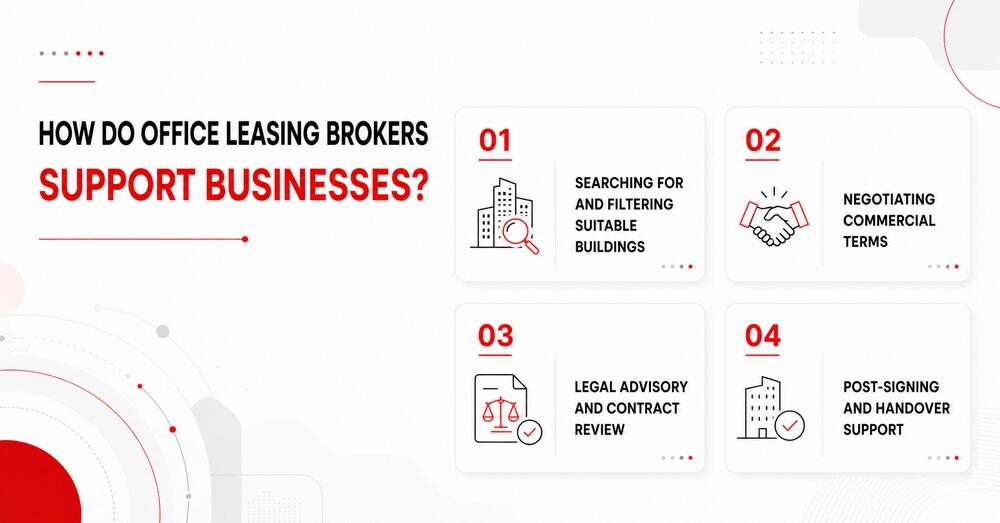
Office brokers support businesses across four main stages: searching and shortlisting suitable buildings, negotiating commercial terms, providing legal advice and reviewing contracts, and offering post-signing and handover support.
Searching and shortlisting suitable buildings
Based on the business’s criteria for floor area, budget, location, and building grade, the broker compiles a list of suitable options from its existing data network, including both publicly listed and off-market inventory not widely advertised. This process saves businesses time spent reviewing individual buildings and pre-eliminates options that do not meet the requirements.
Negotiating commercial terms
The broker represents the business in negotiations with building owners on rent, fit-out period, rent escalation cycles, and payment conditions. With solid knowledge of market pricing and established relationships with building owners, brokers typically secure better commercial terms than businesses would achieve negotiating on their own.
Legal advice and contract review
Before the business signs, the broker assists with verifying the building’s legal standing — including construction permits, fire safety compliance, and the landlord’s ownership or lawful leasing rights. The broker also reviews contract terms to ensure the business’s interests are fully protected.
Post-signing and handover support
After the contract is signed, the broker continues to assist during the handover stage, connects the business with interior design and fit-out contractors if needed, and helps resolve any issues that arise during the move-in period.
How does self-search differ from leasing through a broker?
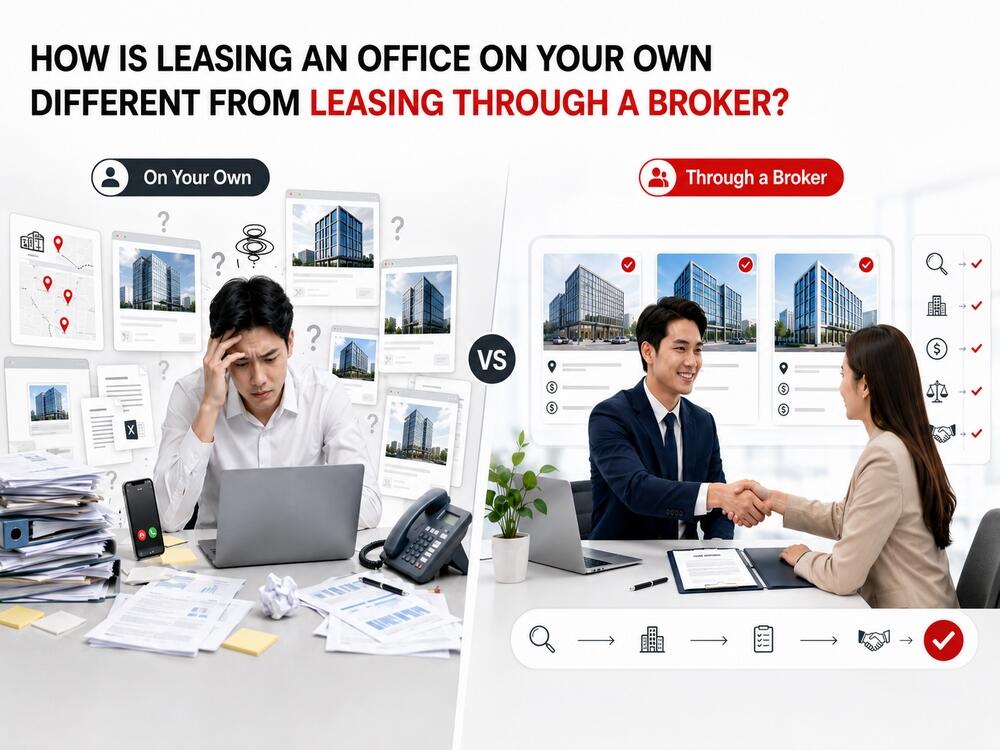
The two approaches differ noticeably across six dimensions: service cost, access to available space, time spent searching, negotiating capability, legal due diligence, and post-signing support.
| Criteria | Self-search | Through a broker |
| Service cost | No intermediary fee | Typically free for the tenant (commission paid by building owner) |
| Access to available space | Limited to public listings, requires searching each source independently | Access to both public listings and off-market inventory not widely advertised |
| Time to find space | Time-consuming — requires contacting and visiting each building individually | Shortened through a pre-filtered shortlist based on criteria |
| Negotiating capability | Depends on the business’s own experience and market data | Advantaged by market pricing data and relationships with building owners |
| Legal due diligence | Business handles independently, with risk of oversights due to inexperience | Assisted review of permits and building legality before signing |
| Post-signing support | None — business handles all issues independently | Continued support through to handover and operations |
The most significant difference between the two approaches is not cost — since brokerage is typically free for tenants — but rather the level of access to information and the time a business must invest to manage the entire office leasing process on its own. Self-search suits businesses that already have experience and sufficient time, while using a broker suits businesses that need to optimize time and minimize risk in negotiation and legal
When should you use a broker, and when can you search independently?
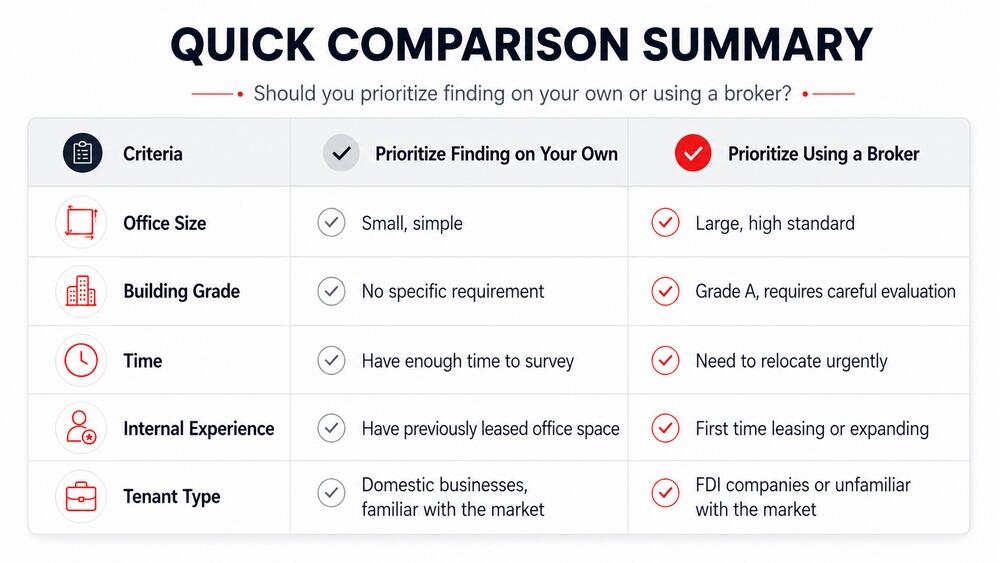
The decision to self-search or engage a broker depends on the scale of the requirement, in-house expertise, and the complexity of the negotiations the business can handle on its own.
When can a business self-search for office space?
- When the target building is already identified: Businesses can contact the developer or building management directly if they already know the specific building, street, or area that suits their operational needs.
- When the space required is small and the need is straightforward: For small-scale offices with few staff and minimal requirements for amenities or building grade, businesses can take the initiative to search and engage directly.
- When the business has prior leasing experience: If the business has previously leased or relocated offices, the in-house team will find it easier to compare prices, assess premises, and review contracts.
- When no complex negotiation is needed: Businesses can self-lease when rent, lease term, deposit, and handover conditions are already clear and require little negotiation.
- When there is sufficient time for the search: Self-searching requires the business to filter information, contact individual buildings, and conduct site visits, so it is only suitable when there is no pressure to relocate quickly.
- When a legal or administrative team is available internally: If the business has staff responsible for contracts, administration, or internal procurement, self-leasing is safer because someone is available to review terms and handover responsibilities.
When should a business use a broker?
- When the target area or building has not yet been identified: The business needs a shortlist of options to compare before deciding, rather than searching each listing source independently.
- When the space required is large and the standards are high: Large-scale offices requiring Grade A standards or a professional brand image demand more thorough building assessment.
- When the business has no prior leasing experience: Businesses leasing or expanding for the first time often lack the data needed to compare prices and evaluate contract conditions.
- When complex commercial terms need to be negotiated: Terms such as fit-out period, rent escalation cycles, or early termination conditions require in-depth negotiating experience.
- When time is limited: Businesses that need to relocate urgently and do not have sufficient time to independently survey and contact individual buildings.
- When the business is an FDI company or unfamiliar with the local market: Foreign businesses or those newly entering the market need support in understanding the legal process and office leasing practices in Vietnam.
Quick-reference summary table
What risks can arise when working with an unreliable broker?
Working with an unreliable brokerage can expose businesses to multiple risks throughout the search, negotiation, and ongoing use of the office. Below are the 8 most common risks businesses should be aware of.
Risk 1: Inaccurate information, wasted site visit time
Some brokers do not update their data regularly, resulting in the introduction of spaces that are already leased, incorrect actual floor areas, or outdated pricing. Businesses lose time traveling for site visits without finding a suitable option.
Risk 2: Advice that does not reflect actual needs
Brokers lacking expertise may propose offices that do not fit the business’s budget, location, or operational goals, prioritizing a quick close over finding the optimal solution for the client.
Risk 3: Non-transparent costs
Some unreliable firms may charge hidden fees to the tenant, despite brokerage services typically being free for the tenant side. Businesses should clarify the fee policy upfront to avoid unexpected costs.
Risk 4: Pressure to make rushed decisions
Some brokers create artificial urgency around timelines or competing interest to push businesses into signing quickly, leaving them without sufficient time to weigh options or compare alternatives.
Risk 5: Weak negotiation and contract review
Brokers lacking experience are unlikely to effectively represent the business in negotiations over rent, fit-out period, or other key terms, causing businesses to miss opportunities for better leasing conditions.
Risk 6: Legal risks associated with the building
If the broker does not conduct thorough legal due diligence, the business may sign a lease for a building under dispute, subject to a mortgage, or non-compliant with fire safety regulations, leading to serious legal exposure later.
Risk 7: Business information leaks
Information about the business’s requirements, budget, and expansion plans may be shared inappropriately if the broker does not have a clear client data confidentiality process.
Risk 8: No support after contract signing
Some unreliable brokers disengage immediately after the contract is signed, leaving the business to handle all issues that arise during handover and the first months of operations without any support.
How to identify a reputable office broker?
Businesses can assess a broker’s credibility through five categories of indicators, combined with a few quick-check questions at the first consultation.
Legal standing and market reputation
A reputable broker has clear legal standing, transparent company information (business name, tax ID, registered address), and an established track record in the market. Businesses should also check genuine reviews from previous clients who have used the service.
Transparency in data and pricing
Reputable brokers provide accurate information on rent, floor area, and amenities from the outset, with no discrepancy between the initial information and actual conditions during site visits. Pricing should clearly set out all associated costs such as maintenance fees and taxes, rather than presenting a single figure that may be misleading.
Professional workflow and data confidentiality
A professional firm follows a clear step-by-step process — from receiving requirements and proposing options to supporting the signing stage — rather than operating ad hoc without structure. Business requirements and plans should also be kept confidential and not shared with third parties without consent.
Negotiating capability and market knowledge
Reputable brokers have a thorough understanding of rent trends by area and building grade, are familiar with common hidden costs, and are capable of representing the business in negotiating key terms such as fit-out period and rent escalation cycles.
Ongoing service after signing
A reputable firm continues to support the business after the contract is signed, from the handover stage through to connecting related services such as interior design and fit-out contractors, rather than cutting contact once the transaction is complete.
Quick-check tip
At the first consultation, businesses can ask directly: “Does your firm charge any fees to the tenant?” and “After the contract is signed, does your firm continue to support during the handover stage?” — how the broker responds clearly indicates the firm’s actual level of transparency and professionalism.
How does RSQUARE support businesses in leasing office space?
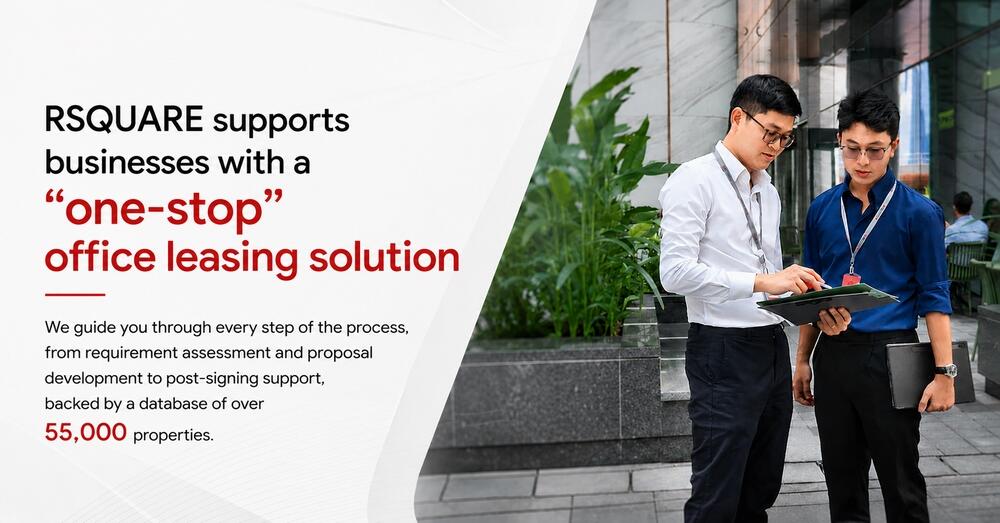
RSQUARE supports businesses in leasing office space through a one-stop model — accompanying them throughout the entire process from needs assessment and option proposals to negotiation and post-signing support, backed by a database of over 55,000 properties.
Data platform and network
RSQUARE maintains a database of over 55,000 offices for rent in Ho Chi Minh City and offices for rent in Hanoi. Vacancy and rental information is updated regularly, enabling businesses to access suitable options quickly.
Stage-by-stage support process
- Needs intake: floor area, budget, location, intended move-in date
- Option proposals and comparison: a shortlist of suitable offices provided with an analysis of advantages and disadvantages
- Site visits: accompanying the business to view pre-selected offices in person
- Commercial negotiation: representing the business in negotiating rent, fit-out period, and contract terms
- Legal support: reviewing contracts and verifying the building’s transparency before signing
Key differentiators
- Consulting services completely free of charge for tenants
- Multilingual support team (Vietnamese, English, Korean), suitable for both domestic businesses and FDI companies
- One-stop model that connects additional related services such as legal and construction when needed
If your business is searching for suitable office space and needs a reliable partner throughout the process, RSQUARE is ready to provide free consultation — from initial needs assessment through to the completion of handover.
Frequently Asked Questions
Is there a fee for leasing office space through a broker?
Businesses leasing office space typically do not pay a service fee to the broker. Brokerage commission is paid by the building owner after the lease agreement is successfully signed, not by the tenant. Businesses should confirm this clearly with the broker before beginning the engagement to avoid hidden fees from unreliable firms.
Does using a broker increase the rent?
Using a broker does not increase the rent, as brokerage commission is paid by the building owner separately from the listed rental rate. Rent is set by the developer or building management and applies uniformly to tenants whether they go through a broker or contact the building directly. In practice, brokers have market data and negotiating experience, so they sometimes help businesses secure a better rate or terms than they would achieve on their own.
Should small businesses lease through a broker?
Small businesses can consider leasing through a broker, particularly when they have no prior leasing experience or do not have dedicated internal staff for this function. Since brokerage services are typically free for tenants, small businesses incur no additional cost by using the service. For simple requirements, small floor areas, and cases where the target building is already identified, small businesses can also self-search without necessarily needing a broker.
Should you work with one broker or multiple brokers at the same time?
Whether to engage one broker or several depends on the urgency of the requirement and the breadth of data coverage the business needs during the search.
When to work with multiple brokers
Businesses can consider working with multiple brokers in the early market survey stage, when the target area or segment has not yet been clearly defined, in order to gather a broader range of information for comparison. This approach also suits situations where the business needs to find space urgently within a short timeframe and wants to maximize access to available inventory.
Why to work with a single broker
Once the business moves into the site visit and negotiation stage, it is advisable to narrow down to one reputable broker with a sufficiently wide data network. Working with multiple brokers simultaneously at this stage often results in receiving duplicate information about the same building from different sources, causing confusion when comparing options. In some cases, issues also arise when multiple brokers introduce the same space to a building owner at the same time, affecting the processing of the business’s enquiry and its standing in the owner’s eyes. Choosing one broker with a broad network — including off-market inventory — ensures sufficient options without the need to engage multiple parties at once.
The decision to lease office space through a broker or to self-search has no single correct answer for every business — what matters is matching the actual requirement to the current in-house capability. Businesses with experience, time, and legal support can self-search effectively. Conversely, businesses that need to optimize time, reduce legal risk, or are leasing office space for the first time should consider working with a reputable brokerage.
RSQUARE is ready to accompany businesses throughout the process of searching for and leasing office space, with a consulting service that is completely free of charge. Contact RSQUARE for support tailored to your needs.