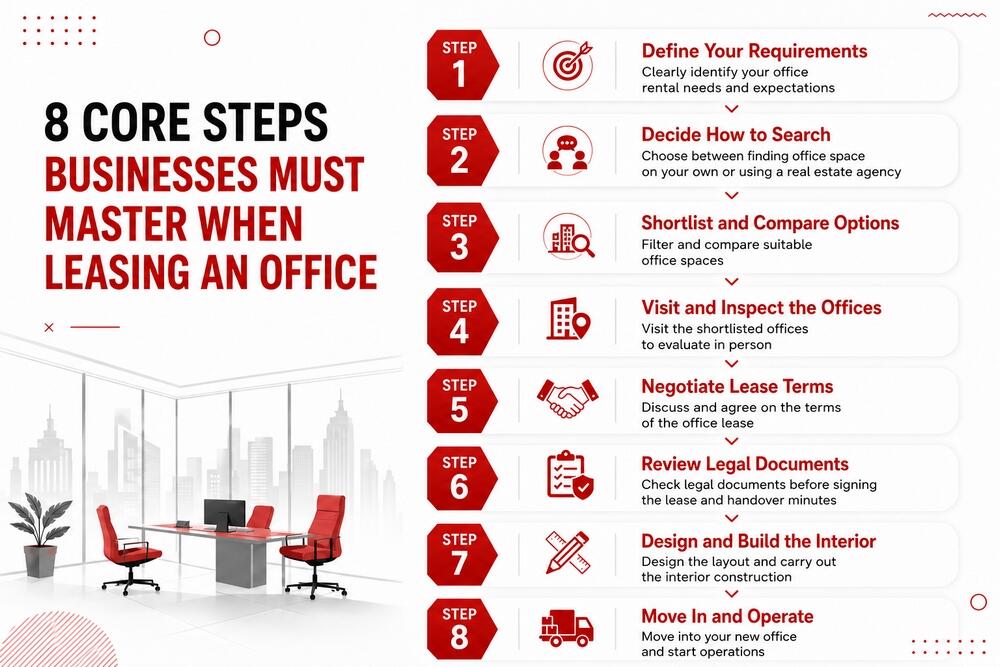
The office leasing process consists of 8 steps, from defining your initial requirements to operating your new office. From the point you set your criteria to signing the contract typically takes 1–2 months. You start by determining the right location, floor area, and budget, then decide whether to search on your own or work with a brokerage. Next, you shortlist options, conduct on-site viewings, negotiate the lease, and verify the legal documents before signing. The final two steps focus on interior design and fit-out, followed by relocating and getting the new office up and running. Each step directly affects the cost, timeline, and legal risk throughout the leasing process.
This article guides you through the office leasing process in 8 specific steps. You define requirements for location, area, budget, and building grade before choosing to search independently or through a broker. After comparing and conducting site visits of target offices, you negotiate key lease terms such as rent, deposit, and handover conditions. Before signing, you thoroughly verify all legal documents and the handover inspection report to avoid dispute risks. The final two steps cover interior design and fit-out, followed by a smooth transition into stable operations. The article also addresses frequently asked questions about advisory fees, leasing timelines, and deposit risks.
Overview of the 8 steps and timeline
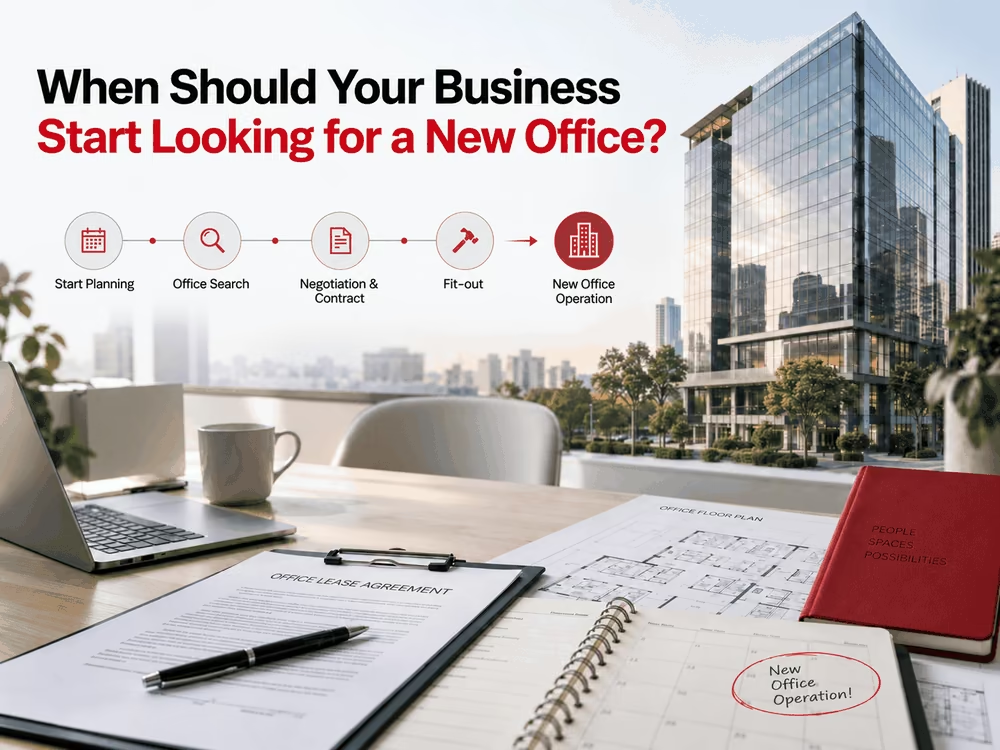
The office leasing process has 8 steps: define your leasing criteria, choose how to search for offices, shortlist and compare options, tour the offices in person, negotiate, verify legal status and the current condition of the space before signing the contract and paying the deposit, design and fit out the interior, then move in and begin operations. From defining criteria to signing the contract usually takes 1-2 months. This can vary depending on how quickly your company makes internal decisions, how negotiations go, and the scale of each business’s fit-out.
| Step | Key tasks | Estimated timeline |
|---|---|---|
| 1. Define leasing criteria | Finalize location, area, budget, office type, building grade, and amenities | A few days to a few weeks |
| 2. Choose how to search for offices | Decide whether to search on your own or work with a brokerage | A few days |
| 3. Shortlist and compare | Collect quotes and narrow down to 3-5 suitable options | About 1-2 weeks |
| 4. Tour offices in person | View the offices and buildings in person | About 1-2 weeks |
| 5. Negotiate | Negotiate rent, fees, lease term, and rent escalation clauses | A few days to a few weeks |
| 6. Verify, sign the contract, and pay the deposit | Check legal documents, prepare a handover condition report, sign the contract, pay the deposit | About 1-2 weeks |
| 7. Design and fit out the interior | Design, obtain building management approval, carry out construction | A few weeks to a few months |
| 8. Move in and begin operations | Relocate, set up infrastructure, start working | About 1-2 weeks |
Step 1: Define 6 core leasing requirements
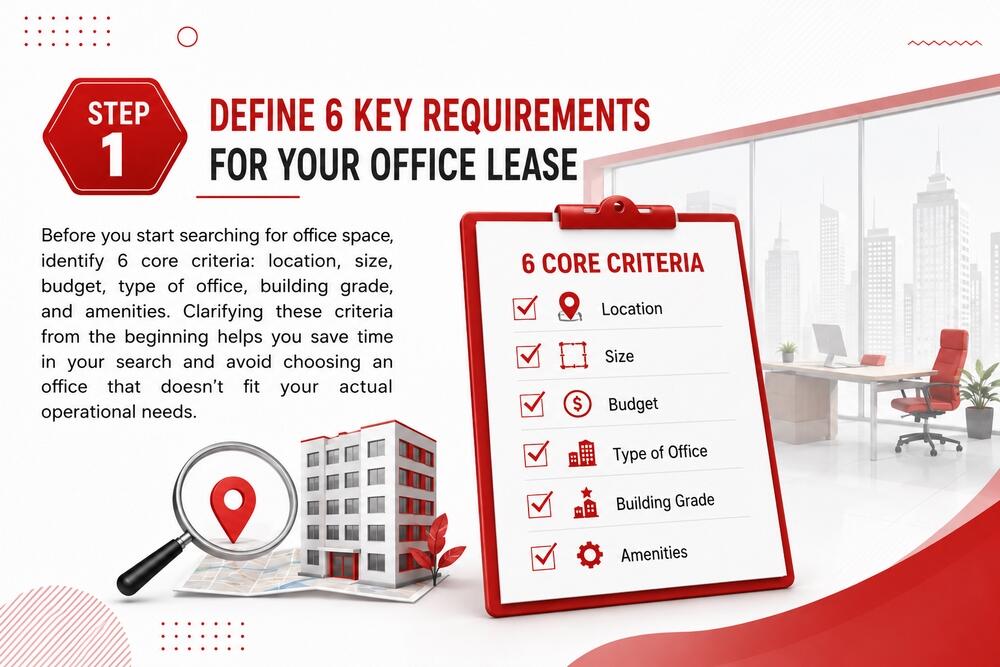
You define 6 core criteria before starting your office search: location, area, budget, office type, building grade, and amenities. Clarifying these criteria from the outset helps you shorten the search process and avoid selecting an office that does not suit your actual operational needs.
- Location directly determines how accessible your office is for staff, clients, and partners. Offices in the central business district (CBD), such as District 1 or District 3, cut down travel time, make it easier to meet partners, and strengthen your brand’s credibility with clients. However, rents run 30–50% higher than in neighboring areas (based on RSQUARE data). By contrast, peripheral locations such as District 7 or Binh Thanh offer considerable rent savings and suit businesses that rarely receive clients at the office, though you should also weigh your employees’ commuting costs and travel time.
- Area should be calculated based on current headcount, hiring plans for the next 1–3 years, and standard space per person, which typically ranges from 3–6 m² depending on the type of work. Beyond the primary workspace, you should also budget for functional zones such as meeting rooms, a director’s office, a reception area, and a pantry. Businesses that lease space too close to their current headcount often need to relocate earlier than planned when they scale up.
- Budget for office leasing extends beyond the listed rental rate and must account for total operating costs, including management fees, parking fees, out-of-quota utility charges, and VAT. Some buildings apply annual rent escalation of 3–5%, so businesses should factor this into their long-term budget rather than relying solely on the rent at the time of signing.
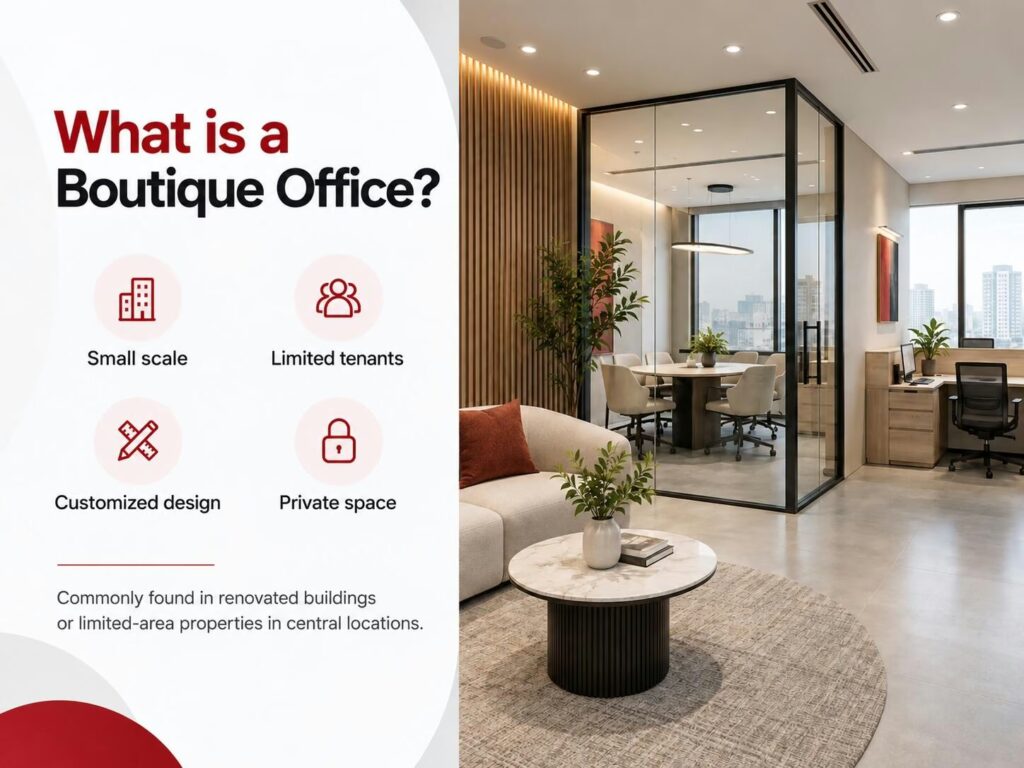
- Office type affects the level of flexibility and long-term commitment required. Traditional offices suit businesses that need stable space, the ability to customize interior design, and are prepared to sign leases of 3–5 years. Serviced offices suit newly established businesses or those that need to get up and running quickly, reducing initial investment costs – though the per-m² rent is generally higher over the long term. A coworking space suited to freelancers, small startups, or teams that need the lowest cost and short rental terms, with the option to rent by seat or by month.
- Building grade directly shapes how partners and clients perceive your business’s image and standing. Grade A and B buildings are located in central districts, with premium architecture and finishes, professionally managed operations, 24/7 security, and a building reception, making them well suited to businesses that frequently receive clients and partners at the office. Grade C buildings are typically older or converted from other uses, with basic technical infrastructure and lobbies and common areas that have seen little investment, making them a fit for businesses that prioritize low costs and rarely host visitors in person.
- Building amenities determine how much disruption your operations suffer when an incident occurs. A backup generator keeps operations running during a grid power outage. Central air conditioning cools the entire floor evenly and bills cooling charges by hours of use, unlike standalone air conditioners that the tenant operates on its own. A car park with capacity that matches your headcount and visitor numbers avoids overcrowding at peak hours. Building reception receives and directs visitors, reducing the need for the business to assign its own staff to the front desk.
Step 2: Decide whether to search independently or through a broker
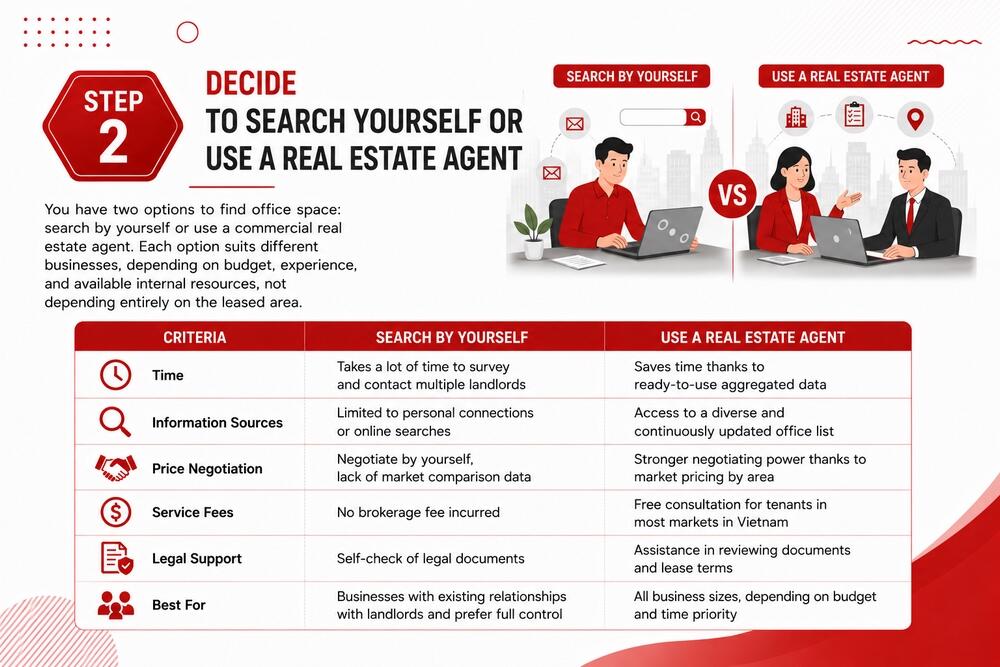
Businesses can search for office space on their own when they already have a relationship with the building owner or only need to view one or a few specific locations. They should lease through a brokerage when they need to compare multiple buildings, negotiate rent, and have the contract reviewed. The criteria list from Step 1 serves as the input for both approaches.
When to search on your own
Searching on your own suits businesses that already have an existing relationship with the landlord or building management, or that want full control over the process. This approach incurs no service fee, but the business has to handle three tasks itself:
- Contact and survey each building.
- Collect rental rates for same-grade buildings in the same area as a basis for negotiation.
- Review the legal documents and contract terms.
Without comparison data, it is hard for a business to judge whether the listed price is reasonable. Many businesses that search on their own end up signing at rates 10-15% above the market average because they lack comparison data across same-grade buildings in the same area.
When to lease through a brokerage
Leasing through a brokerage suits businesses that need to compare multiple buildings, lack negotiation experience, or need someone to review the contract terms. A brokerage helps in four ways:
- Provides rental rate data by street and by building grade, giving you a basis for negotiation instead of accepting the listed price.
- Offers a diverse, continuously updated list of offices.
- Supports negotiation of price and terms.
- Identifies unfavorable clauses, such as unclear rent escalation fees or unfair contract termination conditions.
On cost, most of the office leasing market in Vietnam follows a practice in which the brokerage charges its fee to the landlord (the building owner), not to the tenant. This means you receive free advisory support while still gaining negotiation leverage and legal assistance, whether the leased area is large or small.
| Criteria | Searching on your own | Through a brokerage |
|---|---|---|
| Time | Time-consuming to survey and contact multiple landlords yourself | Shorter timeline thanks to ready-made consolidated data |
| Information sources | Limited to personal relationships or online searches | Access to a diverse, continuously updated list of offices |
| Price negotiation | Negotiate on your own, without market comparison data | Stronger negotiating position thanks to knowledge of area market rates |
| Service cost | No brokerage fee | Free advisory for tenants in most of the Vietnamese market |
| Legal support | Check legal documents yourself | Support with reviewing documents and contract terms |
| Best suited for | Those with an existing landlord relationship who want full control | Those who need to compare multiple buildings and lack negotiation experience |
Businesses with limited experience in commercial office leasing should prioritize engaging a broker, as this saves time, reduces legal risk, and typically incurs no additional cost — regardless of the size of the space being leased.
Step 3: Shortlist and compare suitable offices
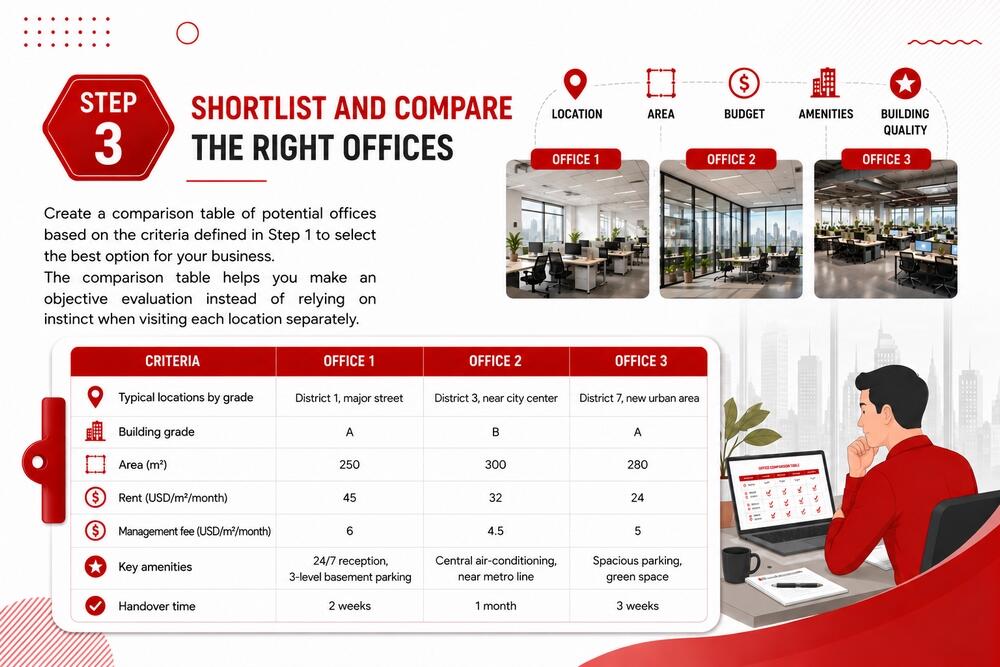
Build a comparison table of your candidate offices based on the criteria you defined in Step 1, then choose the best option for your business. A comparison table lets you evaluate options objectively, rather than deciding on gut feeling after visiting each site separately.
Sample comparison table(illustrative figures; replace with real data when you apply this; rents are quoted excluding management fees and VAT):
| Criteria | Office 1 | Office 2 | Office 3 |
| Location | District 1, main road frontage | District 3, near the center | District 7, new urban area |
| Building grade | A | B | A |
| Area (m²) | 250 | 300 | 280 |
| Rent (USD/m²/month) | 45 | 32 | 24 |
| Management fee (USD/m²/month) | 6 | 4.5 | 5 |
| Total monthly cost, excl. VAT (USD) | 12,750 | 10,950 | 8,120 |
| Security deposit (months) | 3 | 3 | 2 |
| Minimum lease term | 3 years | 2 years | 2 years |
| Annual rent increase | 5% | 5% | 3% |
| Rent-free period | 1 month | 2 months | 1 month |
| Key amenities | 24/7 reception, 3-level basement parking | Central air conditioning, near a metro line | Large parking area, green space |
| Handover time | 2 weeks | 1 month | 3 weeks |
Office 1’s unit rent is almost 1.9 times that of Office 3, but its total monthly cost is only about 1.6 times higher because the areas and management fees differ. That is why you should always compare the total cost row, not the unit rate.
How to Read Quotes So You Can Compare Them Correctly
Office quotes are only comparable once you convert them to the same basis. Each building quotes in its own way, so ask about each item in the table below before filling in your comparison table.
| Item to check | Meaning | What to ask |
| Net rent | Usually the rent excluding management fees and VAT | What does this price include? |
| Gross rent | Usually the rent including management fees, excluding VAT | How much is the management fee when charged separately? |
| Unit of measure | Per m² or for the entire floor | Is the area measured as net usable area or gypsum-to-gypsum area? |
| Currency | Quoted in VND or USD | What is the exchange rate, and when does it apply? |
| Payment frequency | Monthly, quarterly, or annually | How far in advance must you pay? |
The terms “net” and “gross” vary from building to building, so record each landlord’s definition rather than assuming. Then convert every option to the actual total monthly cost (rent plus management fee, multiplied by the area, before VAT).
How to Score and Rank the Options
After filling in the table, score the options to rank them. Assign each criterion a weight based on your business priorities (totaling 100%), then score each office from 1 to 5. The total score is the sum of (score × weight).
| Criteria | Weight | Office 1 | Office 2 | Office 3 |
| Budget | 30% | 2 | 3 | 5 |
| Location | 25% | 5 | 4 | 3 |
| Area and capacity | 15% | 4 | 5 | 4 |
| Amenities and infrastructure | 15% | 5 | 4 | 3 |
| Lease terms | 15% | 3 | 4 | 4 |
| Total score | 100% | 3.65 | 3.85 | 3.90 |
The weights determine the outcome. A business that prioritizes brand image and frequent client meetings should raise the weights for location and amenities, which usually points to a Grade A office in the center despite the higher rent. A business that prioritizes operating cost should raise the weight for budget, which usually points to an office with lower rent and management fees in an area near the center or in a new urban district. This approach helps you narrow the list down to the 2-3 best options before moving on to on-site visits.
Step 4: Conduct on-site visits of target offices
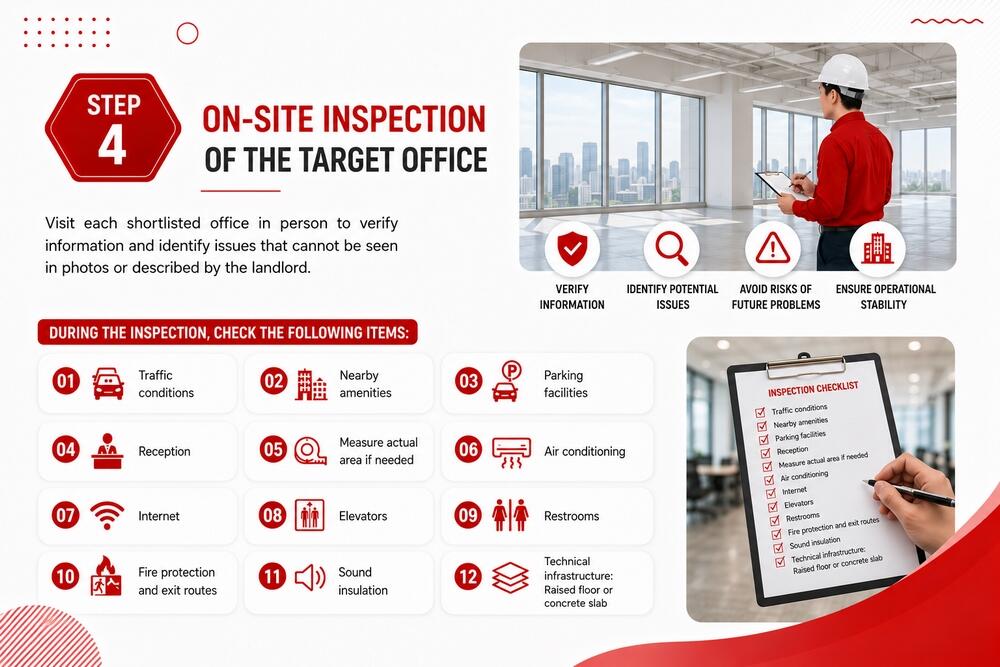
The on-site inspection covers three groups of checks: the interior space, building operations, and the surrounding area. Visit every office on your shortlist at several times of day, for example early morning, midday, and late afternoon, so you can see the elevators, parking, and traffic under real load. This step helps you decide whether an office is worth leasing. Documenting the current condition of each item to settle the responsibilities of both parties belongs to Step 6.
Interior space
| Item | What to check | Red flags |
|---|---|---|
| Area | Re-measure the floor area and confirm whether the figure in the quotation is net usable area or wall-center-line area | The measured area is lower than the quoted figure, and the landlord cannot explain how it was calculated |
| Floors, walls, ceilings | Inspect the surfaces in every area, including corners and the zones near restrooms | Cracks, peeling, yellowing, damp smell, water stains |
| Floor infrastructure | Determine whether the floor is a leveled concrete slab or a raised access floor | Concrete slabs make it hard to run concealed power and network cabling |
| Air conditioning | Compare the central AC capacity with your planned headcount, and stand in the room in the afternoon | The room gets hot in the afternoon, uneven cooling airflow |
| Internet | Test the speed on site, and ask how many carriers serve the building and whether bandwidth can be upgraded | Only one carrier, weak signal in some areas |
| Lighting and ventilation | Observe natural light and air circulation | Stuffy space, lights need to stay on all day |
| Restrooms | Count the restrooms and check their cleanliness on each floor, then compare against your headcount | Too few restrooms for the number of staff, worn-out fixtures |
| Soundproofing | Stand in the meeting room and the work area and listen for noise from neighboring rooms and the corridor | Outside noise is clearly audible, especially for businesses that need private meeting rooms or a call center |
Building operations
| Item | What to check | Red flags |
|---|---|---|
| Elevators | Count the working elevators and time the wait during peak hours | Long waits, elevators that are broken or out of service |
| Parking | Check motorbike and car capacity against your staff and visitors, and ask about fees | The lot is full at peak hours, staff must park far away |
| Security | Observe the guards, cameras, and how access is controlled | Outsiders can walk in and out freely without being checked |
| Fire protection and emergency exits | Verify that the fire protection system has a valid inspection certificate, and walk through the emergency exits | Exits blocked by clutter, no inspection certificate can be produced |
| Reception and building management | Observe response time when visitors arrive, and ask how incidents are handled | Slow responses, no clear point of contact |
Surrounding area
| Item | What to check | Red flags |
|---|---|---|
| Traffic | Observe traffic density during the morning and evening peaks, and measure actual travel times from the main roads | Prolonged congestion around the building, entrance hard to reach |
| Flooding | Ask the building management and current tenants about conditions during heavy rain, and inspect the base of the building and the basement parking | A history of flooding, water marks in the basement or lobby |
| Amenities | Work out the distance to the nearest restaurants, banks, bus stops, and metro station | Staff must travel far for daily needs |
Take photos and videos of the entire survey area so you can compare offices against each other instead of relying on memory.
Step 5: Negotiating price and lease terms
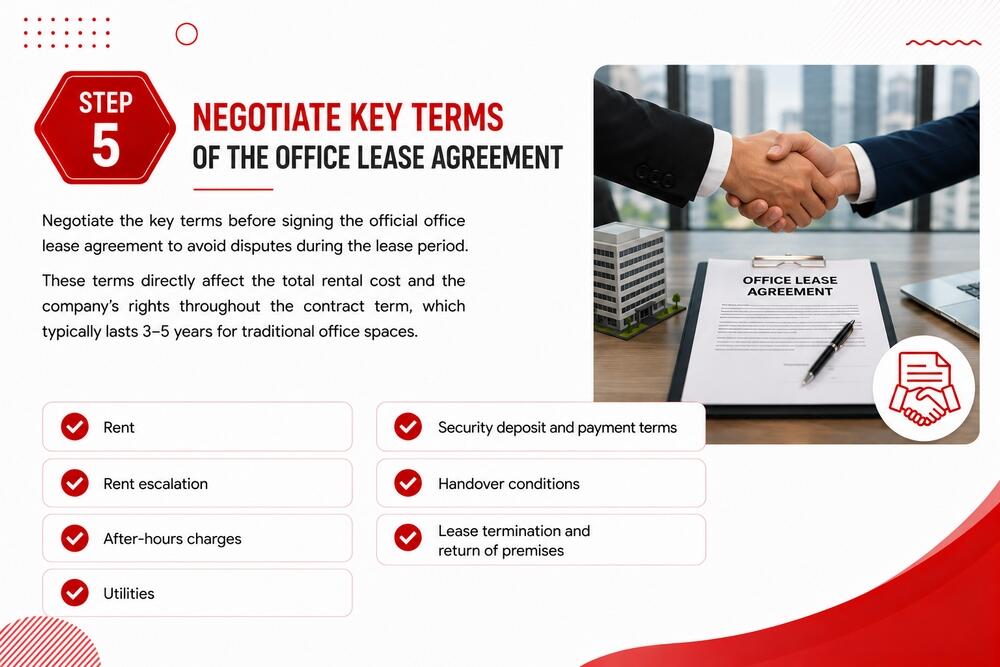
Negotiating an office lease comes down to three tasks: setting a target price based on market data, negotiating the total cost along with the benefits that come with it, and recording every agreement in the contract with specific figures. Landlords usually draft a template contract, and most of its clauses can still be negotiated. A traditional office lease typically runs 3-5 years, so a clause missed at this step affects your costs for the entire term.
Setting a target price from market data
Set your target price from 3-5 buildings in the same area and the same grade, not from gut feeling. For each building, record the rental rate per m², the management fee, and the total monthly cost, then take the average as a benchmark to compare against the asking price of your chosen building.
From this benchmark, set two figures before sitting down to negotiate:
- Target price: the figure you propose first, usually about 5-10% below the asking price.
- Walk-away price: the maximum your company will accept. If the price goes beyond this, you return to the backup options on the shortlist you built in Step 3.
Avoid revealing your maximum budget at the start. Let the landlord put forward their best offer first, then adjust.
Negotiating total cost, not just the rental rate
Total leasing cost consists of the rental rate plus all the additional charges that come with it. Two offices with similar rental rates can differ considerably in actual monthly cost, depending on how each building calculates the items below.
- Rental rate and area calculation: confirm the rate per m² and the area it applies to: gross area (wall-to-wall) or net area (usable). The difference between the two methods can be as much as 10-15% of the actual usable area. You also need to confirm whether the price includes VAT, so you don’t make mistakes when comparing offices.
- Management fee and parking fee: these are fixed monthly costs that are often overlooked when comparing prices. A common management fee is around USD 3-6/m²/month depending on the building grade. For teams of 10 or more, parking fees add up to a significant amount.
- Periodic rent increases have a major impact on long-term costs. A common increase is 3-5% per year, or once every 2-3 years, depending on each building’s policy. Ask for the specific increase to be written as a number in the contract, and avoid the phrase “as agreed by both parties,” since it allows the building to adjust the price at its own discretion.
- After-hours charges apply when a business uses air conditioning or elevators outside office hours, usually charged per hour or in 30-minute blocks. Businesses that often work overtime or run night shifts should negotiate this rate from the start, because some buildings charge quite high rates compared with normal operating costs.
- Electricity and water can be billed in two ways: by separate meter (you pay for actual consumption) or by leased area (split proportionally by m²). Separate metering is more transparent and suits businesses with low electricity consumption. Area-based billing is common in buildings that do not install meters on each floor.
- Currency and exchange rate need to be defined if the contract is denominated in USD. Clarify which bank’s rate is used to convert to VND and at what point in time, or negotiate a maximum fluctuation range.
Negotiating lease term, incentives, and additional benefits
Lease term is a business’s strongest negotiating lever. A long-term contract reduces the landlord’s vacancy risk, so they are more willing to make concessions on price and incentives. A short-term contract is more flexible for the business but usually comes with fewer incentives.
When you commit to a lease of 3 years or more, you can ask for:
- Rent-free period: usually 1-3 months depending on the contract term. You use this period to design and build out the interior in Step 7 without paying rent.
- Fixed rental rate for the first 12-24 months, with no mid-term increases.
- Basic fit-out support, such as partitions, or finished flooring or ceilings.
- Operational benefits: a number of free parking spaces, free meeting room hours per month, and the right to display the company name in the building lobby.
- Priority right of renewal or expansion if the business plans to add headcount.
Negotiating the deposit, handover, and termination
These three clauses define the responsibilities of both parties at the start and end of the lease. If they are not clearly written down, this is the group most prone to disputes.
- Deposit and payment: a common deposit is 3-6 months of rent, and you can propose a lower amount if you sign a long-term lease. The contract should clearly state the cases in which the deposit can and cannot be deducted, along with the refund deadline, so the landlord cannot withhold the deposit on vague grounds. Common payment cycles are monthly or quarterly; choose the cycle that fits your company’s cash flow.
- Handover conditions: confirm the condition of the premises at the time of receipt, including whether air conditioning, lighting, and partitions are provided. Ask the landlord to repair the defects recorded in Step 4 before handover, to avoid disputes over additional finishing costs after the contract is signed.
- Termination and return of premises: this covers the notice period when either party wants to terminate early, usually 3-6 months, and the penalty for improper termination, usually equal to 2-3 months of deposit or rent. You need to negotiate this clause so it is fair to both sides, avoiding a situation where obligations bind only the tenant. If the business plans to expand or downsize, you should also negotiate the right to terminate or swap to a different area flexibly.
All incentives and commitments must be written into the contract or an appendix. Verbal commitments carry no weight when a dispute arises. Once everything is agreed, move on to Step 6 to carry out the legal check, prepare the handover condition report, and sign the contract.
Step 6: Verify the legal documents and the unit’s condition, then sign the lease and pay the deposit
Check the legal documents and the condition of the office first, then sign the lease and pay the deposit. This order helps you avoid ownership disputes, unexpected repair costs, and a withheld deposit later on. This is the most important step from a legal standpoint in the entire office leasing process.
Check the legal documents of the building and the landlord
Ask the landlord to provide the following documents:
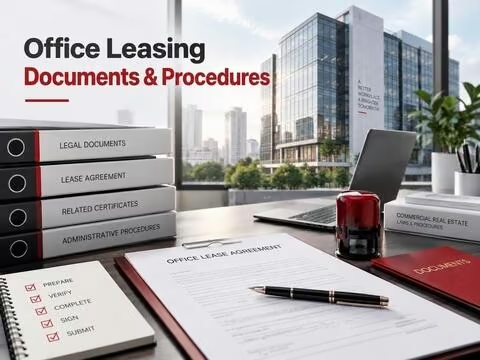
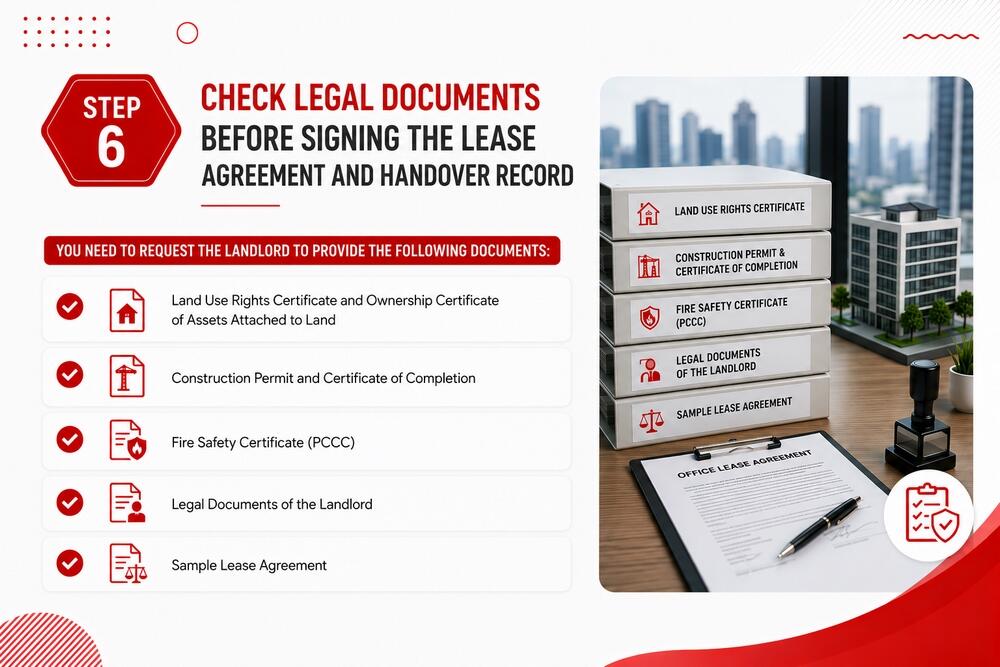
- Certificate of land use rights and ownership of assets attached to the land for the building
- Construction permit and completion certificate confirming the building was legally constructed
- A valid fire prevention and fighting (PCCC) safety certificate
- The landlord’s legal documents: a business license if the landlord is a company, plus a valid power of attorney if the person signing the lease is not the legal representative
- The master lease and written consent to sublease if the landlord is an intermediary rather than the owner
- VAT invoice information if your company needs to claim input tax deductions
Also ask the landlord for a sample lease, then have your company’s legal department or lawyer, or your brokerage, review it before the final negotiation. If the landlord avoids providing documents or only shows copies of unclear origin, stop and verify further before proceeding.
Inspect the office’s condition and prepare a handover record
The condition record formally documents the state of each item in the office before signing. Unlike Step 4, where you assess whether the office is worth leasing, this record sets out each party’s responsibility at handover and when the space is returned. Prepare the record with the following items:
| Item | Details to confirm | Status to record in the document |
|---|---|---|
| Actual area | Re-measure the interior floor area (Net) with a tape measure. | Matches the lease (a tolerance of ±1–2% is acceptable). |
| Electrical system | Location of the main distribution board and electricity meter (record the opening meter reading and photograph it). | System works normally, with no leakage. |
| Air-conditioning | Test the system for cooling, noise, and whether any vents are leaking water. | State the number of units/vents and their condition. |
| Fire protection & internet outlets | Number of sprinkler heads and smoke detectors, and location of the internet cable boxes of the carriers. | Complete and in safe locations. |
| Ceiling, walls, floor | Check the gypsum ceiling (any yellowing from water seepage?), walls (any cracks?), and floor (flat concrete or uneven?). | Record in detail any cracks or seepage so you are not held liable when returning the space. |
| Doors & glass | Main door lock, and whether the building’s exterior glass walls have cracks, fractures, or gaps in the rubber seals. | State any scratches or damage clearly (if any). |
| Keys and access cards | Count the keys and access cards handed over and test that they open the door. | State the quantity received. |
| Photos and videos of condition | Take photos or videos of each item with the date and time displayed. | Attach to the record; each party keeps a copy. |
Sign the record only after checking everything against the actual condition. Attach the record to the lease as an appendix so it carries weight when the space is returned.
Review the terms, sign the lease, and pay the deposit
Even though you negotiated in Step 5, read the entire lease again to make sure every agreement is put in writing:
| Term | What you need to confirm |
|---|---|
| Rental price | Whether it includes VAT and management fees |
| Currency | Whether it is in VND or USD, and which source sets the exchange rate |
| Rent increases | The amount and timing of annual increases |
| Term and renewal | Lease term, and the conditions and price upon renewal |
| Early termination | Conditions, notice period, and penalties |
| Deposit and refund | Deposit amount, refund conditions, and items that may be deducted |
| Rent commencement | The date rent starts and any rent-free period (if applicable) |
| Operating responsibilities | Who bears the cost of repairs, maintenance, and after-hours electricity |
| Agreed incentives | All incentives must be written in the lease or an appendix |
Once all terms are clear, sign the official lease together with its appendices, and only then transfer the deposit. Transfer the money only when the lease bears the signatures and seals of both parties. Never pay a deposit based on a verbal agreement or documents with no legal validity. Keep the signed lease, the transfer receipt, and the invoices for future reference.
Step 7: Interior design and fit-out
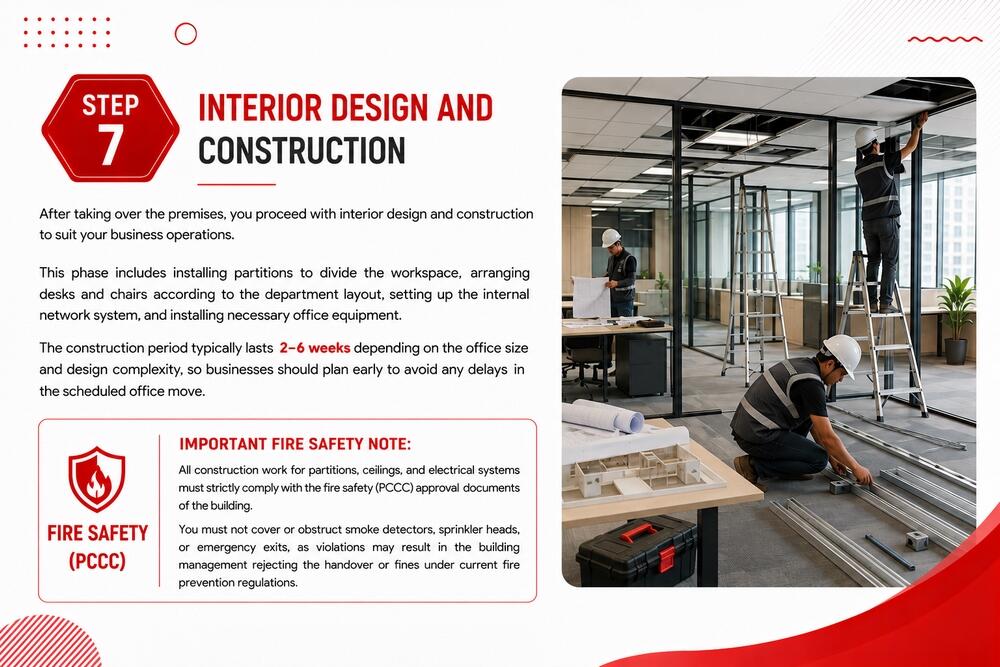
After taking handover of the premises, you proceed with interior design and fit-out to suit your business’s operational needs. This stage includes installing partitions to divide the workspace, arranging furniture according to the departmental floor plan, deploying the internal network, and installing necessary office equipment. Fit-out typically takes 2–6 weeks depending on the floor area and design complexity. Businesses should plan the fit-out early to avoid delays to the planned move-in date.
Critical note on fire safety (PCCC): all fit-out work involving partitions, ceilings, and electrical systems must strictly comply with the building’s approved fire protection design. You must not obstruct smoke detectors, sprinkler heads, or emergency exits, as violations may result in the building management refusing to approve the fit-out or penalties being imposed under current fire safety regulations.
Step 8: Office relocation and operations
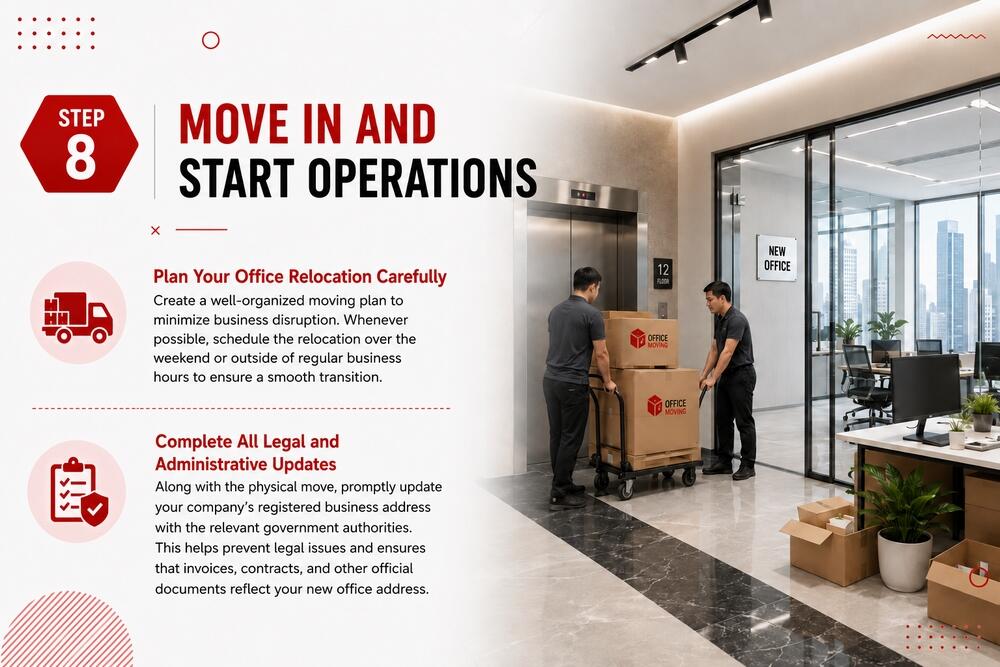
You plan the move carefully to minimize disruption to business operations, typically scheduling it on weekends or outside standard business hours. Alongside the physical relocation, you complete the administrative process of notifying the relevant authorities — including the tax authority and the Department of Planning and Investment — of the change of registered business address within the required timeframe, to avoid legal complications when invoices or company documents still carry the old address.
Frequently asked questions about office leasing
Below are answers to common questions businesses encounter during the office leasing process.
Does RSQUARE charge an advisory fee for office leasing?
RSQUARE provides completely free advisory services to office tenants. Brokerage fees are typically paid by the building owner, with no charges of any kind arising on the part of the business throughout the search, negotiation, and contract signing process.
How long does it take from starting the search to receiving handover?
The average time from initiating the search to receiving handover of the premises ranges from 1–2 months, depending on area requirements, the availability of suitable offices, and the speed at which both parties complete the legal procedures.
Should you pay a deposit before signing the formal lease?
You should pay a holding deposit if you have clearly identified the right office, as the Grade A and Grade B office market in central areas tends to be highly competitive. However, you should negotiate the deposit refund conditions clearly before paying, to avoid losing the deposit entirely if a dispute arises over lease terms or if the landlord changes their position after receiving it. You should only pay a deposit when you have clear written confirmation from the lessor — never based on a verbal agreement alone.
If your business needs support with searching, comparing, or negotiating an office lease, contact RSQUARE now – a unit specializing in completely free office leasing consultation services for office rental in Hanoi and office rental in Ho Chi Minh City.
- Hotline: +84-28-3636-9641 (Viet/Eng) | +82-2-6925-3298 (Kor)
- Email: support@rsquare.vn