Overtime fees in office leases are surcharges tenants pay to building management for using the office outside standard working hours. For businesses that regularly work late, hold evening meetings, or operate 24/7, this cost directly impacts total occupancy expenses yet is easily overlooked when comparing initial quotes. This article explains what overtime fees are, three common calculation methods, the situations that trigger them, the factors that determine the rate, how to include the relevant clauses in a lease contract, and negotiation tips to help businesses control costs from the outset.
What is an overtime fee in an office lease?
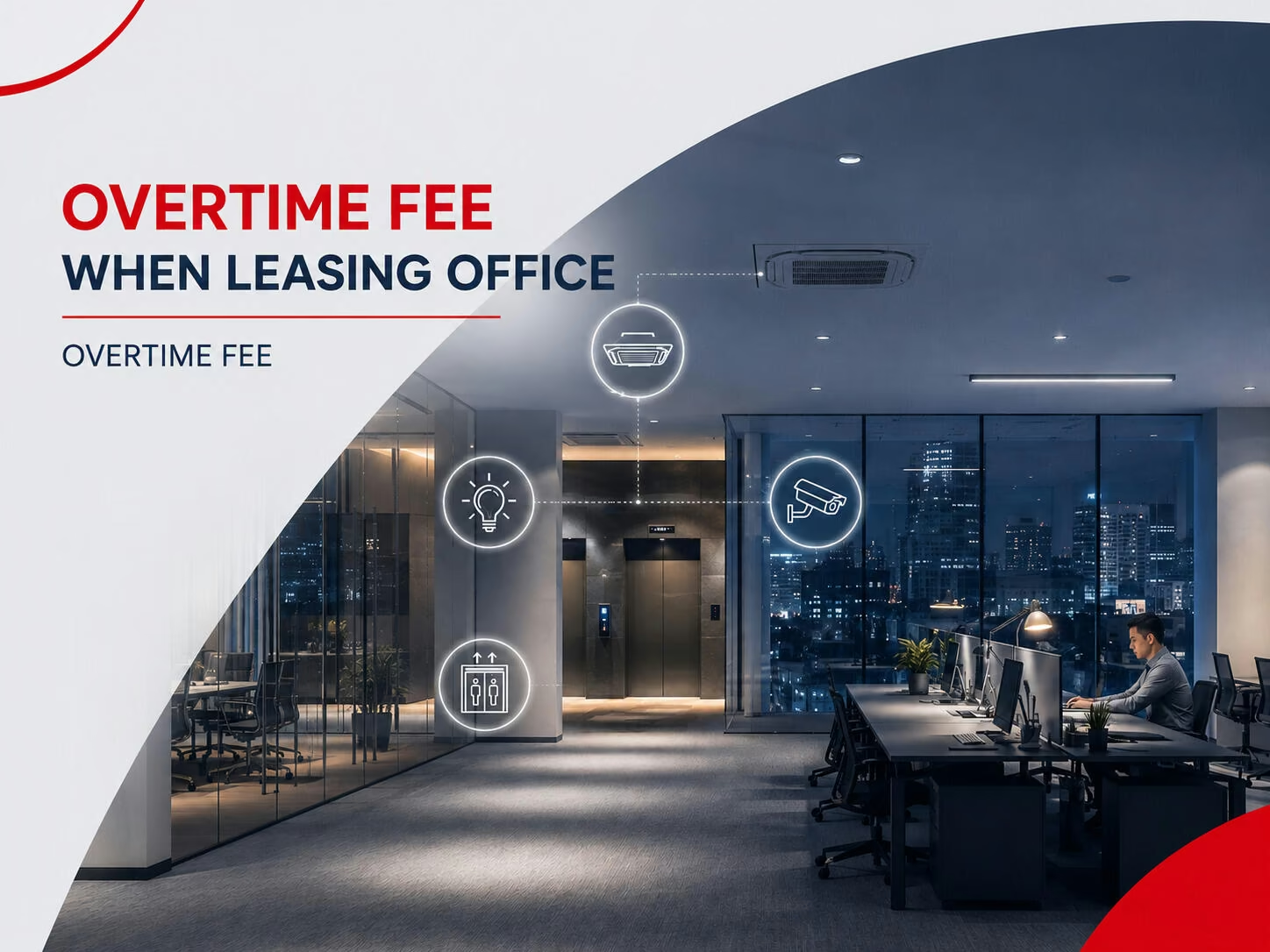
An overtime fee in an office lease is a surcharge tenants pay to building management for using the office outside the standard working hours specified in the contract. In English this charge is called an Overtime Fee (OT Fee), and it applies to the use of space, air-conditioning, lighting, and elevators beyond the regulated business hours.
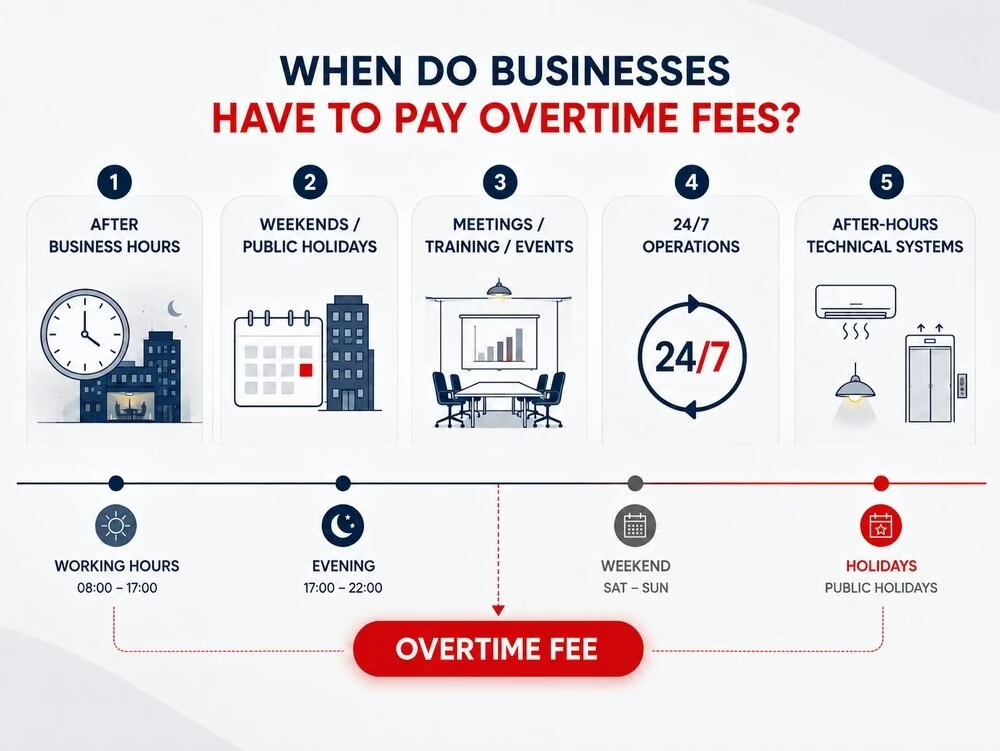
Standard working hours are treated as “free” usage time, typically 8:00–18:00 Monday through Friday and Saturday mornings. Any activity outside this window – evenings, nights, weekends, and public holidays – is classified as overtime. These figures represent common market practice; each building sets its own hours in its internal regulations or lease agreement.
Buildings charge this fee to offset the additional operating costs incurred outside regular hours, including electricity, air-conditioning, elevators, security, and on-call personnel. It is a legitimate and transparent cost, not an arbitrary hidden charge.
The overtime rate varies between buildings. It depends on the building grade and type of air-conditioning system; buildings with central AC typically apply stricter charges, while those with zone-based VRV/VRF systems are more flexible.
Businesses need to understand this fee because it is usually not included in the base rent and is easily missed when comparing quotes. For organizations with high overtime frequency – such as regular late shifts or 24/7 operations – overtime fees can significantly affect total long-term operating costs.
3 overtime fee calculation methods in office leases
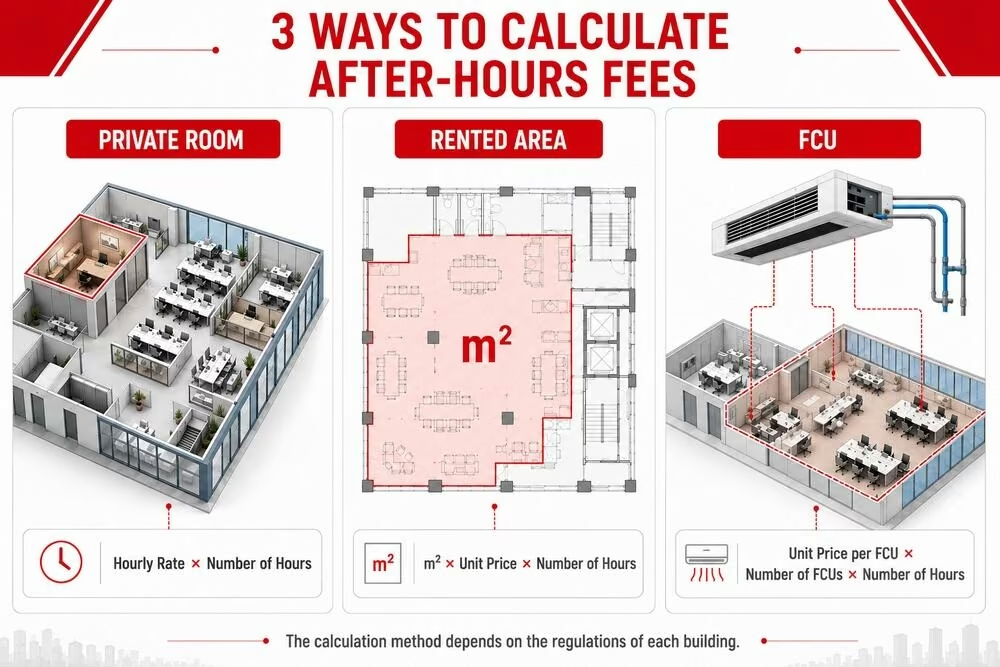
There is no universal standard for overtime fees. The market currently uses three common calculation methods: per private office, per leased area, and per FCU (Fan Coil Unit). The specific method depends on each building’s regulations; businesses should read the lease agreement and service annexe carefully to understand which method applies.
Per private office (fixed rate per hour)
The building charges a fixed fee per office per hour, regardless of floor area. This method is common in Grade B and C buildings and small-to-medium offices with simple operating systems.
Overtime cost = Fixed rate per hour × Hours used
For example, if the building charges 300,000 VND/hour/office and the business uses 4 hours, the total is 300,000 × 4 = 1,200,000 VND (illustrative figure; actual rates are per contractual agreement).
The advantage is easy cost control and straightforward calculation. The drawback is that businesses pay for the entire office even if only part of the space is used, making this method best suited to short overtime needs of around 1–2 hours per day.
Per leased area (VND/m²/hour)
This is the most common method in Grade A and B buildings that use central air-conditioning or a BMS. The fee is calculated by multiplying the leased area by the unit rate and the number of hours used.
Overtime cost = Leased area (m²) × Unit rate (VND/m²/hour) × Hours used
For example, at a rate of 3,300 VND/m²/hour, a 300 m² office working 2 extra hours incurs a cost of 3,300 × 300 × 2 = 1,980,000 VND (illustrative rate).
Businesses should note that unit rates often increase with area size; some buildings apply tiered pricing for thresholds below and above 300 m². Many buildings also require a minimum billing duration per registration, typically 2 hours. This method is transparent and easy to verify, but costs can be high for large spaces or frequent overtime use.
Per equipment used – FCU (Fan Coil Unit)
The building charges based on the number of air-conditioning units (FCUs – Fan Coil Units, i.e., indoor units or cooling coils) activated outside standard hours. This method is common in technically advanced Grade A and B buildings where the air-conditioning system is divided by zone or floor.
Overtime cost = Unit rate per FCU per hour × Number of FCUs × Hours used
For example, an office of approximately 150 m² using 3 FCUs for an additional 2 hours per day over one month at 400,000 VND/FCU/hour would incur a monthly fee of 400,000 × 3 × 2 × 30 = 72,000,000 VND (illustrative figure).
This method is optimal for businesses that use only part of their space after hours – for instance, activating AC only in the meeting room rather than the entire floor. The prerequisite is that the building has an air-conditioning and ventilation system that can be switched on and off independently by zone, typically on large floors of approximately 250 m² or more.
When does a business incur overtime fees?
A business incurs overtime fees whenever it operates in the office beyond the standard hours specified in the lease or building regulations. There are five common situations that trigger this charge:
- Working after regular business hours
- Working on weekends or public holidays
- Hosting meetings, events, or training sessions outside standard hours
- Operating on a 24/7 model
- Using air-conditioning or technical systems outside standard hours
The determining factor is usually not “who stays” but “which building systems are operating outside standard hours.”
Working after regular business hours (evenings, second and third shifts)
This is the most common situation. When a business works overtime beyond the standard hours – typically after 18:00 Monday through Friday – the building charges a fee to offset increased operating costs such as electricity, lighting, air-conditioning, security, and support personnel. The fee applies whether a small team or the entire company stays, as long as the building’s shared systems are activated.
Weekends or public holidays
Businesses incur fees for working during time periods outside the building’s free-use window, including Saturday afternoons (typically after 12:00), Sundays, public holidays, and Tết. All entry and activity at the building during state-regulated public holidays is classified as overtime. Rates for weekends and public holidays are generally higher than on weekdays and vary by building policy.
Hosting meetings, events, or training sessions outside standard hours
Internal training sessions, strategy meetings, or company events held in the evenings or on weekends are still considered overtime office use and may be subject to charges. Even if not part of routine daily operations, the fee still applies if the activity requires air-conditioning, area lighting, or elevator service outside standard hours.
Businesses operating 24/7 (call centers, IT, logistics)
Businesses that operate continuously 24/7 incur overtime fees on a regular basis. This group includes customer care centers, technology and IT companies serving multiple time zones, logistics firms, and international companies. Given this pattern, the practical approach is to negotiate a fixed monthly fee or register a long-term usage schedule rather than billing by the hour.
Using air-conditioning or technical systems outside standard hours
This is the core condition that triggers the fee, because the charge is typically tied to the operation of the building’s technical systems rather than merely the presence of employees. Even a small group staying behind can incur fees if they activate the central air-conditioning, shared lighting, or elevators. In buildings with central AC (chiller/FCU systems with no separate sub-metering), overtime fees arise almost automatically the moment the system is activated.
Overtime registration process
Registering for overtime use typically involves a fixed sequence of steps: checking the regulations, submitting an advance request to building management, receiving confirmation and the applicable fee, using the space within the approved scope, and reconciling payment. Advance registration per building regulations generally results in a lower fee than unplanned use, so understanding the process helps businesses save costs and plan their schedules proactively.
- Check the building’s overtime regulations. Identify the standard working hours, the calculation method (per private office, per area, or per FCU), the minimum billing duration per registration, and the advance notice deadline. This information is found in the lease agreement and service annexe (SLA).
- Submit an advance registration request to building management. The request should specify the date and time, the zone or floor, and the systems required – such as air-conditioning, elevators, and lighting. Many buildings require registration to be submitted within a set lead time as stipulated by the building.
- Receive confirmation and the applicable fee from building management. Management confirms the request and provides the estimated fee based on the agreed calculation method, allowing the business to approve it before using the space.
- Use the space within the approved scope. Operate within the registered hours, zone, and equipment to avoid unexpected additional charges.
- Reconcile and pay. Overtime fees are typically consolidated per billing period and added to the monthly service charge or management fee invoice; businesses should verify actual hours used against the registration before paying.
Registering early and following the correct process reduces the risk of unexpected high charges while enabling accurate budget planning for operating costs.
7 factors affecting overtime fees
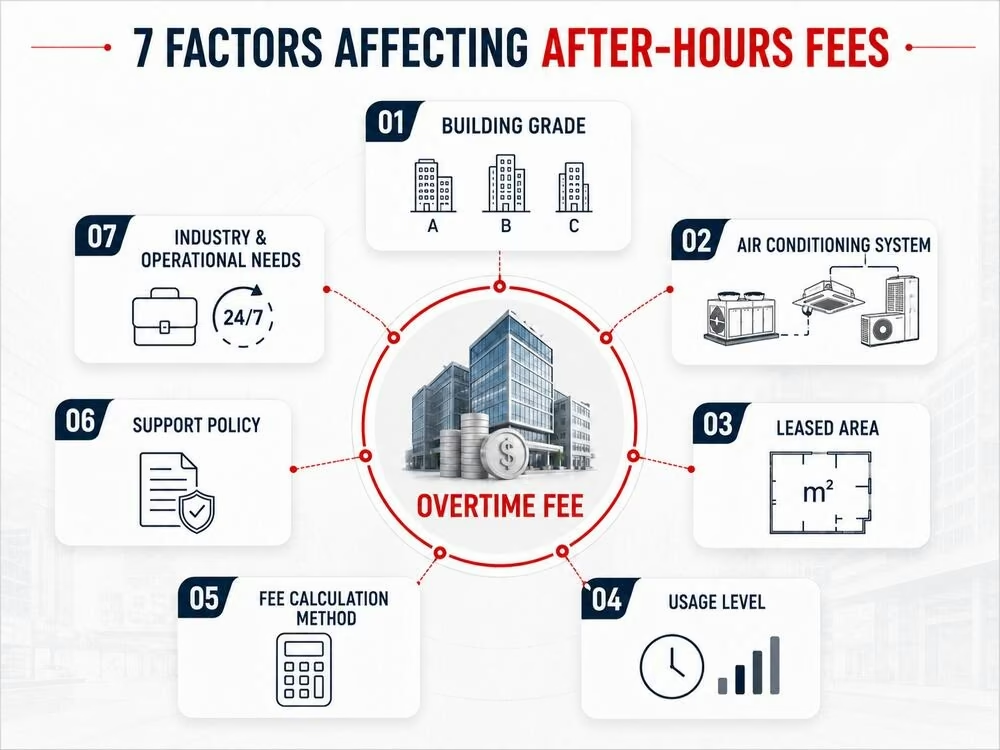
The overtime fee varies between businesses and buildings due to seven main factors: building grade, type of air-conditioning system, leased area, frequency of overtime use, the building’s calculation method, available support policies, and the business’s industry and operational requirements. Understanding these factors helps businesses estimate costs accurately and identify areas open to negotiation.
Building grade (A/B/C)
Building grade is the most influential factor. Grade A buildings have higher system operating costs – central air-conditioning, security, and on-call technical staff – so overtime fees are generally higher than in Grade B and C buildings. Conversely, Grade C buildings have simpler operations, and some offer more flexible overtime arrangements.
Type of air-conditioning system (central vs. individual VRV)
The type of air-conditioning system determines whether fees arise “automatically.” Buildings with central AC (chiller/FCU) charge a fee as soon as the system runs outside standard hours, because it cannot be separated by small zone. In contrast, buildings with VRV/VRF or zone-based local AC allow only the required area to be activated, resulting in lower and more flexible overtime costs.
Leased area
For buildings that charge by m², leased area is directly proportional to overtime fees – the larger the area, the higher the cost per hour. Some buildings also apply tiered unit rates by area size, so businesses leasing large floors should account carefully for this when budgeting.
Frequency of overtime use
The frequency and duration of overtime use directly affects the total fee. A business that works late a few hours per week incurs very different costs from one that operates outside standard hours every day. When overtime use is high and consistent, per-hour billing is typically more expensive than a fixed-rate arrangement.
The building’s calculation method
The same overtime requirement can result in very different totals depending on the calculation method (per private office, per area, or per FCU). Businesses that use only part of their space benefit from FCU-based billing, whereas area-based billing applies to the entire leased floor. The calculation method should therefore be matched to actual usage patterns before signing the lease.
Available support policies
The building’s existing policies determine the actual fee a business pays. Some buildings waive the fee if only lighting and power outlets are used without activating the AC, allow installation of a separate electricity meter, or offer a flat monthly overtime package. Businesses should ask about these policies during the building inspection phase.
Industry and operational requirements
The nature of the business shapes its overtime needs and therefore its overtime costs. Industries such as call centers, IT and technology companies serving multiple time zones, logistics firms, and finance companies during year-end closing typically require extended or 24/7 hours. Businesses with high overtime requirements should prioritize selecting a building and calculation method that suits their operations from the outset to optimize long-term costs.
How to include overtime fee clauses in a lease contract
To avoid disputes and unexpected costs, businesses should stipulate overtime fees clearly in the lease contract or service annexe (SLA) rather than relying on verbal agreements. The core items to address are: the free-use hours, the calculation method, the unit rate, the registration process, and the conditions for adjustment.
- Standard working hours (free of charge). Specify the fee-free hours by weekday and Saturday to establish a clear starting point for overtime billing.
- Calculation method and overtime unit rate. State which method the building applies (per private office, per area, or per FCU) and the corresponding unit rate, to avoid rates that fluctuate at management’s discretion.
- Rates for weekdays, weekends, and public holidays. Separate rates for each time category should be stated clearly, as weekend and public holiday rates are typically higher than weekday rates.
- Minimum billing duration and rounding rules. Specify the minimum registered duration per session – for example, a minimum of 2 hours – and the rounding method for partial hours to avoid unexpected charges.
- Registration process and advance notice deadline. State the registration format, notice period, and point of contact so both parties agree on their respective responsibilities.
- Unit rate adjustment mechanism. Define the conditions and limits for increasing the overtime unit rate during the lease term to prevent sudden mid-tenancy price increases.
- Reconciliation and invoicing format. Agree on how actual hours are recorded, the reconciliation period, and whether a VAT invoice is issued for this charge.
The more detailed the overtime clause in the contract, the better positioned a business is to control its budget and reduce the risk of future disputes.
Tips for negotiating and optimizing overtime costs
Businesses can significantly reduce overtime costs by choosing the right calculation method, negotiating terms upfront, and optimizing actual operating practices.
- Negotiate to separate AC fees from lighting fees. Negotiate so that the overtime fee only applies when central air-conditioning is activated, while staying late to use lighting and power outlets is free. This prevents small overtime groups from incurring charges.
- Choose the calculation method that matches actual usage. Businesses that use only part of their space after hours should prioritize buildings that charge per FCU or per private office rather than by total leased area.
- Negotiate a flat monthly overtime package. Businesses with a large, consistent overtime headcount should negotiate a fixed monthly rate, which is typically cheaper than per-hour billing.
- Consider installing local AC units for specific departments. For departments that regularly work late – such as IT, operations, or sales – it may be worth negotiating the installation of a standalone air-conditioning unit billed via a separate electricity meter.
- Register early and follow the correct process. Advance registration per building regulations generally results in a lower fee than unplanned use and enables accurate budget planning.
- Negotiate to lock in the unit rate for the lease term. Fix the overtime unit rate and the permitted adjustment range in the contract to avoid mid-tenancy price increases.
- Review overtime policies before selecting a building. Compare free-use hours, calculation methods, and support arrangements between buildings during the inspection phase, rather than discovering the costs after signing.
The optimal fee level depends on each business’s industry and overtime frequency, so conducting due diligence and negotiating upfront is the most effective way to control this cost. RSQUARE helps businesses survey and compare overtime policies across buildings, providing free advisory services for office tenants in Ho Chi Minh City and Hanoi.
Frequently asked questions about overtime fees in office leases
The following addresses the most common questions businesses have about overtime fees in office leases.
Does an office with its own electricity meter still have to pay overtime fees?
Usually not in the conventional sense, though a small service charge may still apply. When an office has its own electricity sub-meter – typically in a Grade C building or an office with local air-conditioning – the business pays for actual electricity consumption based on the meter rather than an overtime fee. However, the building may still charge a service fee to maintain security, cleaning, and elevator operation outside standard hours.
How can overtime fees be minimized?
By choosing the right calculation method, negotiating terms upfront, and optimizing operating practices. Practical approaches include negotiating to pay only when the AC is activated, subscribing to a flat monthly package for frequent overtime use, or installing local AC units for departments that regularly work late. These approaches are described in detail in the negotiation and optimization tips section above.
Can a business use only part of its office space after hours?
Yes, if the building’s technical systems allow zone separation. In buildings with VRV/VRF air-conditioning or FCU-based billing, businesses can operate and pay only for the zone they need – for example, activating AC only in the meeting room. In contrast, buildings with central AC that cannot be separated by zone typically charge for the entire leased floor even if only part of it is in use.
Are overtime fees subject to VAT invoicing?
Yes, overtime fees are generally invoiced with VAT as a service charge. Since this is a service provided by building management, it is included on the invoice together with the rent or service fee and is subject to VAT as required by law. Businesses should request that the overtime fee be itemized separately on the invoice for accounting purposes.
Does failing to register in advance result in a higher overtime fee?
Possibly. Many buildings charge a higher rate or an additional surcharge for unplanned requests. Advance registration allows management to arrange technical and security staff, so it generally attracts a lower unit rate. Some buildings refuse to provide service without advance registration, or will only activate systems once confirmation is received.
Is it possible to negotiate a waiver of overtime fees in the contract?
Yes, but it depends on the negotiating position and building policy. Businesses leasing a large area or signing a long-term contract may be able to negotiate a number of free overtime hours per month, or a waiver of lighting-related charges with fees applying only when air-conditioning is activated. Buildings with central AC tend to be less flexible than those with zone-separated systems, so conducting due diligence and negotiating proactively from the outset is the most effective way to manage this cost.
Overtime fees are a variable cost, directly tied to how often a business operates outside standard business hours and each building’s own policy. Businesses should clarify the unit rate, the hours to which it applies, and the relevant contract terms before signing a lease, to avoid office leasing costs that fall outside the original budget once operations begin.
With a team well-versed in the office markets of Vietnam’s two major economic hubs, RSQUARE offers office for lease in Hanoi and office for lease in Ho Chi Minh City services, helping businesses review operating-cost clauses — including overtime fees — in detail before making a leasing decision. Contact RSQUARE for advice on an office leasing plan suited to your budget and operating model.