Renting an office requires a business to prepare the right legal documents and follow a strict procedure, from inspecting the premises to completing the registration of its head office address. The lease dossier consists of three groups: documents proving the landlord’s right to lease the building, the tenant’s legal entity documents, and supplementary documents for FDI enterprises. The process of preparing the lease dossier goes through 6 steps, from conducting a legal review of the building to registering the head office address. Before signing, you need to carefully review seven groups of contract clauses, confirm the conditions for registering a business at the leased address, and check the conditions under which rental costs can be treated as deductible expenses.
What documents are required in an office lease dossier?
The office lease dossier consists of three groups of documents: legal documents from the building owner, legal entity documents from the leasing business, and supplementary documents for foreign direct investment (FDI) enterprises. The building owner is responsible for proving legal ownership and the lawful right to lease, while the tenant proves its legal entity status and signing authority. FDI enterprises additionally prepare documents on their investment status. These three groups of documents determine whether the lease contract is valid and whether the leased address is eligible for headquarters registration.
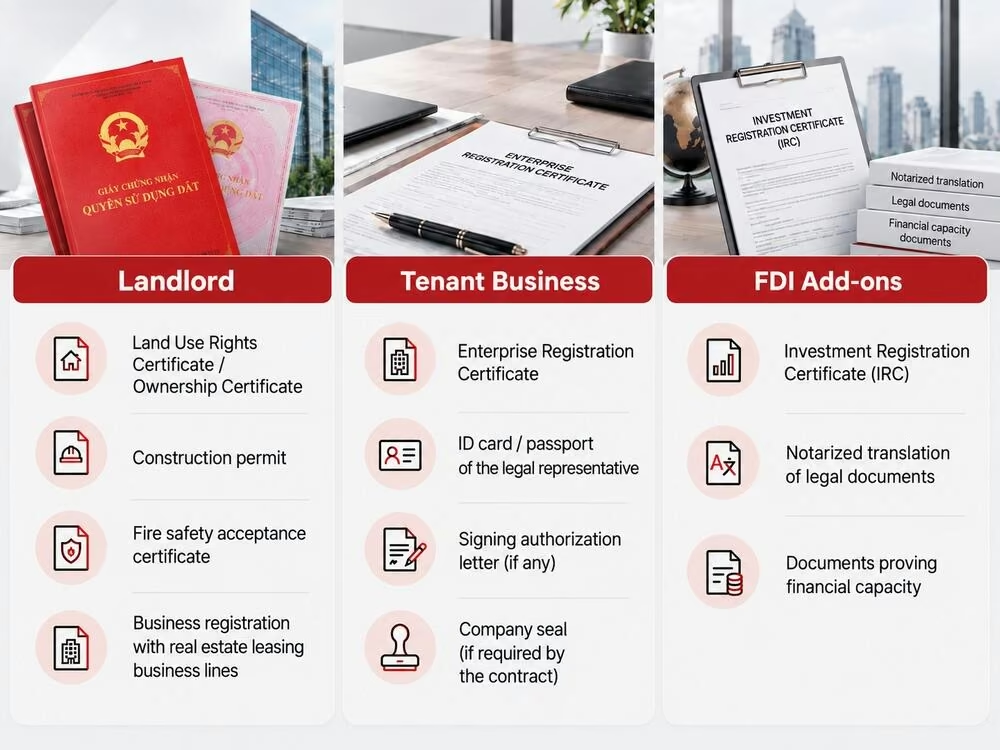
| Lessor | Leasing Business | Additional for FDI |
| Red book/pink book | Enterprise registration certificate | Investment registration certificate (IRC) |
| Construction permit | ID card/passport of the legal representative | Notarized translation of legal documents |
| Fire safety acceptance | Power of attorney to sign (if any) | Financial capacity documents |
| Business registration with real estate leasing sector | Company seal (if required by the contract) |
Legal documents from the building owner
The building owner provides documents proving legal ownership and the right to lease the premises. This is the group of documents the tenant needs to review carefully, as it determines whether the contract is legally valid and whether the premises are eligible for headquarters registration.
- Land use right and property ownership certificate (red book or pink book) – proves ownership and the right to lease the premises.
- Construction permit – confirms the building was legally constructed for office use.
- Acceptance document confirming fire prevention and fighting (PCCC) conditions are met – proves the building meets fire safety requirements.
- Enterprise registration certificate of the investor, with a real estate leasing business line – confirms the building owner is licensed to conduct leasing operations.
- Contract or power of attorney if the signatory is not the owner; cooperation agreement or introduction letter if signing through an operating unit or broker.
When working with a building for the first time, you should request to compare the originals or notarized copies of the above documents. This verification step helps confirm the lease right and prevent disputes from arising later.
Legal documents from the leasing business
The leasing business prepares documents proving its legal entity status and authority to sign the contract. This dossier helps the building owner confirm that the tenant is a valid legal entity and that the signatory has sufficient representative authority.
- Enterprise registration certificate – proves legal entity status when signing the contract.
- ID card or passport of the legal representative – used for verification at signing. If the signatory is not the legal representative, a power of attorney and the ID card of the authorized person must be included.
- Contract signing request or approval document – applicable to large enterprises with strict legal and accounting control processes.
- Company seal – if the contract requires sealing to complete the procedure.
A business in the process of being established can lease an office in advance and use the lease contract to register its headquarters address, provided the building is legally licensed for office leasing to avoid the registration dossier being rejected.
Supplementary documents for FDI enterprises when leasing an office
Foreign direct investment (FDI) enterprises prepare a number of additional documents beyond the standard legal entity dossier. This is a group of documents RSQUARE regularly assists foreign tenants with, especially Korean enterprises, so you should understand it clearly in order to prepare in advance.
- Investment registration certificate (IRC) – proves legal investment status in Vietnam.
- Notarized translations of related legal documents, with consular legalization if the documents were issued abroad.
- Financial capacity documents – some building owners require these to assess the tenant’s ability to pay.
For businesses that have not yet completed their investment procedures, the lease contract is often used as a basis to submit along with the IRC application dossier – so the term and address information on the contract need to be consistent with the registration dossier.
What steps does the office leasing procedure include?
The office leasing process consists of 6 steps in sequence: building survey and legal due diligence, lease term negotiation, holding deposit, contract signing, premises handover and fit-out, and registration of the head office address. The first three steps belong to the pre-contract phase: inspecting the premises, agreeing on the lease terms, and reserving the space. The last three take place after signing: taking over the premises, completing the interior fit-out, and formalizing the head office address with the relevant government authorities.
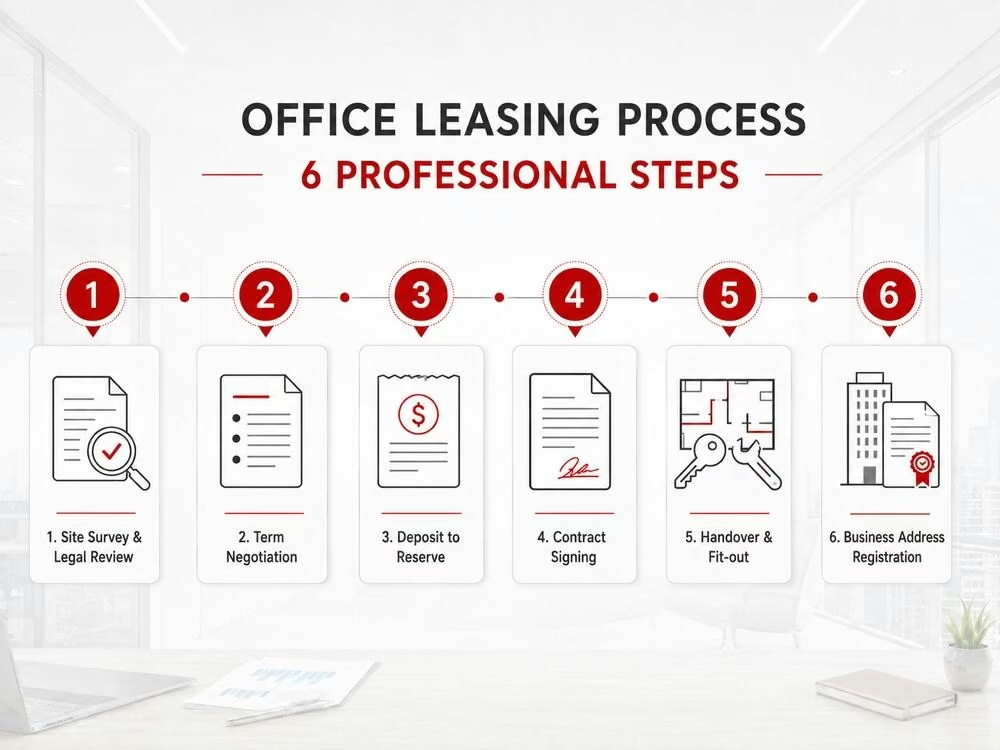
Step 1: Survey and legal check of the building
The first step is to verify the building’s legal status before negotiating price, as this is the foundation for the lease contract not being invalidated or generating risks later. You need to check the following factors:
- Whether the building has a legal ownership certificate.
- Whether it has a construction permit for commercial/office use.
- Whether it has passed acceptance testing and has a document confirming fire safety (PCCC) conditions are met.
- Whether the building is licensed to be leased as a business registration location.
The last factor is the most important for businesses that need to register a headquarters. Premises without commercial function status can cause the business registration dossier to be rejected, even if the rental price and location are both suitable.
Step 2: Negotiate lease terms
Once the legal requirements are met, the two parties negotiate the main terms of the lease contract. The items that need to be agreed on include:
- Rental rate, management fee, and VAT.
- Lease term and renewal conditions.
- Area and handover condition – the rate needs to be clearly finalized as based on GFA or NLA at this step.
- After-hours fees, if any.
- Free fit-out period.
- Regulations on returning the premises at the end of the contract.
If the tenant is a foreign enterprise, the two parties should agree to draft a bilingual contract with a clear floor plan appendix attached. This is an important link to keep the lease dossier consistent with the investment procedures of FDI enterprises.
Step 3: Pay a holding deposit
A holding deposit confirms the tenant’s good faith and reserves the premises while the two parties finalize the official contract. This deposit is usually accompanied by a memorandum of understanding or letter of intent (MOU/LOI), which clearly states the conditions for refunding or forfeiting the deposit if either party changes its decision.
You need to distinguish between a holding deposit and a contract security deposit. The holding deposit is paid before signing, and is usually deducted or carried forward into the security deposit once the official contract takes effect.
Step 4: Sign the lease contract
The two parties sign the official lease contract together with its appendices after agreeing on all terms. A complete contract package usually includes the main contract, a premises handover appendix, building regulations, and a floor plan. At the time of signing, the tenant pays the security deposit – commonly 2 to 3 months’ rent – and the two parties determine the effective date of the contract.
An office lease contract is not required to be notarized under the 2015 Civil Code; the parties only notarize it if they mutually agree to do so to increase its legal value. This is explained in more detail in the FAQ section below.
Step 5: Hand over the premises and fit-out construction
After signing, the lessor hands over the premises together with an acceptance record documenting the current condition before the business begins interior fit-out. At this step, you need to:
- Check the actual condition of the premises – flooring, ceiling, electrical system, air conditioning, and fire safety.
- Prepare a handover record clearly stating the items, condition, and accompanying equipment, if any.
- Determine the reference date for calculating when rental charges begin.
At the same time, you need to understand the free fit-out period and the building’s construction regulations – working hours, deposit levels, and approved contractors. A complete acceptance record helps the business reduce the risk of disputes when returning the premises at the end of the term.
Step 6: Register the headquarters address with state authorities
Once the legal premises are in place, the business registers or updates its headquarters address with the business registration authority. The lease contract serves as the basis for proving the right to use the address. The dossier is submitted at the Business Registration Office and processed within about 3 working days from when the authority receives a valid dossier. The detailed procedure is presented in the section on business registration at a leased office address below.
Which contract terms need to be carefully checked?
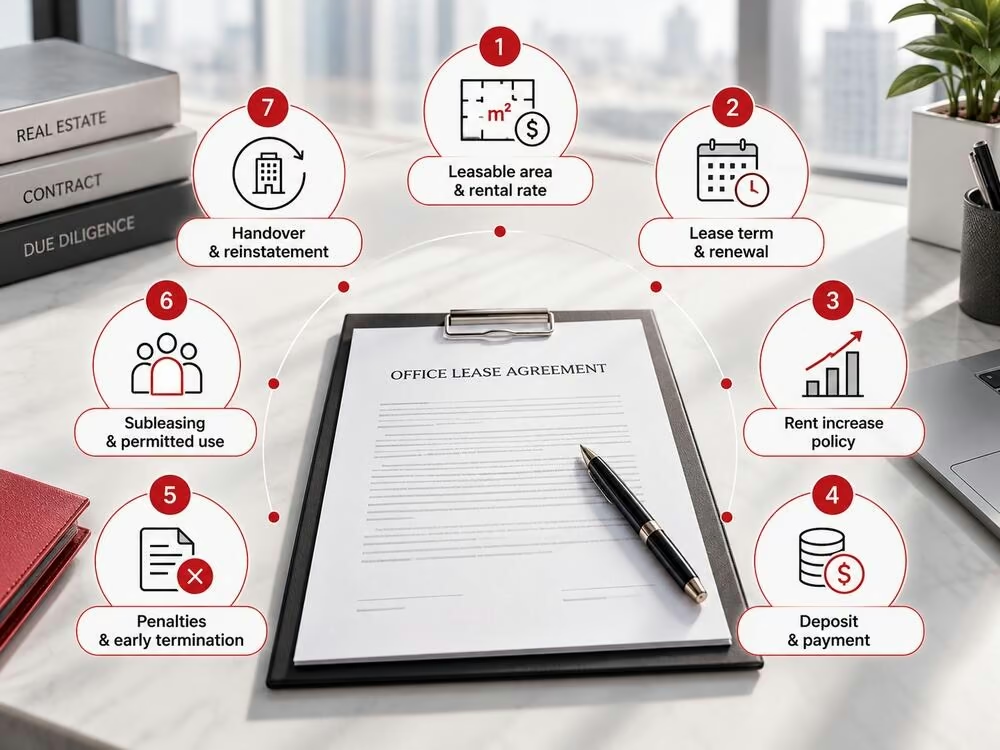
An office lease contract has seven groups of terms you need to check carefully before signing: how area and rate are calculated, the term and renewal policy, the price escalation policy, deposit and payment conditions, penalty and early termination clauses, the sublease policy, and reinstatement responsibilities. These are the groups of terms that directly affect the actual cost and legal risk of the business throughout the lease period.
How lease area and rate are calculated (GFA vs NLA)
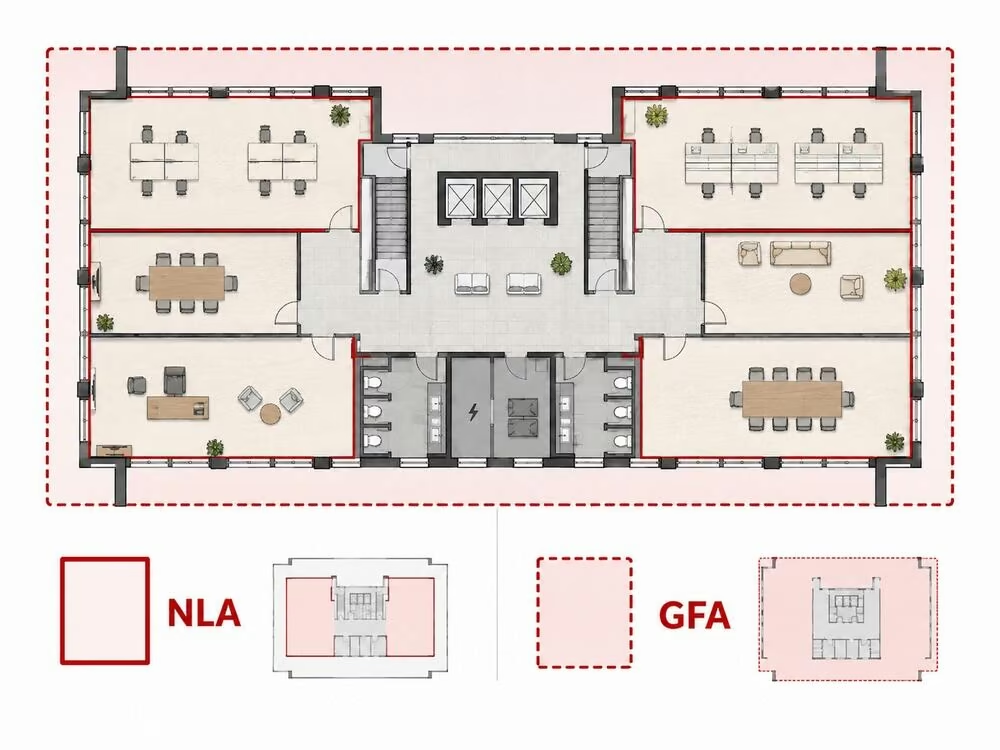
Leased area is calculated according to two different standards, which directly affect the actual cost per square meter used. GFA (Gross Floor Area) is the total floor area, including shared areas such as corridors, elevator lobbies, and mechanical areas. NLA (Net Leasable Area) is the net leased area – the area the business actually uses.
| Criteria | GFA | NLA |
| Includes | Usable area + shared area | Actual usable area only |
| Figure | Larger | Smaller |
| Meaning for the tenant | Lower rate but pays for shared area too | Accurately reflects the area used |
The ratio between the two standards is called the efficiency ratio. When the rate is quoted on GFA, the actual cost per NLA square meter will be higher than the figure shown in the quote. You need to clearly determine which area the rate is based on in order to compare accurately between buildings. How GFA and NLA are calculated is analyzed in detail in a separate article on office leasing area.
Lease term and renewal policy
Common office lease terms range from 2 to 5 years, depending on the size of the business and the level of interior investment. Contracts usually include an option-to-renew clause, allowing the tenant to continue leasing upon expiry, provided notice is given a certain period in advance.
You need to check three points: the notice period for renewal before the contract ends, the mechanism for setting the rental price for the renewal term, and any accompanying binding conditions. A clear renewal clause helps the business plan proactively and avoid being caught off guard on price when re-signing.
Rent escalation policy over time
Most long-term lease contracts include an escalation clause applied on a periodic basis. The increase is usually fixed at a percentage rate per year, or adjusted according to a reference index. You need to clearly determine when the increase starts to apply and whether there is a cap on the increase.
The most important point is that the calculation formula must be clear in the contract. A vague escalation clause can cause the rental cost in the final years of the contract to far exceed the business’s initial budget.
Deposit and payment conditions
The security deposit in an office lease contract is usually 2 to 3 months’ rent, refunded at the end of the term after deducting any outstanding obligations. You need to clarify the following payment conditions:
- Rent payment cycle – monthly or quarterly.
- Payment currency and the conversion exchange rate if the rate is quoted in USD.
- Conditions and timing for refunding the deposit at the end of the contract.
- Penalties applicable when the tenant pays late.
The currency and exchange rate clause is especially important when the rental price is quoted in USD, as exchange rate fluctuations directly affect the actual cost paid in VND.
Penalty and early termination clauses
This clause stipulates the consequences when a party terminates the contract early. A tenant who terminates early usually forfeits the security deposit and may also face a penalty on the remaining rent, depending on the agreement. You need to check the notice period required before termination, the force majeure cases that are exempted, and the termination conditions applicable to each party.
The point that requires the most careful reading is the symmetry of the penalties. Many contracts impose heavy obligations on the tenant but lenient ones on the lessor, so you need to review this to balance the interests of both parties before signing.
Sublease and shared-space policy
This clause determines whether you are allowed to sublease or share the premises with another party. Many contracts allow sharing space with affiliated companies or members of the same group, but require prior written approval from the building owner.
You need to note the effect of this clause on headquarters registration. If a third party shares the premises to register a business address, the conditions and procedures need to be clearly confirmed with the building owner.
Repair and reinstatement responsibilities at the end of the contract
The reinstatement clause stipulates the obligation to restore the premises to their original condition (reinstatement) at the end of the contract. You need to clarify the boundary between what must be restored and what is accepted as fair wear and tear, to avoid disputes over dismantling costs at the end of the term.
In addition, the contract needs to allocate repair responsibilities between the two parties throughout the lease period, and how the interior and equipment being handed back will be handled. De-fitting costs should be budgeted for from the start, not discovered in the final month of the contract.
What is the procedure for business registration at a leased office address?
To use a leased office address as its headquarters, a business needs to ensure three conditions: the address is legally eligible to serve as headquarters, the dossier for registering or changing the headquarters address is prepared, and the dossier is submitted at the business registration authority. When changing the main headquarters address, the business must register the change of content on the Enterprise Registration Certificate within 10 days from the date of the change.
Conditions for a leased address to be used as company headquarters
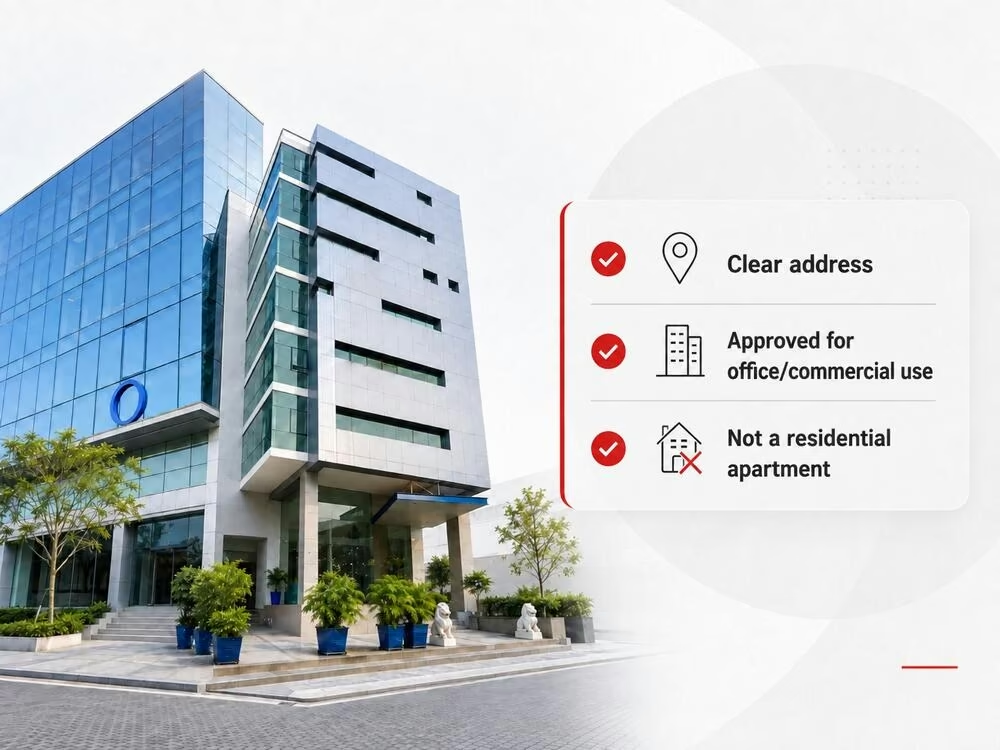
The leased address must be a valid, clearly defined commercial address to be used as the company headquarters. Specifically, the address needs to meet the following conditions:
- Clearly specify the house number, street name, ward/commune, and province/city.
- Belong to a building with office function that is licensed to be leased as a business location.
- Not be a residential apartment or collective housing unit intended for living purposes.
Under Housing Law No. 27/2023/QH15, apartments and collective housing units are not permitted to be used as a business’s headquarters address. This is why an office in a commercial building is the safe choice for headquarters registration – the address falls within the area licensed for business use under the construction permit, so the registration dossier is not rejected on the grounds of property type.
Dossier for registering/changing the headquarters address
The dossier for changing the headquarters address consists of documents proving the business’s valid decision to make the change. The basic dossier includes:
- Application form for registering a change to enterprise registration content – according to the current prescribed template.
- Resolution or decision on the headquarters address change, issued by the competent authority: the owner for a single-member limited liability company; the members’ council for a multi-member limited liability company or a partnership; the general meeting of shareholders for a joint-stock company.
- Meeting minutes corresponding to each type of business.
You need to note one important point: when moving the headquarters to a different district or province, the business must complete the procedure to finalize tax obligations at the old tax authority before submitting the address change dossier. This step extends the total processing time compared to moving within the same area.
Where to submit the dossier and processing time
The dossier is submitted at the Business Registration Office under the provincial Department of Finance where the new headquarters address is located. Processing time is within 3 working days from the date a valid dossier is received. Businesses can submit the dossier online through the national business registration portal. If additional procedures with the tax authority are required when moving to a different district/province, the total time may extend to 10–15 working days
Can office rental costs be counted as deductible expenses?
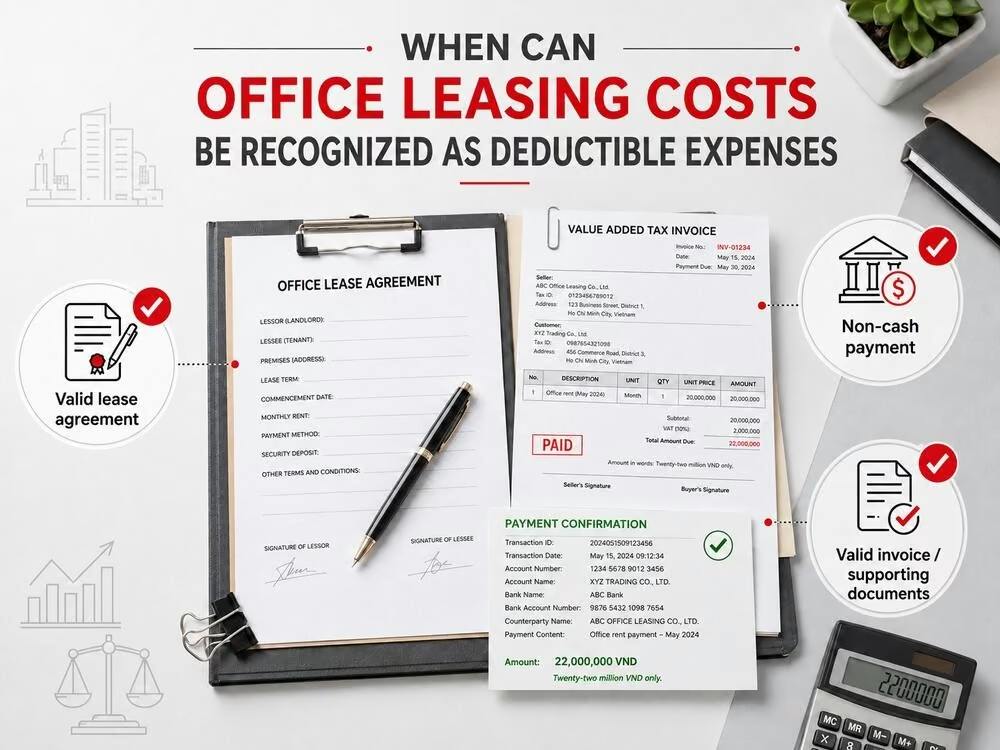
Yes – office rental costs are counted as deductible expenses for corporate income tax purposes, if three conditions are fully met: the expense serves production and business operations, there are complete and valid supporting documents, and payment is made by non-cash methods for expenses of VND 5 million or more. The specific dossier depends on whether the lessor is a business or an individual, and whether the individual’s rental revenue exceeds the taxable threshold.
Conditions for rental costs to be tax deductible
Office rental costs are deductible when the business gathers enough supporting documents proving the expense is genuine and serves the business. The conditions include:
- A valid lease contract, signed by both parties and clearly stating the purpose of leasing for office use.
- Non-cash payment documents for payments of VND 5 million or more, according to guidance applicable from 2026.
- Invoice or substitute documents depending on the lessor: a VAT invoice if the lessor is a business; a set of tax documents if the lessor is an individual.
When leasing from an individual, the business cannot deduct input VAT, because an individual lessor is not subject to issuing VAT invoices under regulations. In this case, the tax-payment-on-behalf document serves as the basis for proving the expense, without needing a VAT invoice from the individual.
Required dossier when the lessor is an individual with revenue above VND 1 billion/year
An individual lessor with total revenue above VND 1 billion/year incurs VAT and personal income tax obligations. The applicable tax rate is 10% of revenue – comprising 5% VAT and 5% personal income tax. Since the individual does not issue VAT invoices themselves, the leasing business gathers a dossier in place of an invoice:
- Lease contract clearly stating the rental price and the agreement on tax obligations.
- Rent payment documents made through a bank.
- Tax-payment-on-behalf documents – the state budget payment receipt for VAT and personal income tax, if the contract agrees that the business pays the tax on behalf of the individual.
When the business pays the tax on behalf of the individual, this must be clearly stated in the property lease contract, and the business does not need to prepare a declaration list. The tax-payment-on-behalf document is the most important basis for the expense to be recognized as a deductible expense.
Required dossier when the lessor is an individual with revenue of VND 1 billion/year or below
An individual lessor with total revenue of VND 1 billion/year or below is not required to pay VAT or personal income tax, and does not issue an invoice. In this case, the leasing business only needs a minimal dossier to recognize the expense:
- Office lease contract with valid signatures from both parties.
- Rent payment documents – non-cash payment if the expense is VND 5 million or more.
- Declaration list as prescribed when the individual directly declares tax.
Note that the VND 1 billion threshold is based on that individual’s total annual leasing revenue, not just the contract with your business alone. Even though no tax obligation arises, the individual lessor must still fulfill the obligation to declare revenue through self-declaration.
How to avoid risks when preparing office lease documents and procedures?
To avoid risks when leasing an office, a business needs to control two groups of issues: legal risks arising from the building side, and mistakes in the business’s own document preparation process. The first group lies in the due diligence stage before signing; the second lies in carefulness when completing paperwork. Controlling both well helps ensure the contract is valid and the leased address is eligible to serve as headquarters.
Common legal risks
Legal risks mainly come from the building’s legal status and the lessor’s right to lease. Common risks include:
- Leasing a building that has not passed fire safety acceptance – can affect operations and result in penalties if the building is subject to mandatory fire safety approval.
- The lessor does not have a legal right to lease – leads to an invalid contract, and the business loses its deposit and must relocate.
- The property is under dispute or mortgage – the tenant’s right to use the premises is threatened if the property is subject to enforcement action.
- The address is not eligible for headquarters registration – the business registration dossier is rejected even after the contract has been signed and paid.
Each of the above risks stems from skipping the initial legal check step. Requesting to fully verify the building’s documents before paying a deposit is the most effective way to prevent this.
Common mistakes when preparing documents
Besides risks from the building side, many issues arise from the tenant business’s own document preparation process. Common mistakes include:
- Missing power of attorney to sign the contract when the signatory is not the legal representative, putting the contract at risk of being invalidated.
- Information mismatch with the business registration – company name, tax code, or address that doesn’t match, causing problems when registering the headquarters.
- Not checking the GFA and NLA area ratio, resulting in paying for a larger area than what is actually used.
- Overlooking the reinstatement clause, causing end-of-term dismantling costs to exceed the budget.
Most of these mistakes can be avoided by reviewing the dossier alongside checking the contract before signing. For complex transactions or FDI enterprises, office leasing advice from a professional brokerage helps identify risk points early. RSQUARE assists tenants with the building’s legal review and completing the dossier throughout the leasing process.
Frequently asked questions about office lease documents and procedures
Is an office lease contract required to be notarized?
Not required. An office lease contract is not among the transaction types required to be notarized under the 2015 Civil Code, so the contract remains valid once both parties sign with proper authority. The parties only notarize it if they mutually agree to do so to increase its legal standing, typically applied to long-term or high-value contracts.
Does a virtual office need the same full lease dossier as a traditional office?
Not entirely the same. A virtual office uses a service contract together with an address confirmation document to register headquarters, in place of a physical premises lease contract. However, the conditions for a valid address still apply – the address must belong to a building with commercial function, not a residential apartment.
Can a newly established business lease an office before obtaining a business license?
Yes. The founding individual signs a deposit contract or a principle agreement first, then transfers it to the company once the Enterprise Registration Certificate has been obtained. The office lease contract is the basis for the business to register its headquarters address when submitting the establishment dossier.
Who is responsible for preparing the legal documents – the tenant or the lessor?
Each party prepares its own set of documents. The lessor provides documents proving ownership and the legal right to lease; the tenant provides documents proving its legal entity status and signing authority. To fully review both sides before signing, a business can use RSQUARE’s office leasing consultancy service to minimize legal risk.
Preparing complete legal documentation and understanding the leasing process helps businesses shorten negotiation time, avoid unexpected costs, and minimize legal risks when renting office space. Drawing on experience advising hundreds of domestic and international businesses, RSQUARE provides office leasing services in Hanoi and office leasing services in Ho Chi Minh City, supporting businesses from site survey and contract negotiation through to completing legal documentation — making the office leasing process fast and transparent.