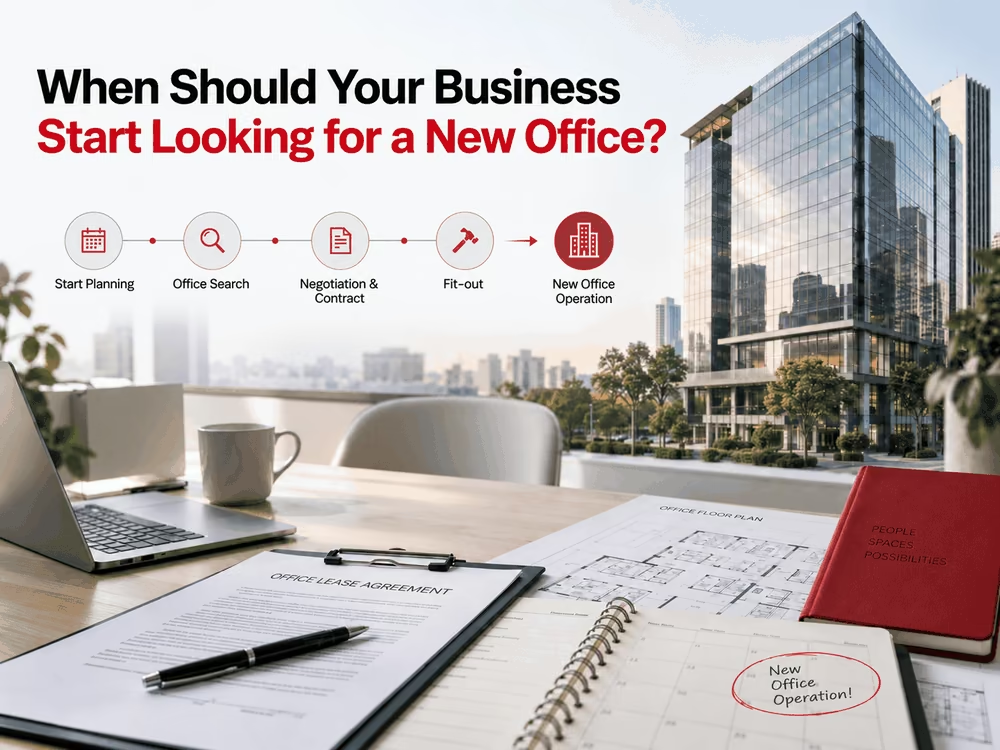
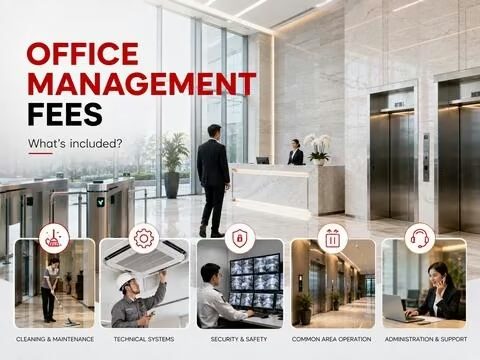
FDI companies leasing office space in Vietnam face distinct challenges compared to domestic businesses: no legal entity at the time contracts need to be signed, insufficient market data to benchmark rental prices, and office standards mandated by the parent company. This article examines how to select the right office type for each stage of business development, criteria for determining building grade and location that fit the business model, legal considerations when signing contracts without a legal entity, a complete cost structure to budget for, and the role of a brokerage firm throughout the process.
What criteria should FDI companies use to select an office?
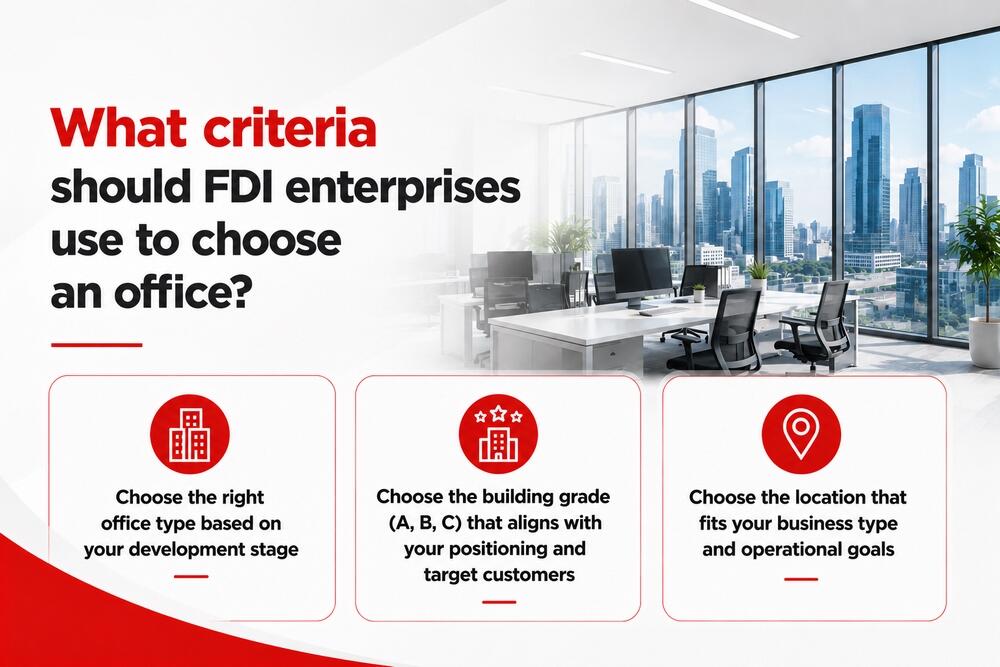
FDI companies should evaluate office space based on three closely linked criteria for choosing office: the office type that matches their current stage of development, the building grade that accurately reflects their brand positioning and target clients, and a location suited to their specific business model. These three criteria do not exist in isolation — a company in the market exploration phase typically does not need a Grade A+ building in the most expensive location, while a company that is already established and regularly hosts international partners needs to invest appropriately across all three factors to maintain brand image.
Selecting office type by stage of development
Each stage of an FDI company’s development in Vietnam calls for a different type of office, depending on the certainty of the business plan and the projected headcount.
| Stage | Headcount | Suitable office type | Commitment duration | Key risk |
| Exploration & Setup | 1–5 people | Virtual office or serviced office | Month-to-month or under 1 year | No formal legal entity yet; difficult to sign long-term contracts under a Vietnamese company name |
| Early Operations | 5–20 people | Serviced office or coworking space | 1–2 years | Higher cost per person than traditional offices if maintained over the long term |
| Growth & Stabilisation | 20–50 people | Traditional office, mid-sized | 3–5 years | Long-term commitment while headcount plans may still shift in response to business conditions |
| Scale-Up | 50+ people | Traditional office, large space or entire floor | 5 years or more | High fit-out investment; need to budget space for further growth |
FDI companies entering Vietnam should avoid committing to long-term contracts during the exploration phase, as business plans at this stage remain heavily dependent on actual market research outcomes. Transitioning gradually from serviced offices to traditional offices once headcount has stabilised allows companies to optimise costs without taking on long-term commitment risk when the plan is still uncertain.
Selecting building grade (A, B, C) by positioning and target clients
Building grade generates real commercial value only when a company regularly hosts clients or partners on-site. FDI companies operating as back-offices, shared service centres, or production facilities — where clients rarely visit — gain almost no proportional commercial benefit from paying a premium for a Grade A+ building in a prime location.
Conversely, companies in finance, consulting, or legal services — where the office’s image directly affects credibility with partners — need to invest appropriately in building grade so that the asset performs its intended role.
How client visit frequency influences building grade selection:
| Business scenario | Frequency of client visits | Grade typically selected | What is actually being purchased | Risk |
| Representative office, frequent partner meetings | High (weekly) | A or A+ | Brand credibility, first impression with partners | High rental cost but not cost-efficient if headcount is small |
| Operational HQ, partners visit periodically | Medium (monthly) | A or B | Balance between image and operating costs | Easy to misjudge if the “just enough” threshold for each client type is not clearly defined |
| Back-office, customer service centre | Low (rarely) | B or C | Efficient workspace, cost savings | Paying a premium for a higher-grade building without gaining proportional commercial value |
| Factory, production management office | Very low or nearly none | C or office within industrial park | Proximity to factory, low operating costs | Not relevant to traditional office building grade |
The cost gap between building grades differs markedly between the two markets. In Ho Chi Minh City, Grade A+ is approximately 25% more expensive than Grade A, and Grade A runs up to 60% more expensive than Grade B. In Hanoi, the gaps are wider: A+ is around 33% above A, A is around 76% above B, and B is around 70% above C. The step between Grade A and Grade B is the most notable price jump in both markets.
FDI companies weighing Grade A against Grade B should carefully assess whether this cost difference is proportional to the commercial value gained — particularly when client visit frequency is medium to low.
Some FDI companies still opt for Grade A despite infrequent client visits because their parent company enforces global office standards — driven by corporate brand policy or mandatory ESG requirements, not by commercial performance in Vietnam. In such cases, companies should discuss the actual cost differential candidly with the parent company to build a basis for budget negotiation.
Companies should also request specific information from the landlord about the property management operator, green certifications, and actual MEP systems, rather than relying solely on the grade stated in the listing — as some buildings self-classify as Grade A without fully meeting the actual criteria.
Selecting location by business type and operational objectives
The right office location depends on clearly identifying who visits the office most often — clients, partners, or internal staff only. Each business type has different location needs, and choosing the wrong location can result in a company paying a premium for an advantage it does not actually use.
| Business type | Who visits the office most often | Suitable location | Drawbacks |
| Finance, consulting, law firms, investment funds | Partners, clients, investors | CBD (central business district), key corridors such as Nguyen Hue, Le Duan, Dong Khoi | High rental cost; requires a significant budget to sustain long-term |
| Trade, technology, B2B services | Periodic partners, recruitment candidates | Near-CBD or areas with strong transport infrastructure | Requires balancing brand image and cost; easy to misjudge if the “just enough” threshold is not clearly defined |
| Manufacturing, management offices | Internal staff, transport/logistics partners | Near industrial zones, factories, or transport corridors linking ports/airports | Far from the city centre; difficult to attract office staff if the location is too isolated from residential areas |
| Back-office, customer service centres | Primarily internal staff; external visitors rare | Suburban or near-central districts; prioritise lower costs | May affect talent attraction if public transport connections are poor |
FDI companies should avoid applying a single location standard across all of their operations in Vietnam. A group with both a finance division and a customer service centre, for example, does not necessarily need to place both in the same central location — separating them by operational function helps optimise the budget while ensuring that the client-facing division has an appropriate address.
When evaluating locations, companies should cross-reference actual commute time data for key staff and partners rather than relying solely on geographic distance to the city centre on a map. A location that appears close to the centre in distance but is regularly congested during peak hours may be less effective than a location that is farther away but better connected by transport.
What legal and contractual considerations should FDI companies keep in mind when leasing office space?
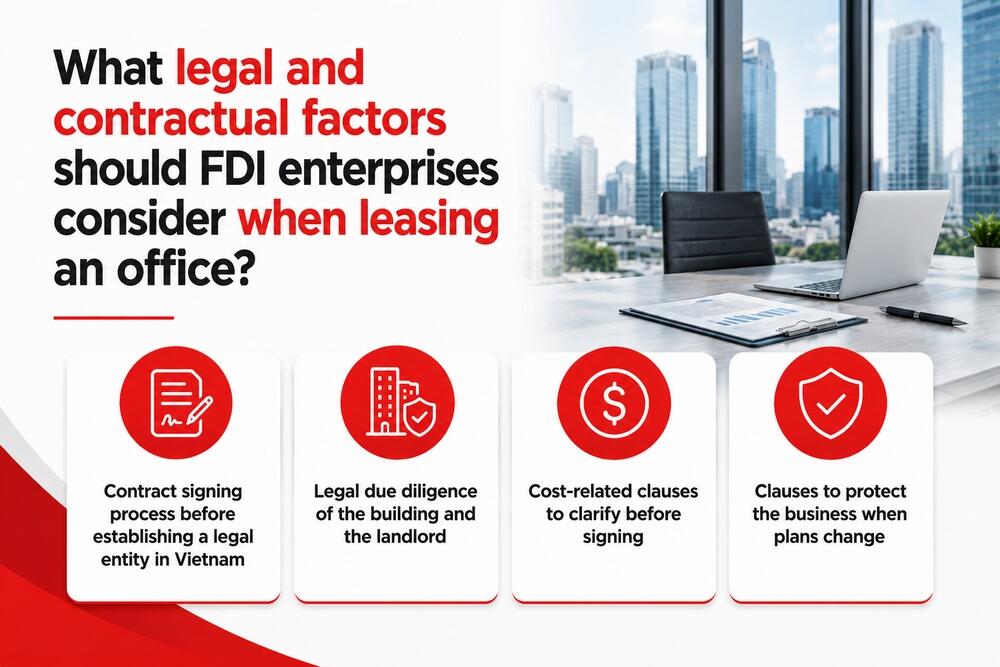
FDI companies face higher legal risks than domestic businesses when leasing office space in Vietnam, primarily due to the time gap between when a premises is needed and when the entity establishment process is complete. The four groups of legal and contractual issues below require careful handling before signing.
Contract signing sequence when no legal entity yet exists in Vietnam
Many FDI companies need an office address to complete investment registration and entity establishment procedures, but do not yet have a legal entity to sign the lease under — a common circular problem in the early stage.
- Sign a Memorandum of Understanding (MOU) or deposit agreement to reserve the space: a representative office or individual representative can sign a preliminary agreement with the building owner, then transfer the rights and obligations to the formal legal entity once registration is complete.
- Use an existing representative office (if the parent company already has a representative office in Vietnam) to sign as the contracting party on a temporary basis during the transition period.
- Contract assignment clause: the preliminary agreement should clearly state that the tenancy rights will be transferred to the formal legal entity as soon as the business registration certificate is issued, to avoid disputes over the contracting party later.
- Validity period of the temporary agreement: should be limited to the expected timeframe for completing the legal process — typically 3–6 months — to avoid being locked in if entity establishment takes longer than anticipated.
Legal due diligence on the building and the landlord
Before signing a formal lease, FDI companies need to conduct due diligence on the following legal factors to avoid disputes over usage rights:
- The landlord’s land use rights certificate and building ownership certificate, confirming that the signatory has the legal authority to enter into the contract
- The building permit and completion certificate, confirming the structure was built and inspected in accordance with regulations
- A valid fire prevention and firefighting certificate (PCCC), especially important for FDI companies required to comply with the parent company’s strict safety standards
- The current legal status of the building (not subject to active disputes, mortgage, or clearance under urban planning)
Cost clauses to clarify before signing
The lease agreement must clearly specify the following cost terms to prevent disputes during the tenancy:
- Whether the quoted rent includes or excludes management fees and VAT
- The payment currency (VND or USD) and the applicable exchange rate if the contract is denominated in USD but paid in VND
- The cycle and rate of periodic rent increases, with the calculation formula stated explicitly rather than left as a general “subject to negotiation”
- The conditions and timeline for deposit refund upon lease expiry
- Responsibility for repair and maintenance costs between the tenant and the landlord, specified by individual item category
Protective clauses for when business plans change
FDI companies often cannot accurately predict their pace of growth in the Vietnamese market in the early years, so the lease should include flexible clauses to reduce risk when business plans shift:
- Break clause: allows the company to terminate the lease early for a pre-agreed penalty, rather than being bound to the full lease term if the business plan does not proceed as expected
- Expansion or contraction clause: the right of first refusal to lease additional adjacent space when the business grows, or the right to surrender part of the space if headcount decreases
- Force majeure clause: protects the company in situations beyond its control, such as natural disasters, pandemics, or changes in foreign investment policy that affect business operations
- Intra-group lease assignment clause: permits the lease to be transferred between entities within the same group in the event of a restructuring, avoiding the need to renegotiate from scratch
FDI companies should engage an independent lawyer or legal advisor to review the full contract before signing — particularly the penalty and termination clauses, which are the two groups of provisions that most commonly give rise to disputes in commercial office leasing practice in Vietnam.
What costs does office leasing involve for FDI companies?
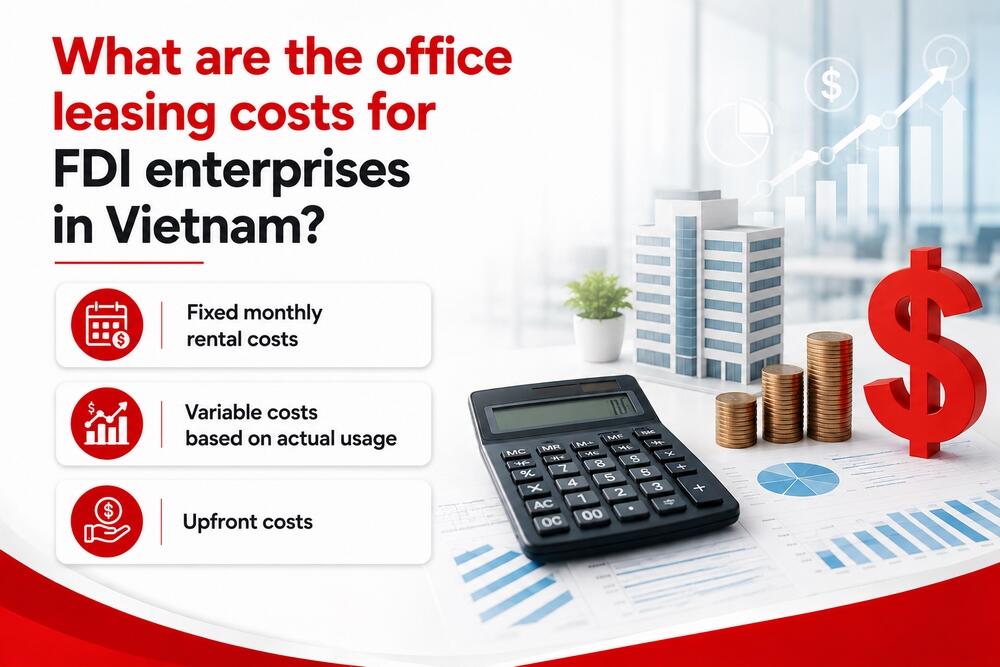
Office leasing costs for FDI companies fall into three groups: fixed monthly costs, variable costs based on actual usage, and upfront costs. Companies should budget for all three groups in full, rather than focusing solely on the unit rate quoted in the initial price list.
Fixed monthly costs
- Office rent: calculated in USD/m²/month or VND/m²/month, typically paid quarterly or annually
- Building management fee: covers operating costs for common areas, charged separately from rent, and varies by building grade
- Fixed parking fee: applies to buildings that charge parking on a monthly basis
Variable costs based on actual usage
- Electricity: charged based on actual consumption, measured by a separate meter
- Per-visit parking fee: applies when office visitors arrive infrequently
- After-hours air conditioning fee: incurred when the company needs to work outside standard building hours, common for FDI companies operating across different time zones from their parent company
- Meeting room or supplementary amenity fees: applies in buildings with meeting rooms available for hire by the hour
Upfront costs
- Security deposit: typically equivalent to 3–6 months’ rent, with a direct impact on the cash flow of a newly established entity
- Fit-out costs: partitions, electrical systems, internet infrastructure, furniture — the proportion depends on the handover condition (shell and core vs. fitted)
- Brokerage fee (if applicable): clarify from the outset which party is responsible for payment
- Notarisation and legal fees: lawyer review fees, notarisation fees if required by law
Unnecessary cost overruns to watch for
FDI companies should be cautious about unclear charges, such as “surcharge” fees for services they do not use. Request an itemised breakdown of every cost component before signing the contract, and clarify which items are mandatory and which are optional to avoid unbudgeted overruns.
Should FDI companies use a brokerage firm when leasing office space?
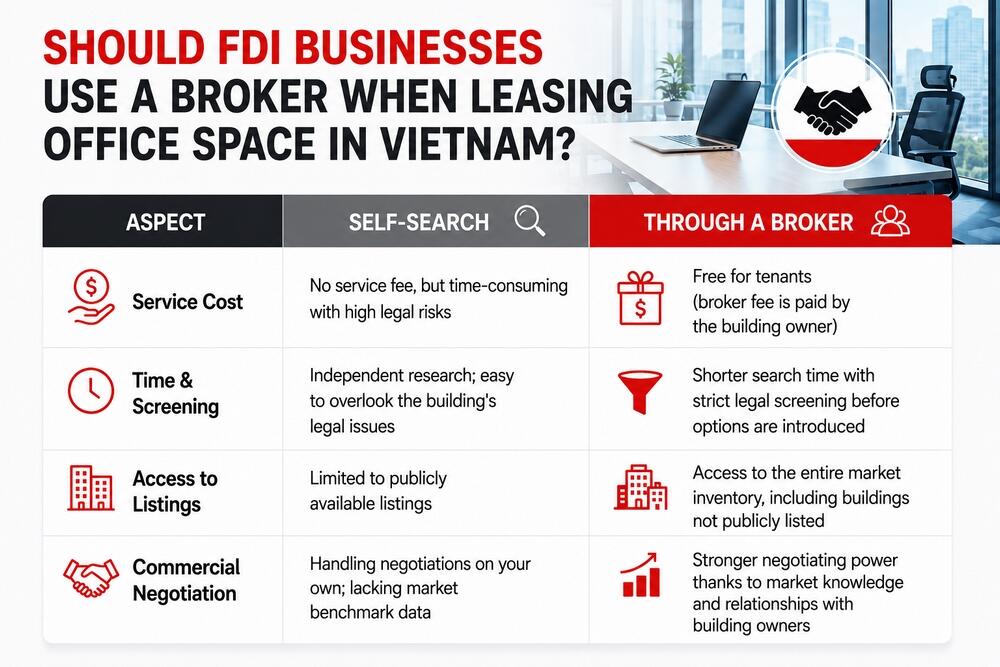
FDI companies typically face a greater information disadvantage than domestic businesses when searching for office space independently — they lack market data, are unfamiliar with legal procedures in Vietnam, and find it difficult to assess the transparency of landlords. Using a professional brokerage firm helps close this gap across four key dimensions.
| Dimension | Self-search | Via brokerage firm |
| Service cost | No fee but time-intensive, high legal risk | Free for the tenant (broker is paid by the building owner) |
| Time and screening | Self-sourced; legal issues with the building easy to overlook | Shorter search time; strict legal screening before any introduction is made |
| Inventory access | Limited to publicly listed options | Access to the full actual inventory, including buildings not publicly listed |
| Commercial negotiation | Self-negotiated; lacks market comparison data | Negotiation advantage through market pricing knowledge and landlord relationships |
The most important point for FDI companies is that brokerage services are typically free for the tenant, as the brokerage firm receives a commission from the building owner upon successful transaction. This means FDI companies gain access to the full market inventory, legal screening support, and a negotiation advantage at no additional cost.
Criteria for selecting the right brokerage firm for FDI companies
Four criteria to help FDI companies evaluate and choose a reliable brokerage partner:
- Experience with foreign clients: a firm that has worked with FDI companies understands the specific processes involved — from signing contracts before a legal entity exists, to explaining legal concepts in accessible language. Ask specifically how many FDI clients the firm has advised, rather than accepting general assurances.
- Multilingual support: fluent communication in English or the client’s native language ensures the company fully understands lease terms and avoids misunderstandings when negotiating with Vietnamese landlords.
- Legal transparency: a trustworthy firm proactively discloses unfavourable information such as disputes or encumbrances, rather than focusing solely on positive points to accelerate the transaction.
- Scale of property data under management: a broad and up-to-date database gives the company access to more options, including buildings not publicly listed.
Companies should interview at least 2–3 brokerage firms before making a decision, and compare how each one handles questions about legal risks — this is a more reliable indicator than initial advertising commitments.
Leasing office space in Vietnam is a multi-layered decision for FDI companies — one that extends beyond selecting a floor area and location, to encompass the stage of business development, brand positioning, legal structure in the absence of a local entity, and a complete cost picture. Evaluating these criteria accurately from the outset helps companies avoid legal risk and optimise their budget throughout their operations in a new market.
RSQUARE provides free office leasing in Ho Chi Minh City and office leasing in Hanoi consultation services with bilingual support in English, Korean, and Vietnamese, helping FDI companies access transparent commercial real estate data and complete the office leasing process safely and on schedule. Contact RSQUARE for advice tailored to your company’s development plan in Vietnam.