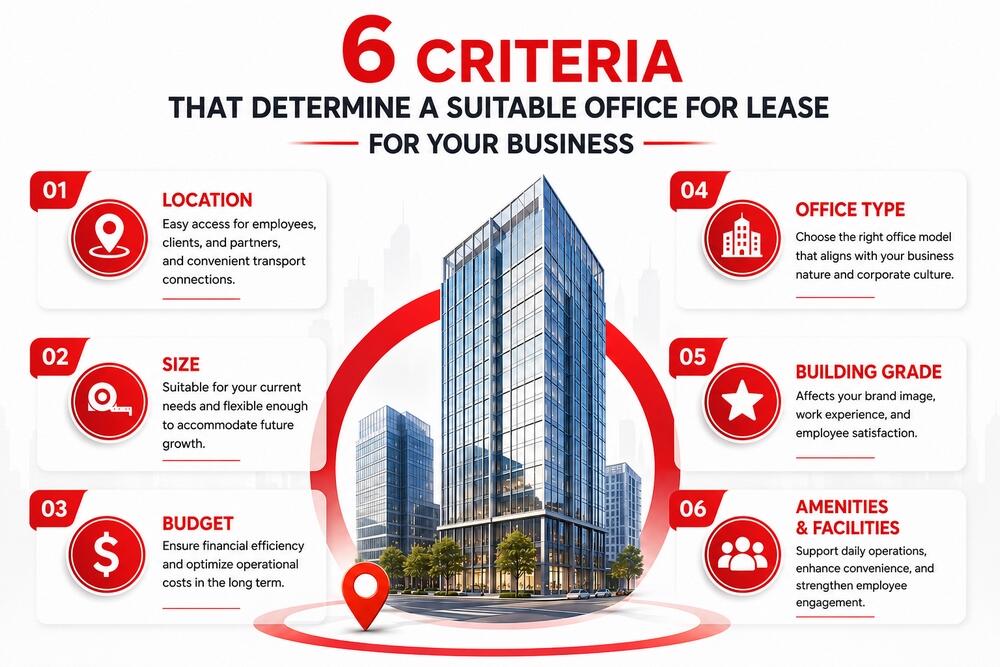
Six criteria that determine a suitable office for rent include location, area, budget, office type, building grade, and amenities. Businesses need to evaluate all six factors simultaneously rather than comparing rental prices alone, because a suitable office must balance operating costs, brand image, and the working experience of staff. Location and building grade directly affect a business’s credibility in the eyes of partners and clients, while area and budget determine the ability to operate stably without unplanned costs.
This article analyzes each criterion in detail: how to choose a location based on business objectives and transport connectivity, the formula for calculating area based on headcount and working model, how to build a complete rental budget that accounts for commonly overlooked fees, the characteristics of 5 popular office types, the A/B/C building grade standards based on location and mechanical and electrical systems, and the amenity groups to prioritize during site visits.
Office location
Office location determines three core factors for a business: brand image, connectivity with partners, and daily operating costs. Businesses should choose a location based on specific business objectives, not on general market trends.
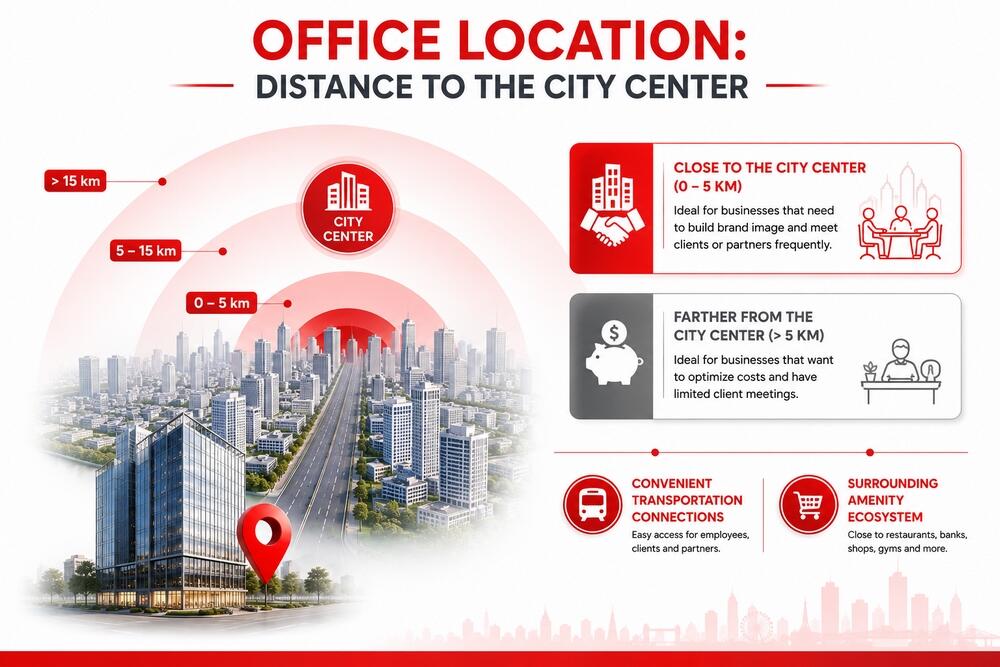
Distance to the city center plays different roles depending on each business’s strategy:
- Businesses that need to build brand image and meet partners frequently prioritize central District 1 streets such as Nguyen Hue, Le Duan, Dong Khoi, Ton Duc Thang, and Hai Ba Trung – where Grade A and A+ buildings are concentrated. This is a suitable choice for industries that place high value on brand image and credibility, such as finance and banking, law, management consulting, insurance, and multinational corporations establishing representative offices. A central location shortens travel time when meeting clients while also creating a professional impression from the office address itself.
- Businesses that need to optimize costs and rarely meet partners in person can choose peripheral areas or districts adjacent to the center such as District 3 (Nguyen Thi Minh Khai, Cach Mang Thang 8 areas), District 7 (Phu My Hung), Binh Thanh District, and Tan Binh District. These areas are suitable for information technology, IT outsourcing, call centers, back-office data processing, and e-commerce — industries that operate primarily internally or online and rarely need to host partners in person.
Convenient transport connectivity directly affects staff productivity and the experience of visiting clients. An office should be located near major road arteries, at a reasonable distance from metro lines (such as Metro Line 1 Ben Thanh – Suoi Tien), and easily accessible by both private and public transport. Businesses should also check peak-hour traffic conditions in the area before committing to a lease.
The surrounding amenity ecosystem helps retain staff and supports daily operations. Three important amenity groups to consider include: restaurants and eateries for lunch, banks and ATMs for quick transactions, and public or in-building parking. An area with a well-developed amenity ecosystem helps staff save commuting time outside working hours while also making it more convenient to host visiting clients or partners.
Office area
The appropriate office area depends on three factors: headcount, working model, and the need for dedicated functional spaces. Businesses should calculate area based on actual headcount data rather than applying a fixed figure to all types of businesses.
Determining area based on headcount and working model
Office area standards vary depending on the working model a business adopts:
- Fixed working model (staff have dedicated assigned seats): the common standard is 5–6 m² per person, including desk space, walkways, and personal storage. This model suits businesses with stable workflows and low staff turnover.
- Hybrid model (staff alternate between working at the office and remotely): area can be reduced by 20–30% compared to the fixed model by applying hot-desking. Businesses need to maintain a desk-to-headcount ratio that reflects the average number of days staff are present in the office each week.
Quick formula for calculating office area:
Required area = (Headcount × Area per person) + Functional space area
Example: a business with 50 staff applying a fixed model at 6 m² per person, requiring an additional 80 m² for meeting rooms and other functional areas, needs a total leased area of (50 × 6) + 80 = 380 m².
Area for functional spaces
Beyond the main working area, businesses need to allocate dedicated space for the following functional areas:
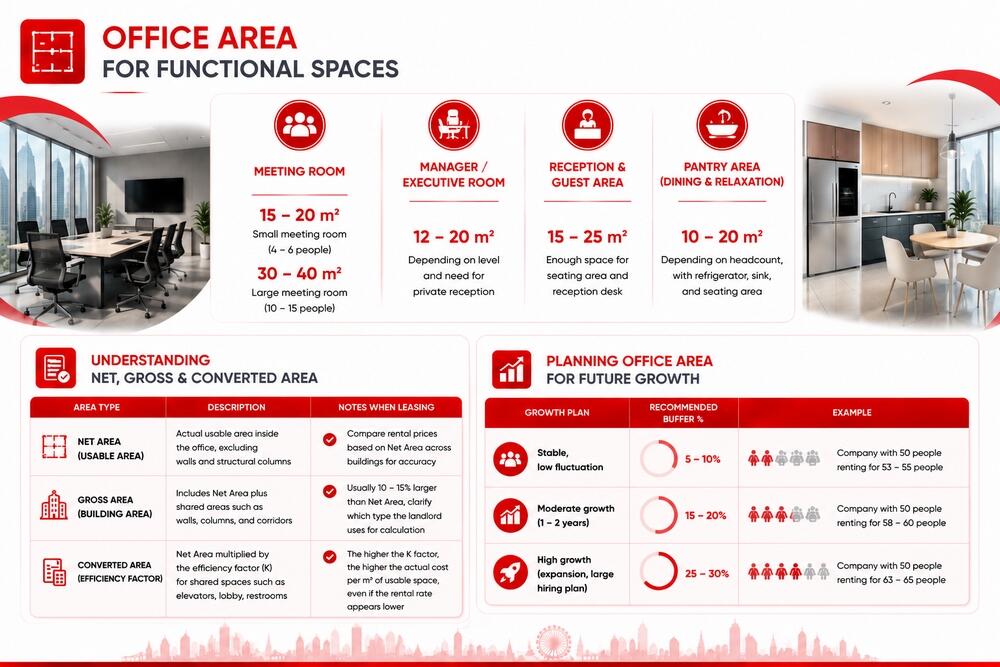
- Meeting rooms: minimum 15–20 m² for small meeting rooms (4–6 people), 30–40 m² for large meeting rooms (10–15 people)
- Director/Management office: typically 12–20 m² depending on seniority and private meeting needs
- Reception and guest waiting area: 15–25 m², with sufficient space for waiting chairs and a reception desk
- Pantry area (dining and rest): 10–20 m² depending on headcount, with space for a refrigerator, sink, and seating area
Distinguishing Net Area, Gross Area, and Converted Area
These three area types determine the actual amount a business pays when renting office space, even though all are expressed in m².
| Area Type | Characteristics | Note when leasing |
| Net Area (Usable Area) | Actual usable space inside the office, excluding enclosing walls and load-bearing columns | Compare rental prices by Net Area across buildings for the most accurate figure |
| Gross Area (Gross Floor Area) | Includes usable area plus walls, columns, and shared corridors | Typically 10–15% larger than Net Area; always clarify which unit type the landlord uses for pricing |
| Converted Area (K Factor) | Net Area multiplied by a load factor for shared spaces (elevators, lobbies, public restrooms) | The higher the K factor, the greater the actual cost per m² of usable space, even if the quoted unit price is low |
Allowing for expansion in area planning
Businesses should factor in a buffer area when signing long-term leases to avoid having to relocate when headcount grows.
| Growth Plan | Recommended buffer | Illustrative example |
| Stable, low change | 5–10% | A 50-person business leases space for 53–55 people |
| Moderate growth (next 1–2 years) | 15–20% | A 50-person business leases space for 58–60 people |
| Rapid growth (branch expansion, large-scale hiring) | 25–30% | A 50-person business leases space for 63–65 people |
Budget
The office rental budget extends beyond the quoted price per m² and includes numerous fees that arise throughout the operating period. Businesses need to calculate the full actual cost before comparing office options.
Formula for calculating total office rental cost:
Total rental cost = (Unit price × Leased area) + Management fee + Parking fee + VAT + Additional operating costs
Example: A business leases 500 m² of Grade B office at 25 USD/m²/month, with a management fee of 5 USD/m²/month, a fixed parking fee of 300 USD/month, and 10% VAT.
- Base rent = 25 × 500 = 12,500 USD
- Management fee = 5 × 500 = 2,500 USD
- Parking fee = 300 USD
- Subtotal before tax = 12,500 + 2,500 + 300 = 15,300 USD
- VAT (10%) = 1,530 USD
- Total monthly rental cost = 16,830 USD
Businesses should request a detailed breakdown of all fee items from the landlord before signing the lease, rather than relying solely on the advertised unit price.
Budgeting by building grade
Each building grade corresponds to a different budget range and level of amenities, helping businesses quickly identify the cost bracket that suits their needs. Office rental budgets in Hanoi and Ho Chi Minh City differ to some extent due to variations in building stock and market competitiveness between the two markets.
| Grade | Ho Chi Minh City (USD/m²/month) | Hanoi (USD/m²/month) | Location and amenity characteristics |
| Grade A+ | 50 USD and above | 40–55 USD | Prime central location (District 1 in Ho Chi Minh City, Hoan Kiem/Ba Dinh in Hanoi), modern M&E systems, international property management, green certification (LEED/LOTUS) |
| Grade A | 40 to below 50 USD | 30–40 USD | Central or near-central, full amenities, professional management |
| Grade B | 25 to below 40 USD | 17–25 USD | Good location but not necessarily central, full basic amenities |
| Grade C | Below 25 USD | 10–17 USD | Peripheral or adjacent districts, minimal amenities, suitable for cost-optimizing businesses |
Prices above exclude management fee, VAT, and other operating charges.
Commonly overlooked costs when budgeting
Many businesses account for the unit price only and overlook fees that arise across three stages: monthly operations, initial investment, and lease termination.
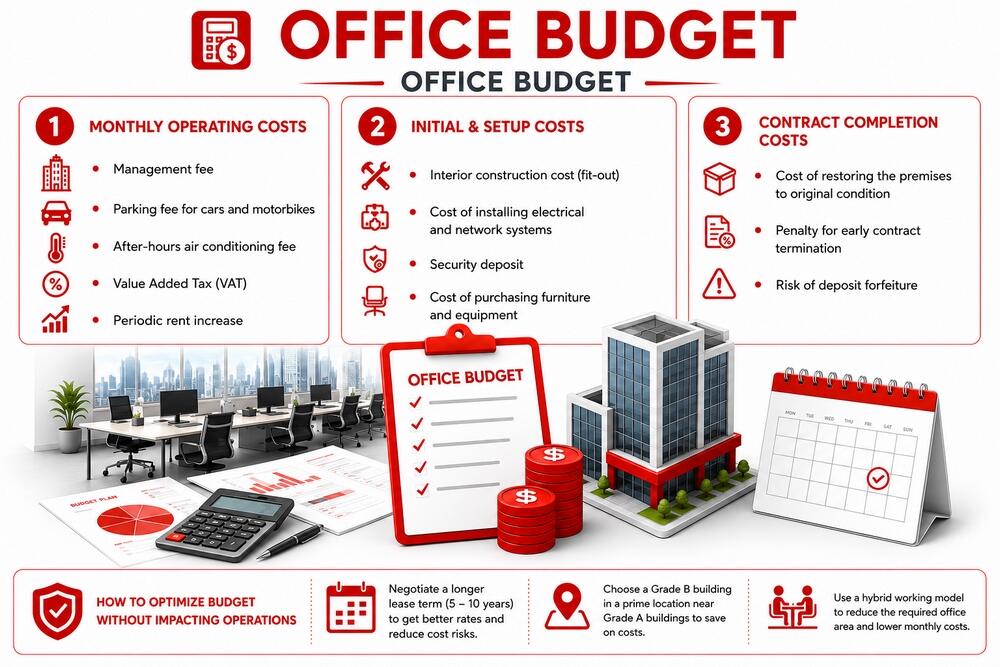
Monthly operating costs
- Building management fee: typically charged separately, not included in the base unit price
- Car and motorcycle parking fees: some buildings charge a fixed monthly rate, others charge per entry
- After-hours air conditioning fee: applies when staff work outside standard business hours
- Value added tax (VAT): 8–10% of total contract value; confirm whether the quoted price is inclusive or exclusive of VAT
- Periodic rent escalation: typically 3–5% per year or every 2–3 years; review this clearly in the contract terms
Initial investment and fit-out costs
- Fit-out costs: include partitions, flooring, ceilings, and custom lighting systems
- Electrical and internal network installation: cabling, switchboards, and backup power systems for office equipment
- Security deposit: typically equivalent to 3–6 months of rent, directly affecting initial cash flow
- Furniture and equipment procurement: desks, chairs, storage units, and office equipment if leasing a bare-shell office
Lease termination costs
- Reinstatement costs: removing partitions and repairing damage incurred during the tenancy
- Early termination penalty: applies if the business vacates before the committed lease end date
- Deposit forfeiture risk: arises if the business breaches handover conditions or fails to provide notice within the required timeframe
How to optimize rental budget without affecting operations
Businesses can reduce office rental costs through three main approaches without compromising operational quality. Negotiating a longer lease term (5–10 years) typically allows businesses to secure a more favorable unit price compared to short-term leases, while also reducing the risk of sudden rent increases. Choosing a Grade B building in a near-central location instead of a Grade A building in the city center can yield significant cost savings while maintaining transport convenience. Adopting a hybrid working model reduces the required leased area, thereby directly lowering total monthly rental costs.
Office type
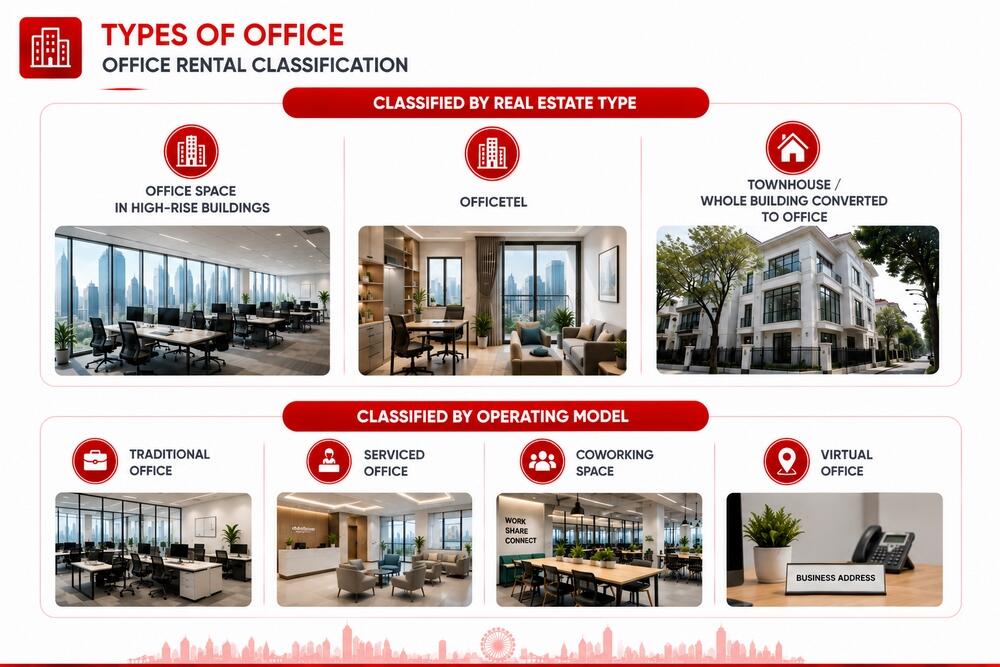
Offices for rent are categorized by two main criteria: real estate type and operating model. Each criterion reflects a different perspective when a business selects an office — from construction quality and property ownership characteristics to management model and flexibility of use.
Classification by real estate type
Real estate type affects legal compliance, space design possibilities, and the professional standard of the office.
- Office floors in commercial buildings: the most common type, purpose-built for office use with elevator systems, central air conditioning, and 24/7 security. This type suits businesses that need a professional working environment and the ability to expand floor space as headcount grows.
- Officetel: a combined residential-office model, typically located within condominium or mixed-use developments. Officetel units are generally smaller than traditional office floors, making them suitable for small businesses or startups that need low rental costs and flexible locations.
- Shophouses or standalone residential buildings converted to offices: give businesses exclusive use of a separate space, with no shared amenities with other tenants in the building. This type suits businesses that need an independent space and the freedom to design according to their own brand identity; however, the legal status regarding permitted land use must be carefully verified before signing a lease.
Classification by operating model
The operating model determines the flexibility of the lease and the business’s initial investment costs.
| Type | Characteristics | Suitable for |
| Traditional office | Business self-designs, fits out, and manages the workspace; long-term lease (3–5 years) | Stable businesses with a need to design office space according to their own brand identity |
| Serviced office | Fully furnished space with reception and operations services provided by the landlord; more flexible lease terms | Businesses that need to move in quickly without making an upfront fit-out investment |
| Coworking Space | Shared working space with amenities shared among multiple businesses; monthly or per-seat contracts | Startups, freelancers, or businesses needing rapid expansion without long-term commitment |
| Virtual office | Registered business address and mail/phone answering services only, with no fixed physical workspace | Businesses needing a valid legal address while operating primarily remotely or without a fixed office |
Building grade
Building grade is classified based on four main criteria: location, mechanical and electrical systems, property management quality, and green standards. Businesses should verify all four criteria rather than relying solely on the “Grade A” or “Grade B” label provided by the landlord, as there is currently no mandatory unified grading standard across buildings in the market.
| Criteria | Grade A | Grade B | Grade C |
| Location | Central Business District (CBD), fronting major roads, convenient transport access to key arteries | Near-central or in areas with good transport infrastructure; not necessarily fronting major roads | Peripheral or adjacent districts, heavily reliant on private transport |
| M&E Systems | VRV/VRF central air conditioning, high-speed elevators, automatic fire suppression systems, 100% backup generator | Central or split-unit air conditioning, standard elevators, partial backup generator | Split-unit air conditioning (wall-mounted or cassette units), basic elevators, limited or no backup generator |
| Management | Professional management firm (CBRE, Savills, JLL, etc.), 24/7 reception and security, regular cleaning and maintenance | In-house or small-scale outsourced management, security and cleaning during business hours | Owner-managed or no dedicated property management |
| Green Standards | International green certification (LEED, LOTUS, or equivalent) | Some buildings hold green certification; not mandatory | Rarely holds any green certification |
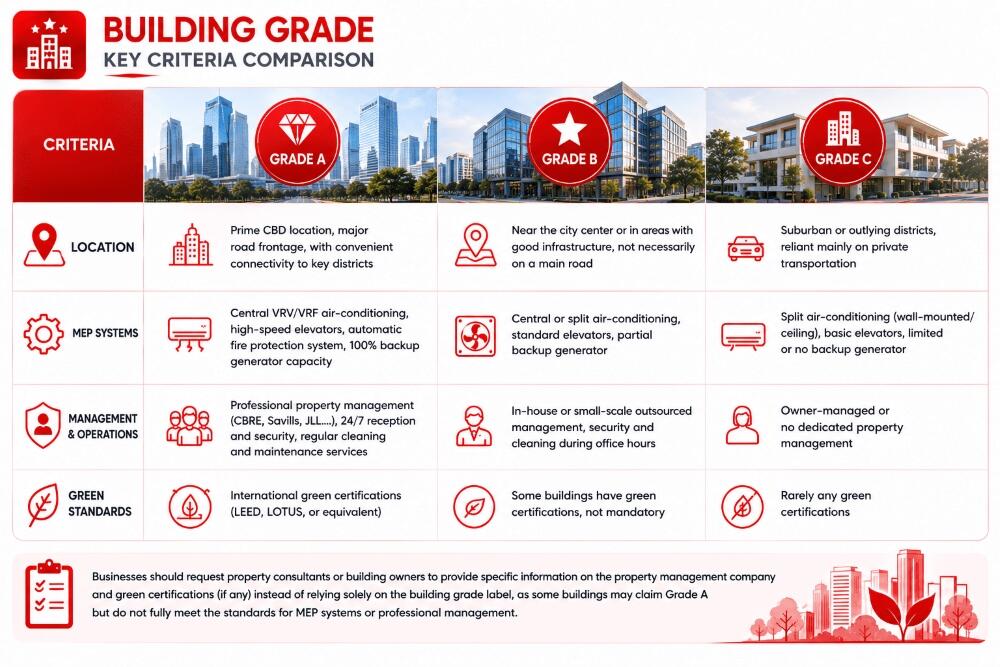
Businesses should ask the consultant or landlord for specific information about the property management company and any green certifications rather than relying solely on the building grade label, as some buildings self-declare Grade A status without fully meeting the criteria for M&E systems or professional management.
Building amenities
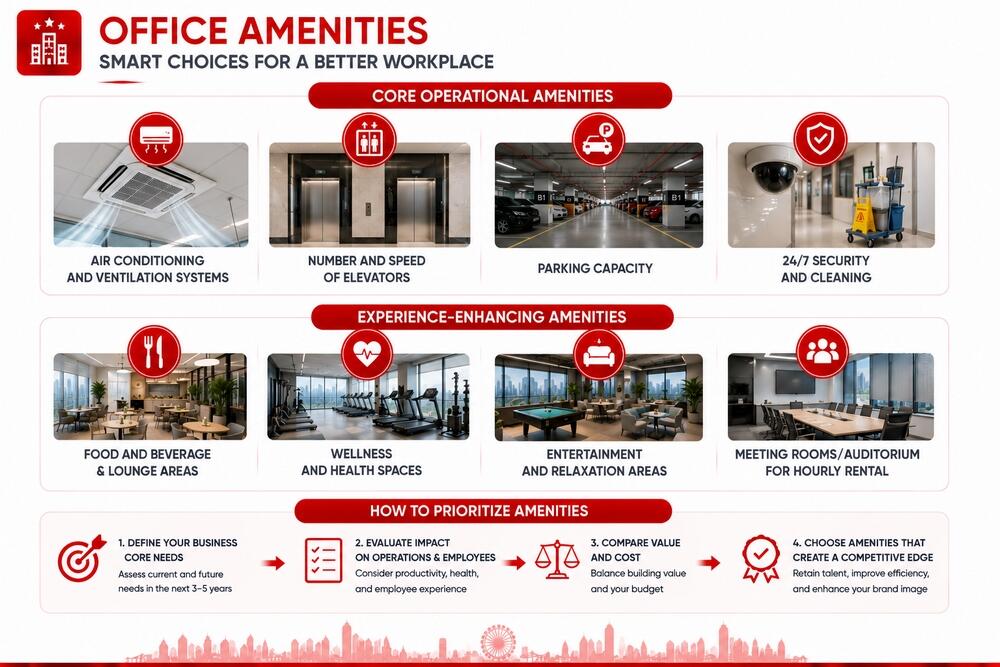
Building amenities are divided into two main groups: core operational amenities that ensure daily activities run smoothly, and experience-enhancing amenities that improve the quality of staff’s working environment. Businesses should prioritize evaluating core operational amenities first, then consider experience-enhancing amenities based on remaining budget.
Core operational amenities
- Air conditioning and ventilation systems: must operate consistently throughout working hours, especially important for offices with high staff density or server rooms. Businesses should verify that the air conditioning capacity meets the thermal load for the leased area, along with the ability to operate outside standard business hours when needed.
- Elevator speed and quantity: directly affects travel time during peak hours, particularly in high-rise buildings with multiple tenants. A low elevator-to-floor ratio and low usage density reduce waiting times and avoid impacting staff productivity.
- Parking capacity: must meet the car and motorcycle parking needs of both staff and visiting clients. Businesses should confirm the exact number of allocated parking spaces to avoid overloading when headcount grows.
- 24/7 security and housekeeping: includes access control systems, CCTV, lobby security personnel, and a housekeeping team maintaining common areas throughout the day. This is an important factor for asset security and a professional working environment.
Experience-enhancing amenities
- Food and beverage and hosting areas: Grade A buildings typically have restaurants, cafés, or food courts within the premises, allowing staff and clients to dine without leaving the building.
- Health and wellness facilities: includes a gym, medical room, or dedicated rest areas for staff, contributing to long-term health and morale.
- Recreational and relaxation areas: rooftop gardens, in-building green spaces, or recreational rooms give staff a space to unwind between intense working sessions.
- Meeting rooms and conference halls available for hourly rental: useful for businesses that need to host events, seminars, or large-scale meetings without investing in large dedicated meeting rooms within their own office.
How to identify amenity priorities
Businesses should draw up an amenity list ranked by direct impact on daily operations, then cross-reference it against the rental budget determined earlier. Core operational amenities must be fully met before considering experience-enhancing amenities, because shortfalls in the core group — such as insufficient parking or overloaded elevators — directly affect the daily operations of all staff. Businesses with a young workforce or in industries that prioritize employee experience (technology, creative sectors) may choose to allocate additional budget toward experience-enhancing amenities to attract and retain talent.
Six criteria — location, area, budget, office type, building grade, and amenities — together determine whether a rental office is truly suitable for a business. Evaluating all six factors simultaneously helps businesses avoid rushed leasing decisions that lead to unplanned costs or having to relocate sooner than expected. Each business will weigh these criteria differently depending on its industry, headcount, and long-term development strategy.
RSQUARE provides free office leasing in Ho Chi Minh City and office leasing in Hanoi consultancy services, helping businesses find an office that meets all of the above criteria. Contact RSQUARE to receive support with site visits and identifying the office option best suited to your business’s needs.