The most common security deposit for office leases ranges from 1 to 3 months’ rent, depending on the type of office, building grade, and contract term. This is the first cost a business must pay upon signing a lease, yet it is often misunderstood — particularly regarding what constitutes a reasonable deposit amount, how payment works, and the conditions for refund. Many businesses only encounter deposit-related issues at the end of the lease term, leading to disputes or partial loss of the amount paid. This article covers the concept of an office lease security deposit, common deposit levels by office type and building grade, the payment process, contract clauses to include, refund conditions, and how to avoid losing your deposit throughout the lease.
What is an office lease security deposit?
An office lease security deposit is an amount of money the tenant transfers to the landlord at the time of signing the lease, to guarantee performance of the obligations set out in the contract. The deposit is held throughout the lease period and returned when the contract ends, provided the tenant has not violated any agreed terms.
Role for the landlord
- Ensuring payment obligations: the deposit serves as a reserve for the landlord to draw from if the tenant is late or fails to pay rent, management fees, or other charges — rather than immediately pursuing legal action or debt recovery, the landlord can temporarily deduct from the held deposit to cover any shortfall
- Compensating for property damage: if the premises are damaged beyond normal wear and tear during the tenancy — for example, damage to the electrical system, floors, or walls caused by non-compliant fit-out work — the landlord has the right to retain part or all of the deposit to cover repair and restoration costs
- Binding contractual responsibility: the deposit creates an opportunity cost for the tenant if they wish to leave early, thereby discouraging unilateral early termination without prior notice, and giving the landlord time to find a replacement tenant and maintain stable occupancy
Role for the tenant
- Demonstrating goodwill and establishing credibility from the outset: willingness to pay the agreed deposit signals that the business has the financial capacity and a serious commitment to the contract, which can facilitate negotiation of other terms — such as a rent-free fit-out period or payment conditions
- Basis for full recovery of the deposited amount: if the tenant pays on time, maintains the premises in good condition, and does not violate any agreed terms throughout the lease, the deposit will be returned in full at the end of the contract — it is essentially a temporarily “frozen” asset, not a lost cost, so businesses should plan their cash flow accordingly to avoid disruption during the period the deposit is held
- Basis for protecting the tenant’s interests if the landlord defaults: in cases where the landlord fails to meet its obligations, the deposit and related contract clauses provide the tenant with grounds to request refund and corresponding compensation
Notes on handling breaches
The general principle in the market is that the breaching party bears the disadvantage regarding the deposit — the tenant may forfeit the deposit if they unilaterally terminate the contract in breach of the agreement, while a landlord who breaches will typically be required to return the deposit along with additional compensation. This is a general reference principle; the specific extent and application depend on the clauses both parties have signed in the contract — businesses should read the deposit penalty clause in the actual contract carefully and not assume a fixed ratio applies by default.
How much is an office lease security deposit?
The common security deposit level in the Ho Chi Minh City and Hanoi markets ranges from 1 to 3 months’ rent, depending on the type of office, building grade, and contract term.
Deposit by office type
- Traditional office: typically requires a deposit of 2–3 months’ rent, due to the long-term nature of the contract and higher level of commitment
- Serviced office / coworking space: lower deposit, usually 1–2 months’ rent; in some cases, short-term monthly contracts may not require a deposit at all
Deposit by building grade
- Grade A: deposit is typically at the highest level, commonly 3 months’ rent, due to the high asset value and tenant stability requirements
- Grade B: commonly 2–3 months’ rent
- Grade C: usually 2 months’ rent; in some cases, only 1 month may be required
Additional factor: contract term
Long-term leases (3–5 years or more) tend to maintain a fixed deposit at the higher end, commonly 3 months, while short-term contracts (under 1 year) may allow for negotiation of a lower deposit, around 1–2 months.
Illustrative calculation example
A business leases 200 m² of Grade B office space at a rate of 20 USD/m²/month, with the contract specifying a deposit of 3 months’ base rent (excluding management fee and VAT):
- Base monthly rent = 20 × 200 = 4,000 USD
- Security deposit = 4,000 × 3 = 12,000 USD
The deposit may be calculated on the base rent or on the total rent inclusive of management fee and VAT, depending on the agreement — businesses should clarify this during negotiation to avoid miscalculation when preparing the required funds.
Office lease security deposit payment process
The office lease security deposit payment process typically takes place across 6 steps, starting from when the business searches for a suitable premises through to handover for use or fit-out.
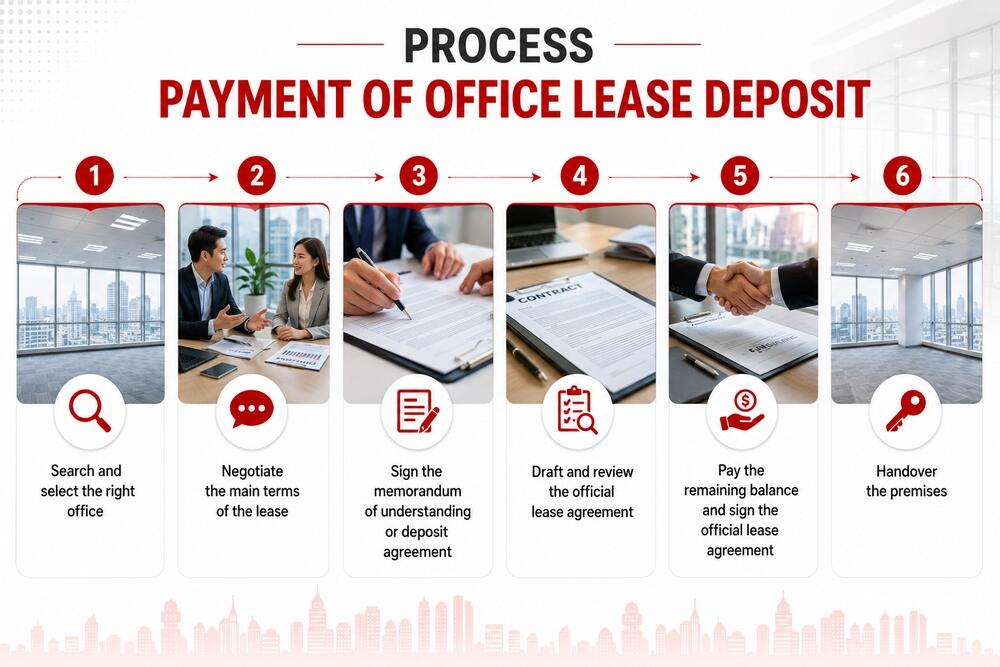
Step 1: Search for and select a suitable office
The business surveys, evaluates, and selects a space that meets its needs in terms of size, location, budget, and amenities — typically working with a broker at this stage.
Step 2: Negotiate key contract terms
Both parties negotiate key terms: rent, payment method, lease term, respective responsibilities, security deposit amount, and refund conditions.
Step 3: Sign a memorandum of understanding or deposit agreement
Before signing the formal lease, both parties typically sign a Letter of Intent (LOI) or Deposit Agreement, in order to:
- Confirm goodwill and commitment from both parties
- Ensure the landlord temporarily stops marketing the space to other prospects during the detailed negotiation period
The business pays an initial holding deposit, usually equivalent to 1–2 months’ rent. This holding deposit will be deducted from the total formal security deposit upon signing the lease.
Step 4: Draft and review the formal lease
The landlord drafts a detailed contract covering all legal clauses. The business should review it carefully, paying particular attention to the deposit refund conditions, refund timeline, and cases where the deposit will not be returned — legal counsel or a specialist with experience in commercial leasing is recommended for high-value or long-term contracts.
Step 5: Pay the remaining balance and sign the formal lease
Upon signing the formal lease, the business pays the remaining deposit balance (if only a partial holding deposit was paid earlier), and may also pay the first period’s rent at the same time. The full deposit will be held by the landlord for the duration of the contract.
Step 6: Premises handover
After completing the signing and payment, the landlord hands over the premises, typically with a handover record confirming the current condition. The business may then proceed with fit-out design and construction (if applicable) and prepare to commence office operations.
Notes on deposit payment
- Payment method: transfers should be made to the landlord’s corporate bank account (as stated in the LOI or contract) rather than in cash, to ensure a clear legal record for future reference
- Protection clause in case of landlord fault: in the holding deposit agreement, the business should request a clear clause stating that if the formal lease cannot be signed due to the landlord’s fault — for example, a price change or failure to provide sufficient legal documentation — the landlord must return the holding deposit in full
Security deposit clauses required in an office lease
An office lease should clearly set out six groups of clauses relating to the security deposit: deposit amount and purpose, payment timing and method, refund conditions and timeline, deduction conditions, breach handling, and deposit adjustment in the event of rent escalation. Having all six groups clearly defined from the outset helps both the business and the landlord avoid most unnecessary disputes throughout the lease.
Group 1: Deposit amount and purpose
- State the exact deposit amount in both numerals and words, or specify it as a number of months’ rent
- Clarify whether the deposit is inclusive or exclusive of VAT — the common practice is that the deposit is not subject to VAT, but this should be stated explicitly in each specific contract, not assumed by default
- State the purpose of the deposit clearly: to guarantee contractual obligations and to compensate for any damage if applicable
Group 2: Payment timing and method
- Specify the timing of each payment installment: upon signing the LOI and upon signing the formal lease
- State the payment method clearly, with a preference for bank transfer to the landlord’s designated account to ensure transparency
Group 3: Refund conditions and timeline
The deposit is returned in full when the tenant has fulfilled all obligations: full payment of office rental costs and related charges, return of the premises in its original condition (subject to normal wear and tear), and no breach of any contract clause. The contract should specify the exact period within which the landlord must return the deposit after premises handover, and set out the penalty or interest rate if the landlord is late in returning the deposit beyond the agreed deadline.
Group 4: Deduction conditions
The landlord has the right to deduct part or all of the deposit in the following cases: the tenant is late in paying rent or service fees beyond the stipulated period, repair costs arise from damage caused by the tenant, or restoration costs arise if the tenant fails to return the premises as agreed. It should also be clarified that if the deposit is deducted during the lease term, the tenant is obligated to top it back up to the original level within a specified period.
Group 5: Handling breaches related to the deposit
- If the tenant breaches (unilateral early termination in breach of the agreement, serious breach of contract terms): the tenant will typically forfeit the full deposit
- If the landlord breaches (unilateral early termination in breach of its commitments, failure to hand over premises on time): the general principle is that the landlord must return the deposit along with corresponding compensation — this is a widely referenced principle, not a mandatory provision in all cases; businesses should specify the exact amount in the contract
Group 6: Deposit adjustment in the event of rent escalation
If the contract includes a clause for rent increases over the years, it should be clarified upfront whether the deposit remains fixed throughout the lease term or whether the tenant is required to top it up in line with the rent increase. Businesses should proactively negotiate to keep the deposit at the original amount to reduce additional cash flow pressure during the lease.
Additional notes
- Dispute resolution mechanism: the contract should clearly specify the method for resolving any deposit-related disputes — negotiation, mediation, arbitration, or court proceedings
- Premises handover record: this is a key document at both the start and end of the lease, and should clearly describe the condition of all assets and equipment to serve as a reference when the deposit is returned
When is the office lease security deposit refunded?
The office lease security deposit is returned when the contract ends in accordance with its terms and the tenant has fully fulfilled all agreed obligations — including full payment of all charges, return of the premises in its original condition, and no breach of the contract.
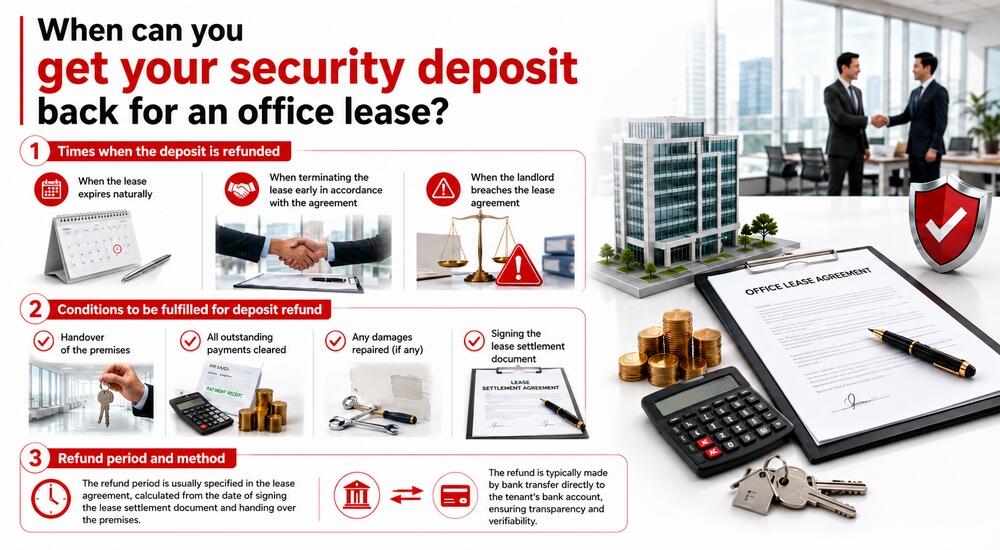
When the deposit is returned
- When the contract expires naturally: the lease ends on its agreed expiry date and neither party continues with a renewal
- When the contract is terminated early by mutual agreement: both parties agree to an early termination with no breach by either side — for example, the tenant has given the required notice period as stipulated in the contract
- When the landlord breaches the contract: in cases where the landlord unilaterally terminates the contract in breach of its commitments, fails to hand over the premises on time, or commits a breach that leads to termination — in these situations the tenant is entirely without fault and is entitled to recover the deposit
Conditions the tenant must fulfill to receive the deposit back
To receive the deposit back (in part or in full depending on the actual circumstances), the tenant must complete the following:
- Hand over the premises: cleaned, personal assets removed, and the premises restored to the condition agreed in the original handover record
- Settle all outstanding charges: full payment of rent, management fees, electricity, water, internet, and parking fees up to the handover date
- Rectify any damage: repair or compensate for damage to building property or equipment caused by the tenant
- Sign the contract liquidation record: both parties have inspected the premises and confirmed in writing
If the tenant does not fully meet all of the above conditions, the landlord has the right to retain part or all of the deposit in proportion to the damage or unfulfilled obligations.
Refund timeline and method
The deposit refund timeline is typically specified in the contract, calculated from the date the contract liquidation record and premises handover are signed. The most common refund method is a direct bank transfer to the tenant’s account, ensuring transparency and a clear record for reference.
How to avoid losing your office lease security deposit
Businesses can minimize the risk of losing their security deposit by proactively taking preventive measures across all three stages: before signing the contract, throughout the period of office use, and when preparing to hand the premises back.
Before signing the contract
- Read all deposit-related clauses carefully, paying particular attention to the refund conditions, deduction cases, and refund timeline — do not sign while any clause remains unclear
- Request that the deposit amount be stated in both numerals and words, and confirm which rent figure the deposit is calculated on (inclusive or exclusive of management fee and VAT)
- Negotiate additional clauses to protect the tenant’s interests — for example, a provision that if the landlord breaches, the deposit must be returned with corresponding compensation
- Consider engaging a lawyer or experienced advisor to review the commercial lease before signing, especially for high-value contracts or long lease terms
Throughout the period of office use
- Prepare a detailed premises handover record at the time of taking over the office, with photos or a clear description of the initial condition — this is important evidence for comparison when returning the premises later
- Pay rent and all charges on time to avoid outstanding balances that could lead to deposit deductions
- Use the premises only for the purpose stated in the contract; avoid changing the function or carrying out fit-out work beyond the permitted scope without prior notice
- Retain all receipts and payment documentation throughout the lease term as supporting evidence when needed
When preparing to end the contract and hand over the premises
- Give notice of intent to terminate or not renew within the period stipulated in the contract, to avoid being deemed to have unilaterally terminated in breach of the agreement
- Proactively inspect and repair any damage that arose during the tenancy before handover, rather than leaving the landlord to assess and deduct at their own discretion
- Request that both a contract liquidation record and a premises handover record be drawn up clearly, with signatures from both parties
- Monitor the deposit refund deadline committed to in the contract and follow up promptly if the deadline passes without receipt of the refund
Most deposit loss risks stem from businesses not fully understanding the contract terms from the outset, or being complacent during the tenancy and at the point of handover. Taking proactive preventive measures across all three stages allows businesses to protect their interests to the fullest when leasing office space.
Frequently asked questions about office lease security deposits
Can a bank guarantee be used instead of a cash deposit?
Some office lease contracts, particularly for large floor areas or major corporate tenants, may accept a bank guarantee in lieu of a cash deposit. This approach can reduce the initial cash flow burden for the business; however, not all landlords accept this arrangement — businesses should raise and negotiate this directly during the contract negotiation stage to confirm feasibility.
What to do if the deposit is withheld without justification?
If the landlord retains the deposit without providing a valid basis, the business should request a written explanation of the specific reasons for the deduction or non-refund, and cross-reference these against the signed contract clauses. If the parties cannot reach agreement, the business may apply the dispute resolution mechanism set out in the contract — negotiation, mediation, or arbitration/court proceedings if necessary. Retaining complete handover records and payment documentation throughout the tenancy will be critical evidence in protecting the tenant’s interests in such situations.
Negotiate deposit terms with RSQUARE
RSQUARE supports businesses in negotiating deposit-related clauses from the contract negotiation stage, helping to minimize the risk of deposit loss and ensuring the tenant’s interests are fully protected in writing.
- Advise on a reasonable deposit level based on actual market data by office type and building grade
- Represent the tenant in negotiating key clauses: refund conditions, refund timeline, deduction cases, and protective clauses in the event of landlord breach
- Review the contract before signing, helping businesses identify any unclear or unfavorable deposit-related clauses early
- Provide end-to-end support through to the handover and contract liquidation stage, ensuring the deposit refund process proceeds as agreed
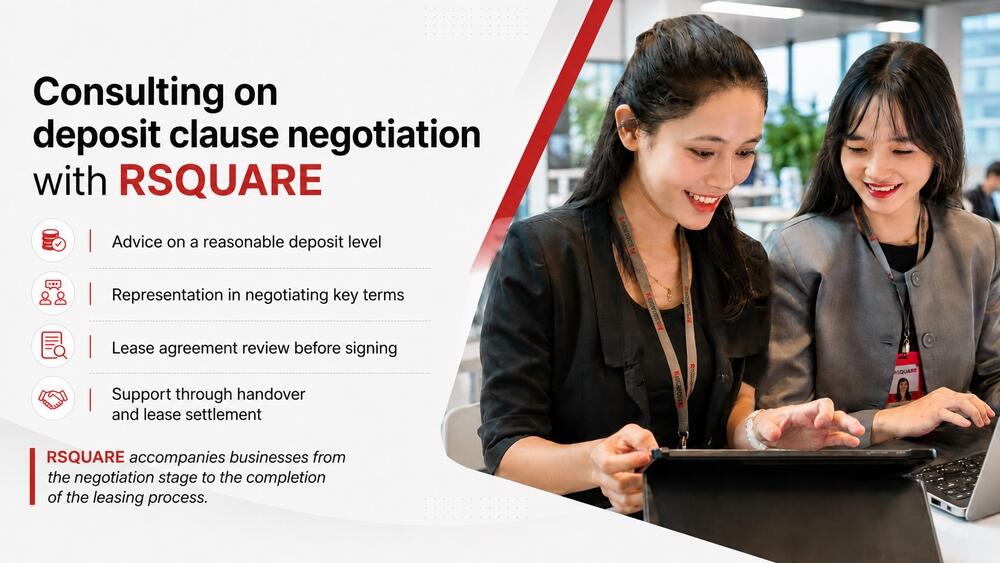
If your business is preparing to negotiate an office lease and wants to ensure deposit clauses are clearly and transparently defined, RSQUARE is available to provide free consultation and accompany you from the negotiation stage through to completion of the leasing process.