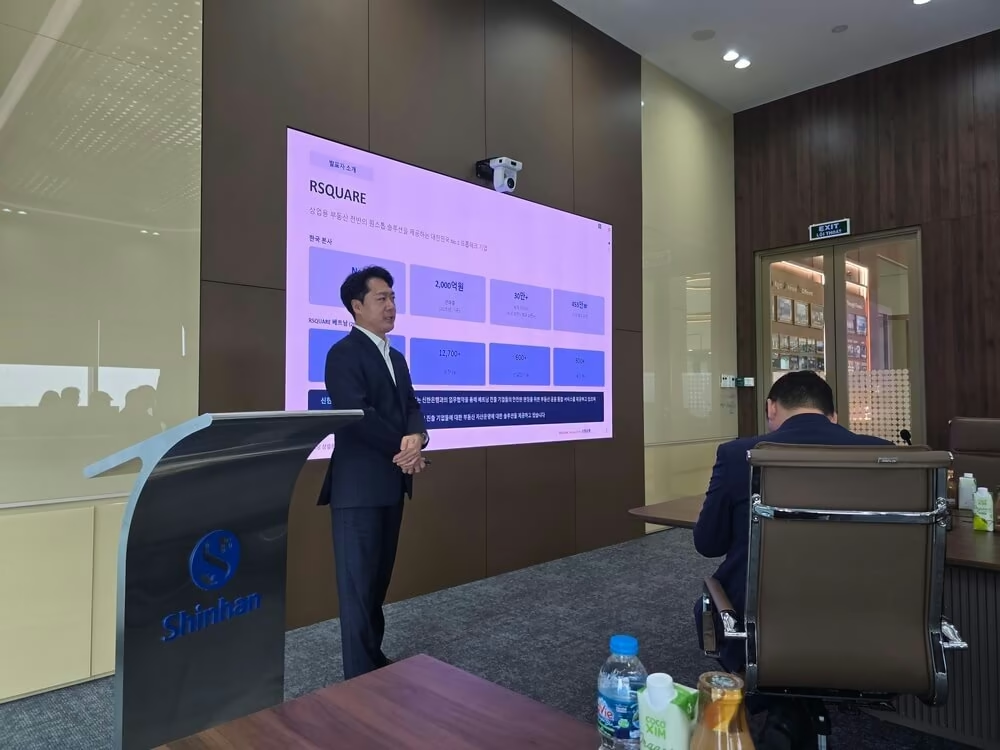
On September 17, 2026, Shinhan Bank Vietnam held a briefing event for experts from Korean securities firms, aimed at providing an overview of the Vietnamese market. Across several sessions of the event, RSQUARE Vietnam’s Branch Director, Mr. Shin Jimin, was in charge of the presentation session on commercial real estate. This article compiles the core points from that presentation: the office rental paradox, Thu Thiem’s role, the differences in the industrial market, and the costs and process of setting up a factory in Vietnam.
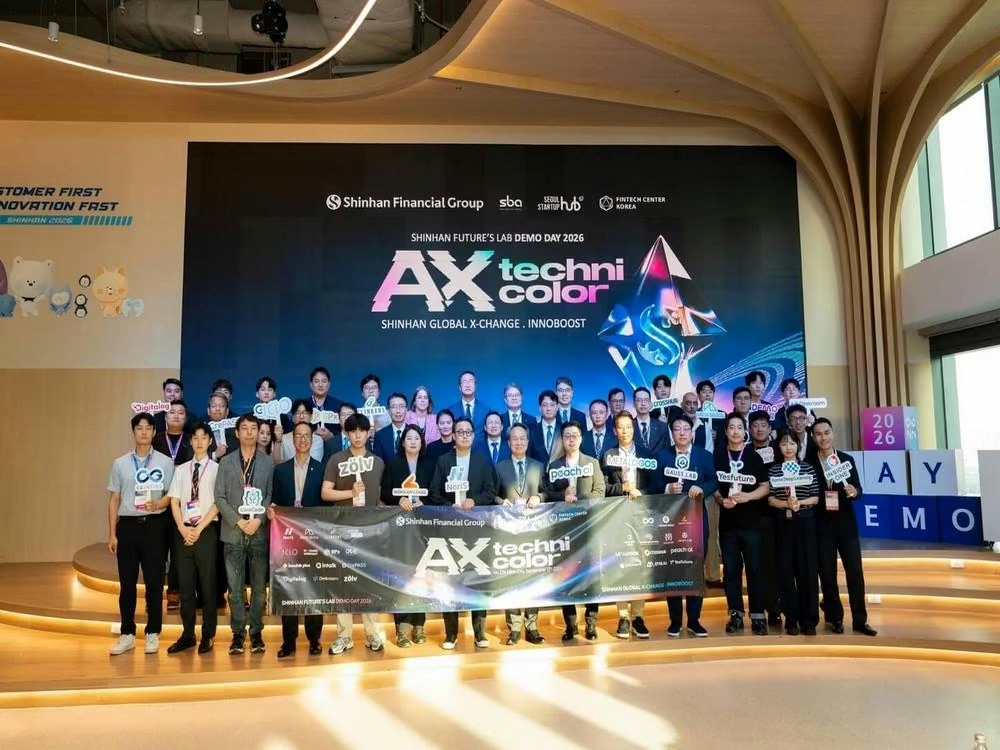
The Shinhan Bank event and RSQUARE’s presentation
RSQUARE joined the event as a partner providing a real estate market perspective. RSQUARE is Korea’s No.1 PropTech company by revenue, established in 2009 and opened its Vietnam branch in 2021. In Vietnam, RSQUARE holds a database of more than 26,400 office buildings, more than 12,700 factories, and more than 600 industrial parks, serving more than 300 corporate clients. Through a cooperation agreement with Shinhan Bank, RSQUARE provides an integrated real estate-finance service for businesses entering Vietnam.
Mr. Shin Jimin’s presentation started from a paradox that can easily surprise Korean investors, then expanded into the overall picture of the office and industrial sectors and practical implementation options.
The paradox: incomes differ 7-9 times, but office rents are nearly equal
Income in Korea is many times higher than in Vietnam, yet Grade A office rents in the two markets are nearly equal. Korea’s 2026 GDP per capita is USD 37,412, compared to about USD 5,000 in Vietnam – a gap of about 7.5 times; the average monthly salary is about USD 2,991 compared to about USD 340 – a gap of about 8.8 times (assuming an exchange rate of 1,400 KRW/USD and 26,300 VND/USD).
Meanwhile, NOC – rent plus management fee – for Grade A offices in District 1, Ho Chi Minh City reaches USD 64.7/m², nearly equal to the roughly USD 70/m² level in the Gangnam (GBD) area of Seoul. For reference, THE METT building, owned by Shinhan Financial Group, has an NOC of about USD 53.2-55.2/m². The question raised: why doesn’t such a large income gap pull rents down correspondingly?
Why does this paradox exist? Differences in the licensing mechanism and supply
Limited Grade A office supply is the core reason rents stay high. The difference lies in the licensing mechanism between the two countries. In Korea, once an application meets the legal requirements, the permit is issued within a stipulated period. In Vietnam, the master plan approval process is a matter of administrative review with no clearly defined processing timeframe, creating a structural delay in supply.
Some signs of this delay were noted in the presentation materials: in 2022, the Ministry of Planning & Investment mentioned about 150 projects stalled in each of Ho Chi Minh City and Hanoi; after the 2021 Thu Thiem land auction, 8 land lots are still being re-auctioned in batches; and in 2026 only one new Grade A office supply source, The Kross (Q4/2026), is expected. In other words, equal rents despite an income gap reflect supply being constrained by the development and approval mechanism.
Grade A offices: Gangnam (GBD) and District 1, Ho Chi Minh City (CBD)
Compared to Gangnam, Grade A offices in District 1 have a nearly equal NOC but a significantly higher cap rate and a higher vacancy rate. This difference is precisely what attracts investors seeking yield.
| Indicator | Gangnam (GBD), Seoul | Grade A District 1 HCMC (CBD) |
| NOC (rent + management fee) | ~USD 70/m² | USD 64.7/m² |
| Vacancy rate | 4.7% | 16.7% (peaked at 20% in 2024, now declining; 2019: 2.5%) |
| Cap rate | 4.28% | 6.00-7.00% (favorable period: ~4-5%) |
| Rent trend (YoY) | Grade A/Prime +6.3% | CBD District 1 +1.1% (Thu Thiem +3.1%; District 7 +2.5%) |
A higher cap rate means a more attractive operating yield on asset value in Ho Chi Minh City compared to regional cities. According to a survey of Grade A office cap rates in Asian cities (03/2026), Ho Chi Minh City stands at 6.00-7.00%, well above Seoul (3.75-4.65%), Singapore (3.25-3.80%), Hong Kong (3.00-4.25%) and Tokyo (2.00-3.00%). Reference figures are cited from Veyond Asia, Good Morning Vietnam Media, Inside Vina (citing JLL) and CBRE Q1 2026.
Understanding the vacancy rate in Ho Chi Minh City correctly
The Grade A vacancy rate in Ho Chi Minh City is not structural but reflects a phase of “temporary oversupply and gradual absorption”. In the 2019-2022 period, the average vacancy rate was only 2-5%. A strong increase in Grade A supply in 2024 pushed the vacancy rate up to about 20%, but by Q1/2026 it had fallen to 13-17%. Within the same context, the rent increase in CBD District 1 (+1.1%) was lower than in Thu Thiem (+3.1%) and District 7 (+2.5%), partly because tenants shifted toward areas with new supply. The materials also present a forecast scenario – vacancy falling to about 10% and rent rising by about 7%/year – but this is a forecast and is subject to interest rate factors.
Regarding definitions, management companies in Korea typically use a threshold of total floor area of about 10,000 pyeong (33,000 m²) and about 330 pyeong per floor for Grade A; Prime grade is 21 floors or more with rent about 40% higher than Grade A. Vietnam has not published a specific floor area threshold, instead assessing location, technical systems, management quality and tenant composition together. In Ho Chi Minh City, there are currently fewer than 10 buildings with GFA over 50,000 m², and one building over 90,000 m², Marina IFC.
Thu Thiem – “the Gangnam of Ho Chi Minh City”
Thu Thiem is likened to “the Gangnam of Ho Chi Minh City” due to its location and supply role. This is a 657-hectare national planning zone facing the District 1 CBD – equivalent to 78% of the area of Seoul’s Yeouido district (840 hectares) – and accounts for about 90% of new Grade A office supply since 2023. Note that “the Gangnam of Ho Chi Minh City” is a comparative positioning term, not an official designation.
The case of The METT is the clearest evidence of absorption capacity. This Grade A office building is 28,000 m², completed in 2023, and has Shinhan Bank Vietnam as a tenant. The occupancy rate rose from 10% (early 2024) to 82% (end of 2024) and reached 97% (08/2026) – showing that a “new building” does not necessarily mean high vacancy risk. Comparative data from nine competing buildings in Thu Thiem and nearby areas (RSQUARE internal database, 08/2026) reinforces this observation:
| Building | Grade | Year completed | Rent (NOC USD/m²) | Vacancy rate |
| The Mett | A | 2023 | 53.2-55.2 | 2.6% |
| The Hallmark | A | 2023 | 58.5 | 1.5% |
| Riverfront Financial Centre | A | 2023 | 64-65 | 5.1% |
| The Nexus | A | 2023 | 63.9-76.9 | 2.9% |
| IFC One Saigon | A | 2025 | 61-68 | ~50% |
| Sonatus Building | A | 2019 | 51.0 | 6.6% |
| Lim Tower 1 (9DTĐ) | B+ | 2013 | 31.5-46.5 | 10.8% |
| The Waterfront Saigon | B+ | 2017 | 42-47 | 0.0% |
| CJ Building | B+ | 2008 | 35.5 | 0.6% |
Five Grade A buildings completed in 2023 all have vacancy rates below 10%. IFC One Saigon (completed 2025, scale of about 120,000 m², with 87,000 m² of office space) currently has about 50% vacancy as a new building still in its fill-up phase.
Industrial real estate: factory rents are close, but land prices differ greatly
For the leasing option, the cost gap between Korea and Vietnam is not large; but for the option of acquiring land and self-developing, the price level in Vietnam is significantly lower. Ready-built factory (RF) rents in Vietnam range from about USD 5.1-5.5/m²/month depending on the province (Bac Ninh 5.5; Hai Phong 5.3; Hung Yen 5.3; Binh Duong 5.3; Dong Nai 5.1), not far from typical industrial parks in Gyeonggi and Chungnam, Korea (about 5.2-7.0).
The major difference lies in industrial land prices. The average land price in Vietnam by province is about USD 160-250/m² (Hanoi 250; Binh Duong 248; Long An 212; Dong Nai 182; Hai Phong 176; Bac Ninh 160), while the official distribution price in Korea is many times higher – for example, Yongin Techno Valley 2 Industrial Complex (Gyeonggi) is about USD 1,642/m² and the Namdong High-Tech Industrial Complex (Incheon) is about USD 1,564/m² (converted at 1 USD = 1,400 KRW; sources: GH Gyeonggi and LH Korea Land & Housing). This gap reflects differences in property rights enforcement risk between the two countries.
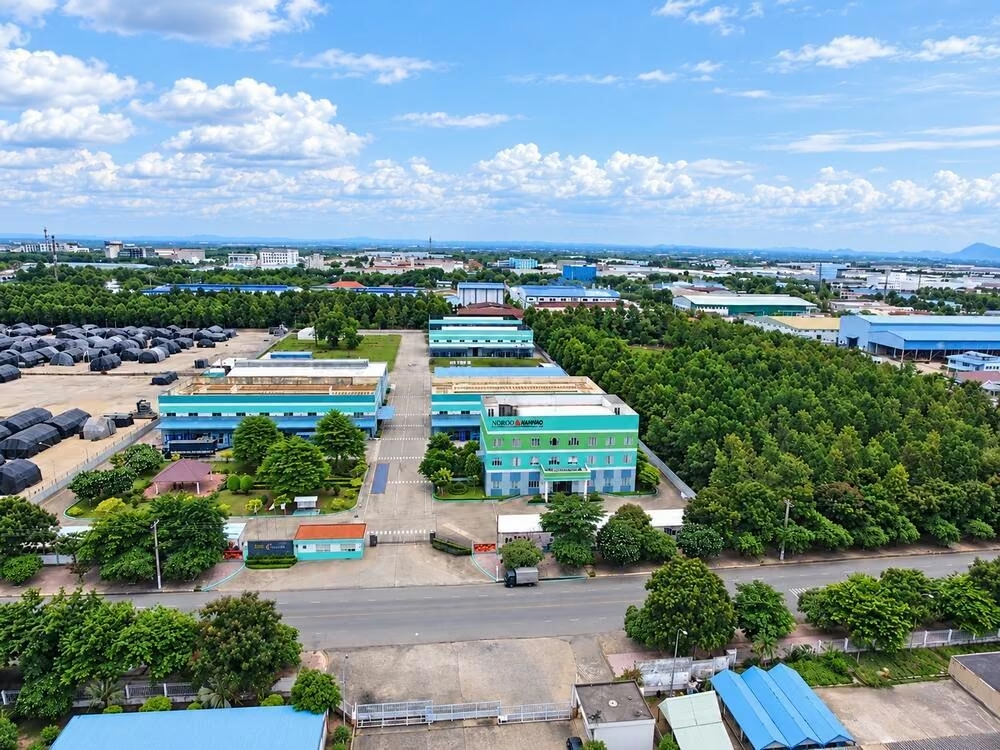
The industrial picture across three regions and sector distribution
Korean investment is concentrated heavily at the two ends of the country. According to KOTRA and FIA data, the North has 5,068 projects worth USD 46.5 billion, the South has 3,948 projects worth USD 26.6 billion, while the Central region is more modest with 518 projects and USD 7.8 billion.
The sector structure varies by region. The North is strong in the manufacturing of electronic components and materials, plastics, textiles, steel and logistics, with semiconductor clusters (Amkor, Hana Micron, Foxconn in Bac Ninh – Bac Giang), batteries (Samsung SDI, Vin ES) and automobiles (Toyota, Honda, VinFast). The South is focused on plastics, textiles, agro-forestry-aquatic processing, steel and household electrical appliances, with notable Korean businesses such as Samsung Electronics, Panasonic, Lotte Chemical, and many auto parts, pharmaceutical and chemical suppliers distributed across Binh Duong, Dong Nai, Long An and Ba Ria – Vung Tau.
Costs and process of setting up a factory in Vietnam
Businesses have two main options, which differ clearly in initial capital and timeline. The figures below are illustrative assumptions for a 5,000 m² (~1,500 pyeong) project in industrial parks near Hanoi or Ho Chi Minh City.
- Leasing a factory: initial cost of about USD 525,000, including a deposit of USD 150,000 (6 months), prepaid rent of USD 75,000 (3 months), and interior fit-out of USD 300,000 (unit price of USD 60/m² for 5,000 m² of factory space). The time to establish a legal entity and obtain licenses is about 5 months (2 months for entity establishment + 3 months for licensing), and the business can begin operating once the legal entity is established.
- Purchasing land and building new: initial cost of about USD 3,570,000, including industrial park land of USD 1,800,000 (unit price of USD 180/m² for a 1-hectare plot), factory construction of USD 1,750,000 (unit price of USD 350/m² for 5,000 m² of factory space), and legal entity establishment & licensing of USD 20,000. Licensing and construction take 1 year or more.
The process of setting up a new factory involves 9 steps over about 12 months, from signing an MOU, registering the IRC/ERC, signing the official sale and purchase agreement, selecting a contractor and design, receiving the LURC (land), obtaining the construction permit, groundbreaking, to receiving completion/fire safety permits and the LURC including the building.
When transferring a factory, there are two methods. Asset transfer changes the asset owner (changing the LURC owner), is approved by the Industrial Park Management Board, and takes 6 months or more; its advantage is eliminating the risk of hidden liabilities from the selling entity and making it easier to find a buyer, suited to being supported by a law firm in Vietnam. Capital transfer (M&A) trades the capital portion of the entity owning the real estate, is approved by the Department of Planning & Investment, and takes 4 months or more; its advantage is simpler procedures and a lower level of administrative intervention, but it is harder to find a buyer.
Korean businesses owning offices in Vietnam: real cases
A number of Korean businesses have owned offices in Vietnam through various forms. Notable examples include THE METT (Khoi Phat Investment, part of Shinhan Financial Group’s investment structure, acquired the project from SonKim Land in 2023), Diamond Plaza (Lotte Group, originally developed by POSCO E&C then transferred), CJ Building (CJ Vietnam), COBI Tower1 (new development investment), and Lotte Eco Smart City (Lotte about 79%, Pha Dat 21%). In Hanoi there are Landmark72, Chamvit Tower and HITC. The asset values mentioned in the materials are estimates.
There are few cases of acquiring operating assets, mainly due to restrictions on real estate ownership rights for foreign-invested entities under Vietnamese law. Under Article 17 of the Constitution and Article 43 of the Land Law, all land belongs to the entire people with the State as the representative owner; foreign individuals do not receive land use rights, but FDI entities with a real estate business purpose can receive land use rights, construct works, and lease them out according to regulations. Even an FDI entity engaged in real estate business, if it acquires an existing building, is not automatically permitted to lease it to a third party. The land use rights term is typically 50 years, extendable up to 70 years in special cases, and is calculated from the time the project is approved rather than from when the buyer receives the transfer.
Where should businesses start?
The starting point depends on the business’s specific goal. For office leasing needs, determining the segment (Grade A/B), area (CBD District 1 or Thu Thiem) and budget is the first step. For factory setup needs, choosing between leasing a factory and purchasing land to build new will determine the initial capital and timeline. For asset ownership needs, an appropriate legal structure is the key factor. RSQUARE provides free consultation and a one-stop service for all three needs.
Frequently asked questions
Are Grade A office rents in Ho Chi Minh City really on par with Seoul?Nearly equal in the core area. Grade A NOC in District 1 reaches USD 64.7/m², close to the roughly USD 70/m² level in Gangnam, even though Vietnam’s average income is many times lower.
Is Thu Thiem worth considering for Grade A offices?Worth considering. This area accounts for about 90% of new Grade A supply since 2023 and shows good absorption capacity, exemplified by The METT reaching 97% occupancy (08/2026).
Can an FDI entity buy and re-lease an office?Not automatically. An FDI entity engaged in real estate business that acquires an existing building is not automatically permitted to lease it to a third party; this right is restricted depending on the investment form and the legal basis of the project.
Is leasing or building a factory more economical?Depends on capital scale and timeline. Leasing has a lower initial cost (~USD 525,000) and faster start-up (~5 months), while building new requires larger capital (~USD 3,570,000) and takes 1 year or more.
The office rent paradox in Vietnam originates from supply being constrained by the approval mechanism, and that very context creates a yield opportunity that regional investors would find hard to match in Seoul, Singapore or Tokyo. Building on office and industrial data covering all of Vietnam, RSQUARE accompanies businesses from segment and area selection through to completing the legal process.