A serviced office is a fully furnished and operationally ready workspace model suitable for businesses that need a professional working environment without the upfront investment in fit-out time and costs. However, this model is not right for every business – whether to lease one depends on company size, budget, and long-term operational plans. This article analyzes the definition, included services and amenities, advantages and disadvantages, a comparison with traditional offices, current reference pricing, and frequently asked questions to help businesses make an informed decision.
What is a serviced office?
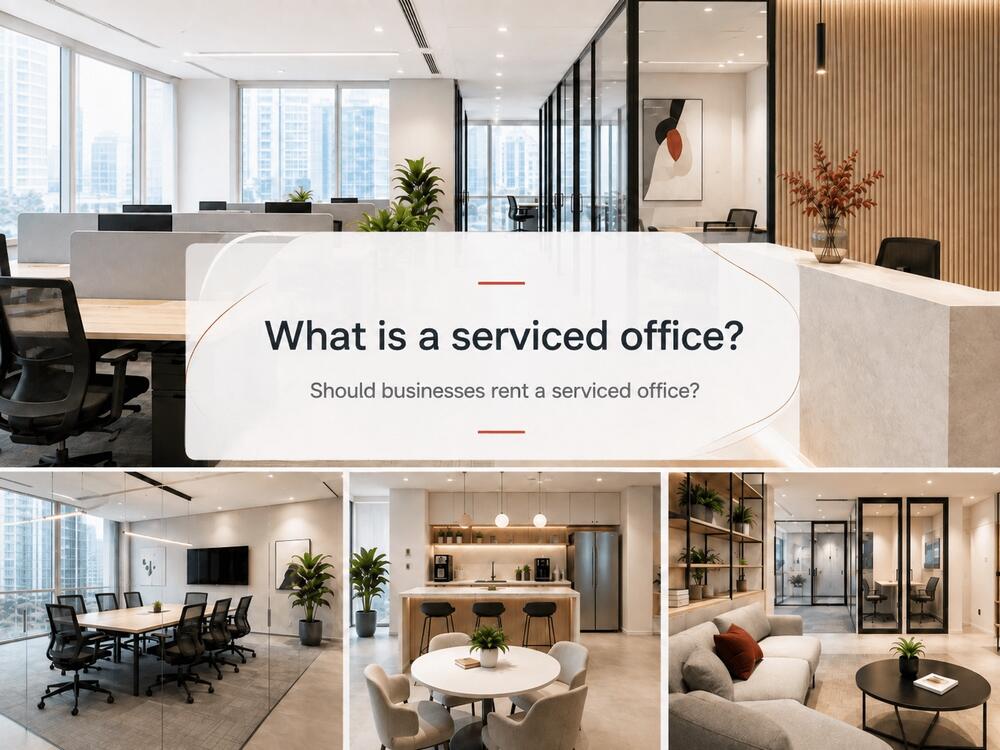
A serviced office is a workspace that comes fully furnished, equipped, and supported by basic operational services provided by the landlord – businesses simply sign a contract and can move in immediately without any fit-out investment.
Core identifying characteristics
- The space is designed and fitted out to the operator’s standards, including furniture, electrical systems, and internet connectivity
- The landlord is responsible for managing and operating the entire space, from cleaning and maintenance to reception services
- Contracts are typically more flexible than traditional offices, priced per room or per seat rather than by raw floor area
Role and significance for businesses
A serviced office solves the problem of upfront time and capital investment – businesses do not need to spend large sums on design, construction, or furniture procurement, and can instead focus immediately on core business activities. It is also an appropriate solution when a business needs to test a new market, open a representative office, or is not yet certain about long-term headcount.
Development trends
The serviced office model is becoming increasingly common in major cities such as Ho Chi Minh City and Hanoi, particularly with the growth of professional operator chains offering a wide range of options from small private rooms to large-scale spaces for entire teams. Compared to traditional offices – where businesses must independently invest in and manage the entire space – serviced offices offer significantly greater flexibility and faster deployment; the specific differences will be analyzed in detail in a later section of this article.
What services and amenities does a serviced office include?
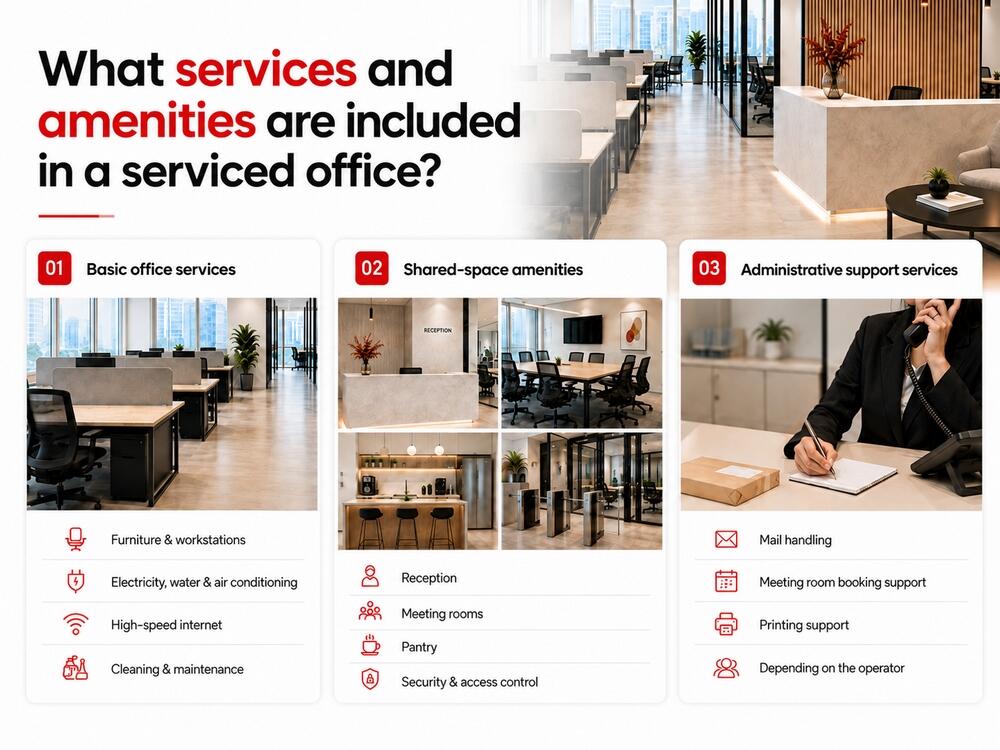
A serviced office typically includes three main categories: core operational services, shared space amenities, and administrative support services – all bundled into a single fee, making it easier for businesses to budget without worrying about multiple separate variable costs.
Core operational services
- Furniture and workspace: desks, chairs, and storage units are pre-arranged to the operator’s standard
- Electricity, water, and air conditioning: usage costs are typically bundled into the rental fee and do not arise separately each month
- High-speed internet: the network is already installed; businesses can use it immediately without registering with an ISP themselves
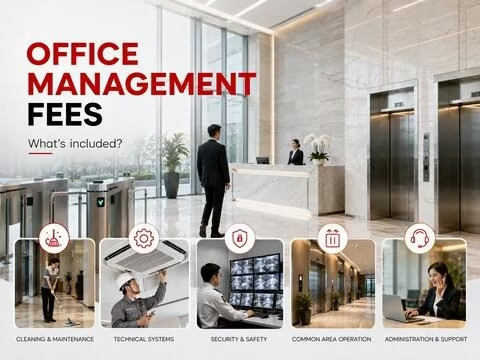
- Cleaning and maintenance: handled by the operator’s cleaning and technical teams; businesses do not need to organize this independently
Shared space amenities
- Professional reception: greeting guests, receiving mail, and handling basic administrative requests
- Shared meeting rooms: businesses can book by the hour or use a set allocation included in the contract
- Shared pantry/lounge area: a space for breaks, beverage preparation, or informal client hosting
- Security and access control: security personnel, CCTV, and access control via key card or access code
Administrative support services (varies by operator – may incur additional fees)
- Business address registration support for newly established companies
- Secretarial services, printing, photocopying, and mail handling
- Networking with other businesses within the same operator’s ecosystem, creating opportunities for business collaboration
Important note
The specific scope of services varies by operator and the pricing tier selected – businesses should request a detailed list of services included in the contract before signing, and should specifically clarify which services are fully included and which will incur additional charges, such as exceeding the free monthly meeting room hours.
Advantages and disadvantages of serviced offices
The characteristics of a serviced office – from fully fitted-out space to flexible contracts – deliver clear benefits for businesses that prioritize fast deployment, while also creating certain limitations that businesses should weigh before committing, particularly when considering long-term cost implications.
Advantages
- Near-immediate occupancy: because the space is already fully furnished and infrastructure is in place, businesses can sign a contract and begin working within days, with no waiting time for fit-out as with traditional offices
- No upfront capital investment: businesses do not need to spend large sums on design, construction, or furniture procurement, helping optimize cash flow from the outset
- Predictable budgeting: most operational costs such as electricity, water, internet, and cleaning are bundled into a single fee, making it easier for businesses to control monthly expenditure without tracking multiple separate line items
- Flexible scaling: shorter contracts allow businesses to move to a larger room or downsize as headcount changes, making it well-suited to growth phases with uncertain staffing needs
Disadvantages
- Higher cost per m² or per person over the long term: when used for an extended period (typically beyond two years), the cumulative cost of a serviced office generally exceeds the cost of a traditional office for the same floor area and duration
- Limited ability to customize the space: businesses cannot freely redesign the space to reflect their own brand identity and must adhere to the operator’s standard configuration
- Reduced privacy in some shared amenities: areas such as meeting rooms, pantries, and reception are shared with other businesses in the same building, which may affect confidentiality or professionalism when hosting important clients
- Dependence on the operator’s service quality: businesses do not directly control the quality of cleaning, security, or the speed of technical issue resolution, and are entirely reliant on the provider’s capabilities and commitment
How does a serviced office differ from a traditional office?
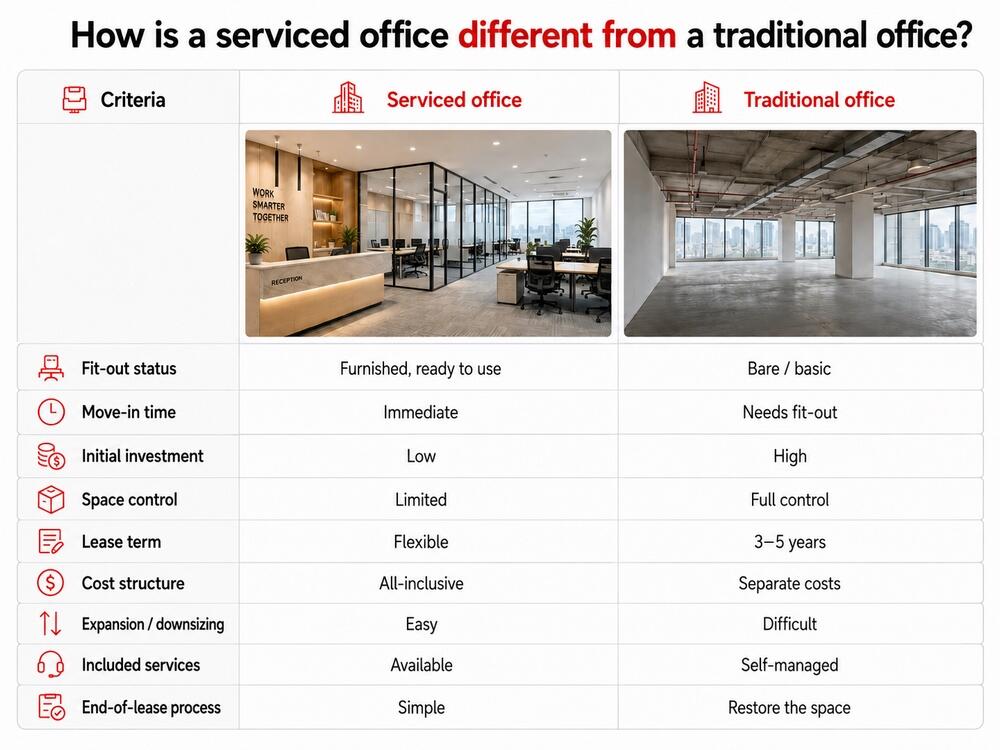
Serviced offices and traditional offices differ significantly in terms of move-in readiness, degree of space control, and cost structure. The comparison table below directly contrasts the two models across specific criteria, helping businesses understand the trade-offs between the two options.
| Criterion | Serviced Office | Traditional Office |
| Handover condition | Fully furnished, ready for immediate use | Shell or basic fit-out, requires own construction |
| Time to occupancy | Fast, near-immediate | Slow, requires fit-out period |
| Upfront capital investment | Low, no additional investment needed | High (self-funded design, construction, and furniture) |
| Degree of space control | Limited, subject to the operator’s standard configuration | Full control over design and brand layout |
| Contract term | More flexible (monthly, yearly) | Long-term (3-5 years) |
| Cost structure | All-inclusive: most costs bundled into a single rate | Separate: rent + management fee + operational costs billed independently |
| Scalability | Easier, can switch to larger or smaller rooms as needed | Difficult, due to long-term commitment and fixed investment |
| Included services | Ready-made (reception, cleaning, shared meeting rooms) | Business self-organizes |
| End-of-contract process | Simple, only personal belongings need to be removed | More complex, space must be restored to its original condition |
A serviced office is most suitable when a business prioritizes speed of deployment and flexibility over long-term cost optimization – particularly during market testing, the opening of a representative office, or when headcount is still uncertain. However, once a business has a clearly defined, stable operational plan of three or more years at a fixed location and has sufficient financial resources for upfront investment, switching to a traditional office typically delivers significantly better cost efficiency over time – which is also why many businesses choose a serviced office as a transitional step before moving to a traditional model when the conditions are right.
What does serviced office rental cost today?
Serviced office rental is priced per seat or per room rather than by floor area as with traditional offices, and the specific rate depends on a range of factors rather than a single fixed figure applicable across the market.
Factors affecting rental rates
- Location/area: serviced offices in central districts are typically priced significantly higher than those in surrounding areas, consistent with traditional office rental pricing patterns
- Building grade: Grade A buildings with premium amenities command higher all-inclusive rates than Grade B or C buildings
- Number of seats/leased area: the rate per seat typically decreases with larger bookings, as operators apply volume-based discounts
- Type of space: private enclosed rooms are typically priced significantly higher than shared hot-desks within the same system, due to differences in privacy and fixed seating
- Operator brand and service quality: established operators with longer track records and more included amenities tend to price higher than newer or smaller-scale providers
How to approach price comparisons between operators
Because rates vary significantly across the factors above, businesses should not simply compare the final quoted rental figure between operators. Instead, they need to assess specifically what is included in that rate – the number of free meeting room hours per month, whether drop-in visitors incur additional charges, and penalty rates for exceeding the initially registered headcount. Two packages with similar price points but different service scopes can deliver very different practical value.
For accurate pricing tailored to specific requirements and budget, businesses should contact the landlord or a leasing advisory firm directly to receive a detailed comparison across multiple options, rather than relying solely on general market reference rates.
Frequently asked questions about serviced offices
Which businesses are best suited to renting a serviced office?
Serviced offices are best suited to businesses that need to start operations quickly, are uncertain about long-term headcount, or are in a phase of testing expansion into a new region or market. Specifically, this is the optimal choice for early-stage startups, foreign businesses entering the Vietnamese market that need a representative office, or small-to-medium-sized teams that prioritize flexibility over long-term investment. Conversely, established businesses with stable operations, larger headcounts, and long-term plans tied to a fixed location should consider a traditional office to optimize costs over the long run.
What is the minimum contract term for a serviced office?
Serviced office lease terms are quite flexible, ranging from a few months to several years depending on each operator’s policy – significantly shorter than traditional office contracts. Some operators offer monthly rental packages for short-term or trial needs, while longer-term packages typically come with preferential pricing. Businesses should confirm with the operator the minimum term, renewal conditions, and the policy for early termination before signing, to avoid unexpected penalty fees.
How does RSQUARE support businesses searching for the right serviced office?
RSQUARE helps businesses search for and compare suitable serviced office options, drawing on aggregated data from multiple operators to save businesses time on market research and enable more informed decision-making.
- Aggregating and comparing multiple options: helping businesses evaluate pricing, amenities, and contract terms across multiple serviced office operators in the same area, rather than having to contact and compare each one manually
- Tailored advisory based on actual needs: recommending the right type of space – from hot-desks and dedicated desks to private rooms – based on headcount, budget, and expected duration of use
- Supporting contract term negotiation: particularly for conditions that are easily overlooked, such as fees outside the package, renewal terms, and early termination conditions
- Ongoing support when businesses need to transition: if the business grows and needs to move from a serviced office to a traditional office, RSQUARE continues to provide advisory support for the next stage
If your business is looking for a serviced office that fits your current budget and team size, RSQUARE offers free advisory services, connecting businesses with a wide range of options in Ho Chi Minh City and Hanoi without the time cost of researching each operator individually.