Traditional offices are the most common office type on the leasing market today, suited to businesses that need a stable workspace with a distinct brand identity. However, not every business is the right fit for this model — the choice also depends on headcount, budget, and stage of growth. This article analyzes the definition, characteristics, advantages and disadvantages of traditional offices, the business profiles they suit best, and a direct comparison with serviced offices to help businesses make an informed decision.
What is a traditional office?
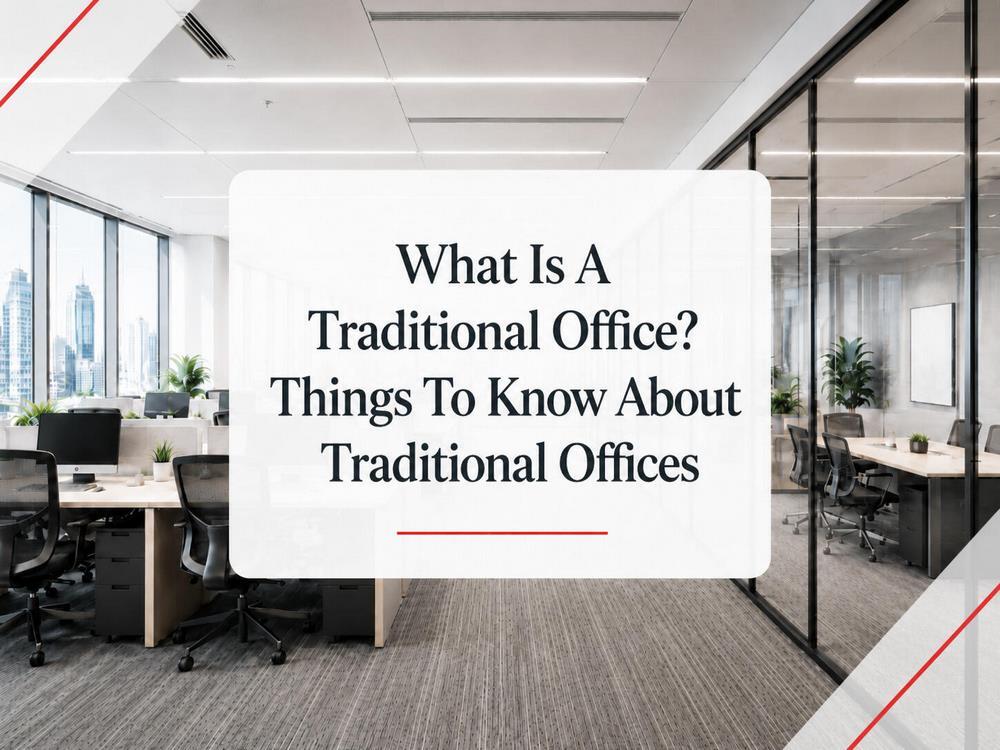
A traditional office is an office model that is exclusively owned or managed by a single business, where the workspace is enclosed by partitions or fixed walls, and the business furnishes the entire space independently.
Core identifying characteristics
- Ownership and management of the space belongs to one business only — not shared with any other party
- Departments and divisions are separated by partitions or solid walls, creating distinct individual workspaces
- Basic furnishings such as desks, chairs, filing cabinets, and office equipment are purchased and arranged by the business according to its own operational needs
Role and significance for businesses
Beyond day-to-day operations, a traditional office also serves as the place where businesses receive partners and clients, and build brand image through a purpose-designed space. It is also the right solution for businesses that need a stable, long-term working environment — and can optimize costs over time compared to more flexible models, provided the total duration of use is long enough.
Market context
Despite the growing popularity of flexible office models such as coworking spaces and serviced offices, traditional offices remain the right choice for large, established businesses that need a space reflecting their own identity — something shared-space models cannot fully deliver.
Characteristics of a traditional office
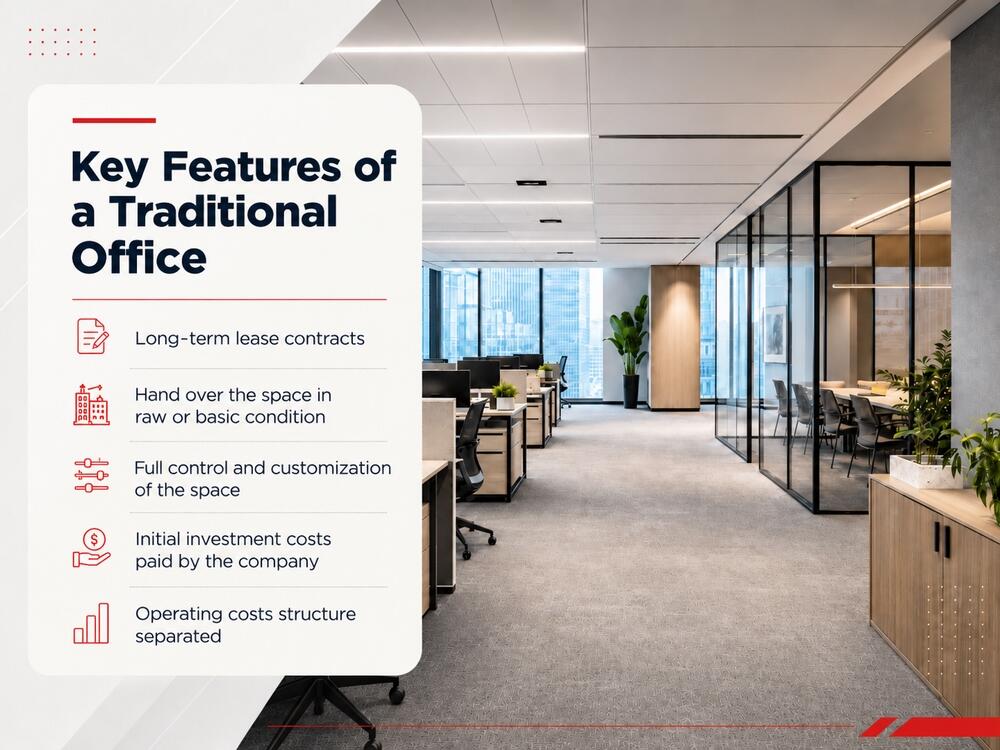
Traditional offices have five defining characteristics that clearly distinguish them from other office models: long-term lease contracts, shell or basic handover condition, full control and customization of the space, fit-out costs borne entirely by the business, and operating costs billed separately from rent.
Long-term lease contracts
Traditional offices typically come with lease terms of three to five years or more, reflecting the stable and long-term commitment between the business and the building owner. This longer term also provides the basis for the business to invest properly in fit-out, as sufficient time is needed to amortize the upfront costs.
Shell or basic handover condition
Unlike serviced offices that are delivered fully fitted, traditional offices are typically handed over in bare shell or warm shell condition — meaning only the core structure and basic electrical and plumbing systems are in place, with no partitions, finished flooring, or furniture.
Full control and customization of the space
The business is free to design the layout, select materials, colors, and spatial arrangement to match its brand identity exactly — without being bound by the common design standards of a serviced office or coworking space.
Fit-out costs borne entirely by the business
All costs for design, fit-out, network and electrical installation, and equipment procurement are funded entirely by the business, completely separate from the base rent. This is a major difference from serviced offices, where these costs are bundled into an all-inclusive package price.
Operating costs billed separately
Costs such as management fees, electricity, parking, and after-hours charges are billed separately from the base rent, allowing the business to monitor and optimize each individual expense item — but also requiring the business to track and manage more cost lines than under an all-inclusive model.
These characteristics are both strengths and limitations depending on the perspective of each business — the next section analyzes the specific advantages and disadvantages of traditional offices.
Advantages and disadvantages of traditional offices
The characteristics of traditional offices — from long-term contracts to full design autonomy — deliver clear benefits for certain business profiles, while also creating limitations that businesses should weigh carefully before committing.
Advantages
- Cost optimization over the long term: with a long-term lease and sufficient floor area, the cost per m² is typically significantly lower than a serviced office when calculated over the full period of use, as the upfront fit-out investment is gradually amortized over the years
- Full freedom to build brand identity: the business can design the space to reflect its brand precisely — from colors and layout to meeting room configuration and reception areas — something shared-space models cannot fully accommodate
- Stability and minimal disruption: a long-term lease gives the business confidence to operate at a fixed location over time, without concerns about frequently relocating the workspace
- Flexible functional layout: the business can independently decide how to divide departments, determine the number of meeting rooms, and configure functional zones to match actual operational needs — unconstrained by a predetermined design
Disadvantages
- High upfront investment: the business must fund all design, fit-out, electrical, and network installation costs independently — a significant expense from the outset that creates cash flow pressure if the business does not have adequate capital reserves
- Extended preparation time: because the space is handed over in shell or basic condition, the business requires fit-out time before it can move in — typically spanning several weeks to a few months depending on scale, considerably slower than a serviced office where occupancy is immediate
- Limited flexibility to scale: having committed to a long-term lease and fixed fit-out investment, the business cannot quickly expand or reduce its footprint if headcount fluctuates beyond projections
- Multiple operating cost lines to manage independently: management fees, electricity, parking, and after-hours charges billed separately from rent require the business to track and control numerous individual items, rather than a single all-inclusive fee as with serviced offices
In general, traditional offices are best suited to businesses that are sufficiently established to accept the higher upfront costs and preparation time, in exchange for long-term cost efficiency and full control over their workspace.
Which businesses should lease a traditional office
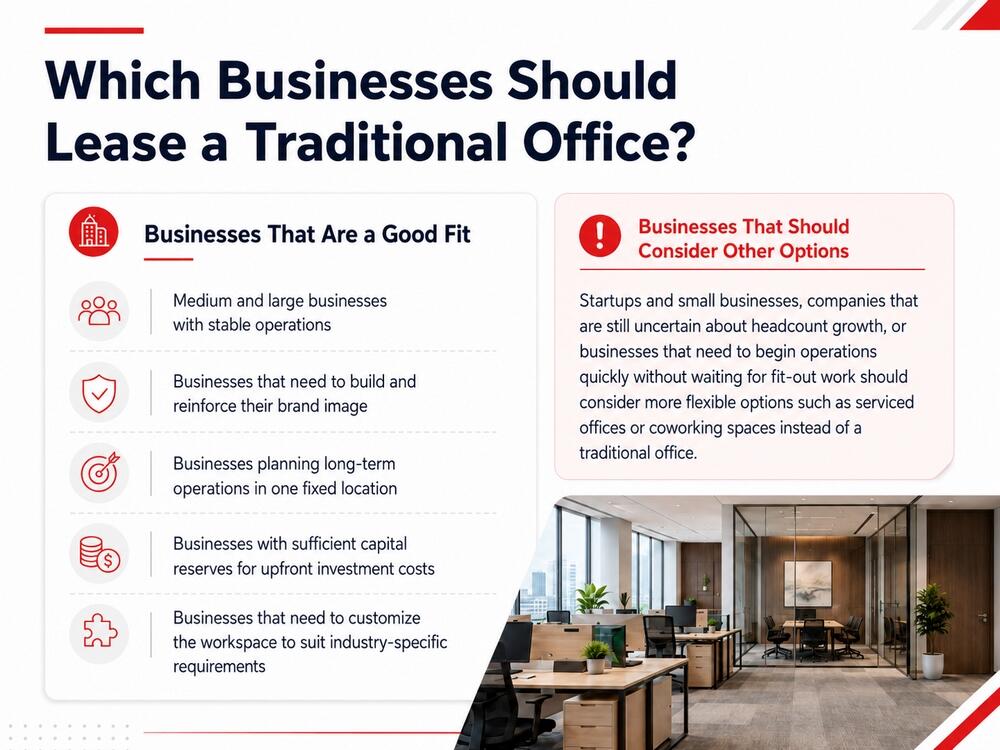
Traditional offices are best suited to businesses with stable headcount, long-term operating plans, and sufficient financial resources to cover upfront fit-out costs — typically businesses that have moved beyond the startup phase and need a workspace that reflects their own brand identity.
Business profiles that are a good fit
- Mid-sized to large businesses with established operations: with a headcount large enough (typically 20 or more), the upfront fit-out investment is amortized more effectively across greater floor area and a longer period of use, delivering better cost per m² over time
- Businesses focused on building and reinforcing brand image: industries where credibility is paramount and regular partner meetings are essential — such as finance, banking, law, and management consulting — where the office environment plays a key role in creating a professional impression with clients and partners
- Businesses with long-term plans at a fixed location: suited to lease terms of three to five years or more, with no plans for sudden relocation or significant headcount changes in the near term
- Businesses with sufficient capital reserves for upfront investment: able to balance cash flow across the security deposit, fit-out costs, and rent from the outset without impacting core business operations
- Businesses requiring space customization for industry-specific needs: for example, the need to set up laboratory areas, product showrooms, or specialized spaces that standard serviced office configurations cannot accommodate
Business profiles that should consider alternatives
Conversely, newly established businesses, small-scale operations, those uncertain about headcount growth, or those needing to move in quickly without waiting for fit-out should consider more flexible models such as serviced offices or coworking spaces instead of a traditional office.
For businesses still deciding between a traditional office and an all-inclusive office, the next section provides a direct comparison of the two models across specific criteria.
Traditional office vs. serviced office: a direct comparison
Traditional offices and serviced offices differ in nearly every aspect of operation — from upfront investment costs and degree of space control to time-to-occupancy. The comparison table below allows businesses to evaluate the two models side by side across specific criteria.
| Criteria | Traditional Office | Serviced Office |
| Handover condition | Shell or basic condition — fit-out required by tenant | Fully fitted — ready for immediate occupancy |
| Time to occupancy | Slow — fit-out period required | Fast — near-immediate |
| Upfront investment cost | High (design, fit-out, and furnishing funded by the business) | Low — no additional investment required |
| Level of space control | Full design and layout freedom aligned with brand identity | Limited — must follow the operator’s standard design |
| Lease term | Long-term (3–5 years) | More flexible (monthly or annual options) |
| Cost structure | Separate: base rent + management fee + individual operating costs | All-inclusive: most costs bundled into a single price |
| Scalability | Difficult — committed to long-term lease and fixed fit-out | Easier — can switch to larger or smaller units |
| Included services | Business arranges independently (reception, cleaning, etc.) | Included (reception, cleaning, shared meeting rooms) |
| Suitable growth stage | Established businesses with stable, larger headcount | Businesses expanding or testing a new market |
The core difference between the two models comes down to a trade-off: low upfront costs and high flexibility (serviced office) versus long-term cost efficiency and full space control (traditional office). Businesses should also factor in their expected duration of use: if the lease is likely to be under two years or headcount is uncertain, a serviced office is typically the better option; conversely, if the business is committing to three or more years at a fixed location, a traditional office generally delivers better cost efficiency over time.
Some businesses also choose to combine both models across different growth phases — starting with a serviced office when the team is small, then transitioning to a traditional office once operations are established and a branded space is needed.
Conclusion
A traditional office delivers long-term stability and full control over a workspace that reflects the business’s own brand identity, but requires significant upfront investment and an extended preparation period. It is best suited to established businesses with long-term plans and sufficient financial resources to invest from day one — while newly established businesses or those with variable headcount should consider more flexible alternatives such as serviced offices or coworking spaces.
If your business needs guidance on choosing between a traditional office and other models based on budget, team size, and growth stage, RSQUARE offers free consulting to help businesses find the most suitable solution in Ho Chi Minh City and Hanoi.