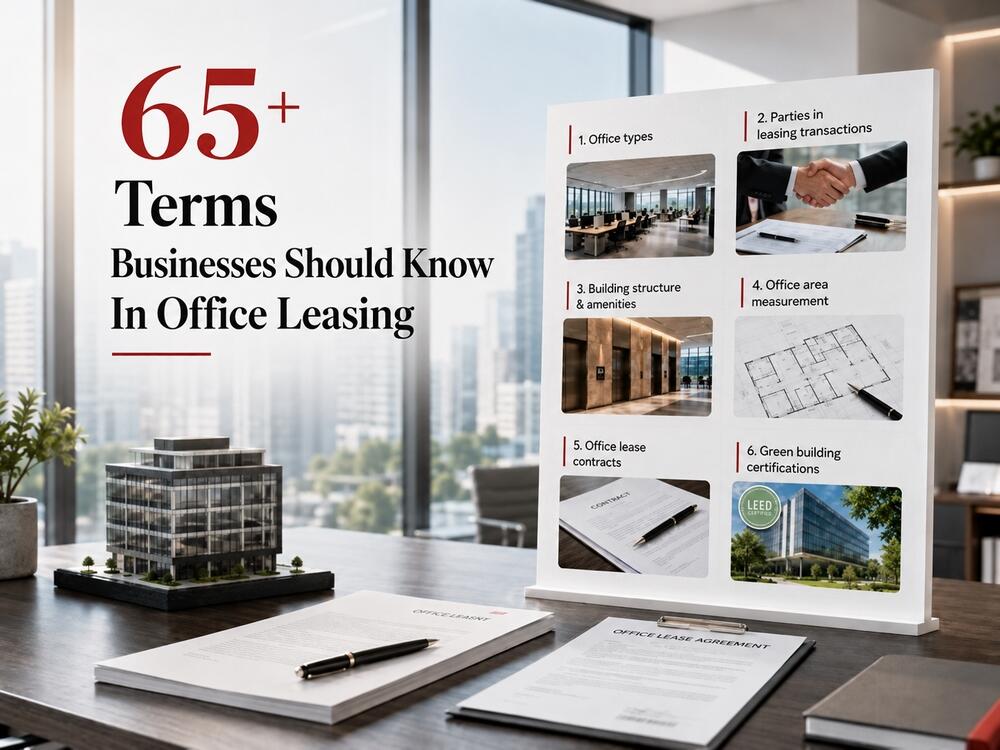
Terminology in office leasing spans six thematic groups: office types, transaction parties, building structure and amenities, floor area, lease contract terms, and green building certifications. When reviewing leasing brochures, contracts, or communicating directly with building owners and international brokers, businesses frequently encounter specialized terms across these groups — and a lack of familiarity can lead to misunderstandings about costs, entitlements, or obligations at signing. This article compiles over 65 of the most common terms, serving as a quick reference when cross-checking against real leasing documents.
Office type terminology
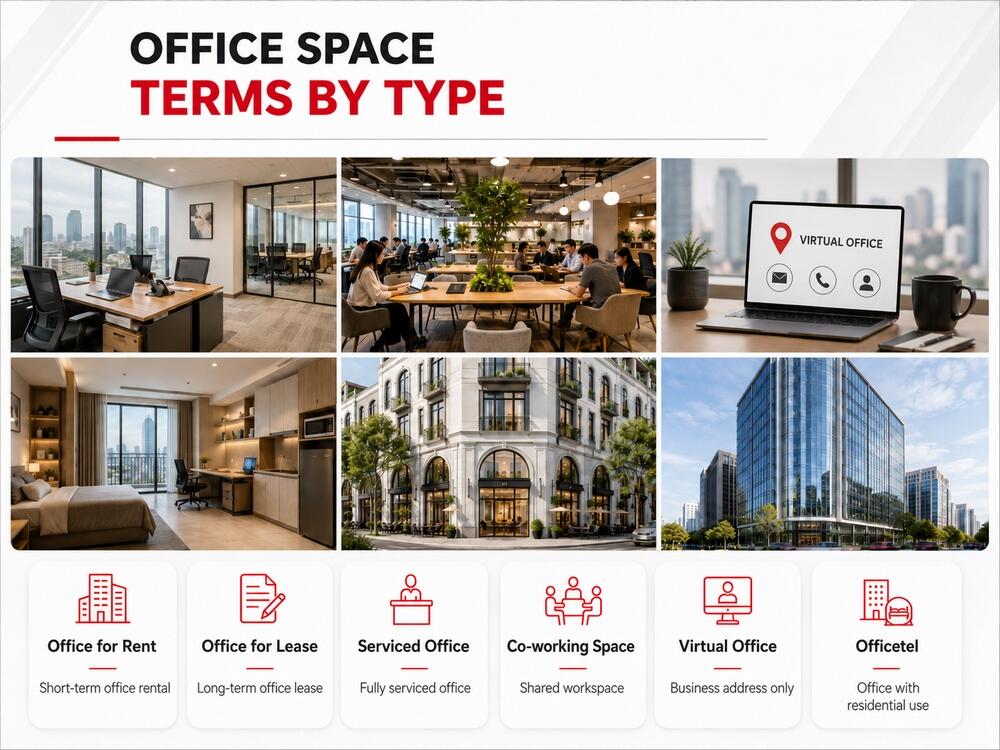
This group of terms appears earliest in the office search journey — typically encountered when browsing real estate listing platforms, reading leasing brochures, or in initial conversations with brokers. These terms describe the nature of the space being offered: the contract format (short-term or long-term), the fit-out condition (furnished or shell), and the building’s location and grade. A clear understanding of this group helps businesses — particularly FDI enterprises and foreign partners — quickly identify the right type of space from the very first search, before diving into detailed contract terms.
| Term | Vietnamese Meaning | Brief Explanation |
|---|---|---|
| Office for Rent | Short-term office rental | Typically refers to listings with flexible lease terms, common on real estate listing platforms |
| Office for Lease | Long-term office rental | More commonly used in formal commercial transactions, usually accompanied by a long-term contract (3–5 years) |
| Serviced Office | Fully serviced/turnkey office | A fully furnished, ready-to-use space that includes operational services such as reception, cleaning, and maintenance |
| Co-working Space | Shared workspace | A model where multiple individuals and businesses share a common workspace and amenities |
| Virtual Office | Virtual office | Provides only a registered business address, with no fixed physical workspace |
| Shared Office | Shared office | Similar to coworking space; sometimes used to describe multiple businesses sharing one large office floor |
| Officetel | Live-work office unit | A hybrid apartment-office unit, typically located within a residential or mixed-use development |
| Shophouse | Commercial shophouse | A street-facing property that can operate as a retail business on the ground floor with offices above |
| CBD (Central Business District) | Central business district | The city’s commercial core, concentrated with Grade A office towers and headquarters of major corporations |
| Grade A/B/C Office | Quality-based office grading | A classification system for buildings based on location, construction quality, and property management standards |
Transaction party terminology
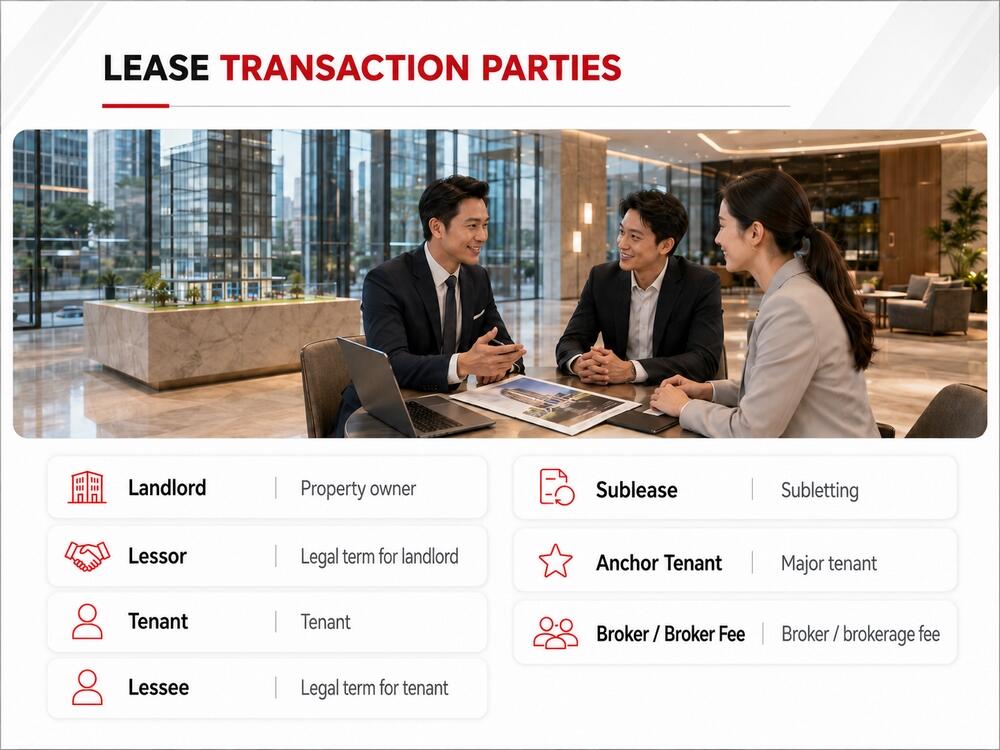
This group describes the role of each party involved in an office leasing transaction — from the building owner and the occupying business to the intermediary connecting both sides. Notably, many terms in this group exist in two parallel forms: an everyday term used in general conversation, and a legal term with greater formality that appears in official contract documents. This parallel usage stems from the tradition of commercial real estate contract law (common law), where legal terms such as Lessor/Lessee are preferred to ensure precision and avoid disputes over interpretation. Businesses need to be familiar with both layers of terminology, as the same role may be referred to differently — during casual discussions with a broker versus when carefully reading through each clause of a signed contract.
| Term | Vietnamese Meaning | Brief Explanation |
|---|---|---|
| Landlord | Building owner | The common term for the owner or the party with the right to lease a building or premises |
| Lessor | Lessor (legal term) | Synonymous with Landlord but carries legal weight; typically appears in formal contract documents |
| Tenant | Occupant/Renter | The common term for the business or individual occupying the leased space |
| Lessee | Lessee (legal term) | Synonymous with Tenant; used in contract documents rather than everyday communication |
| Sublease | Subletting | When a tenant re-leases part or all of their leased space to a third party; usually requires prior landlord approval |
| Anchor Tenant | Anchor tenant | The largest or most prominent tenant in a building, whose presence attracts additional tenants |
| Broker / Broker Fee | Broker / Brokerage fee | An intermediary connecting tenant and landlord; the broker fee is typically paid by the building owner upon successful transaction |
Key Distinction
Landlord/Tenant and Lessor/Lessee are two pairs of synonymous terms that differ primarily in context: Landlord/Tenant is common in everyday communication and general documents, while Lessor/Lessee typically appears in formal, legally binding contract language. Businesses should note that both pairs may appear interchangeably within the same leasing documentation.
Building structure and amenities terminology
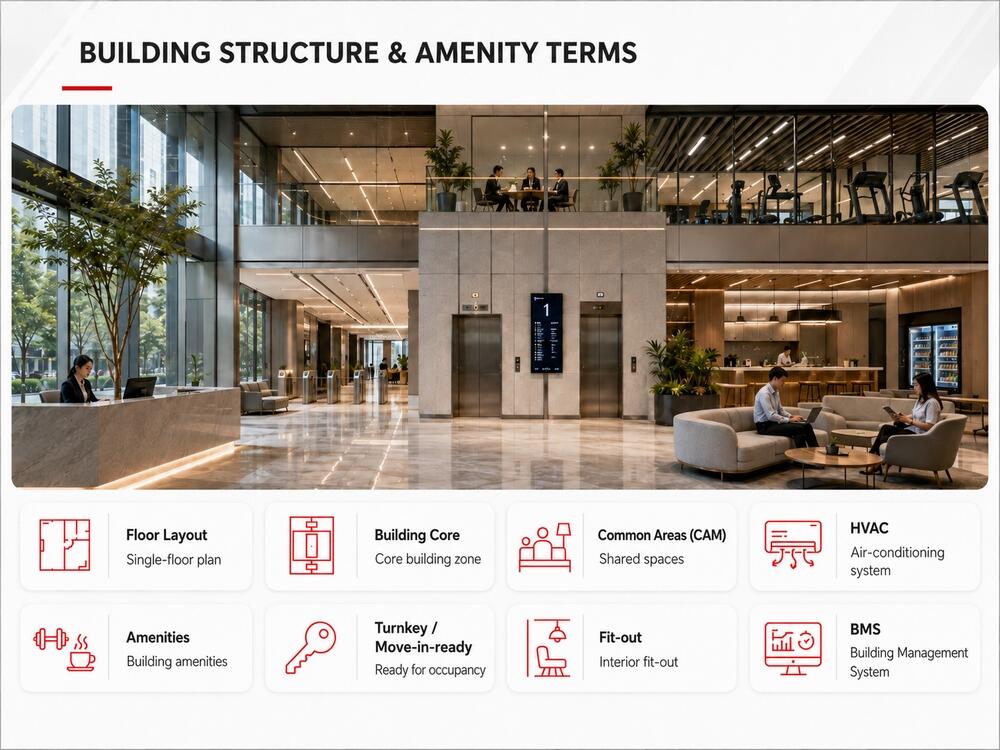
This group of terms appears most densely during the site inspection phase — when reviewing floor plans, discussing technical systems with building management, or cross-referencing leasing documentation against the actual building condition. Unlike the office type terminology (which is broad and general) or the transaction party terminology (which is legal in nature), this group is technical, covering construction and building operations. Many of these terms directly affect both day-to-day user experience and actual lease costs — particularly concepts related to how common areas are allocated into the leasable area. A solid understanding of this group enables businesses not only to read technical documents accurately, but also to ask the right questions during site visits and avoid overlooking factors that could influence their leasing decision.
| Term | Vietnamese Meaning | Brief Explanation |
|---|---|---|
| Layout Floor | Floor plan | A drawing showing the spatial layout of a specific floor, used as a reference when planning interior fit-out |
| Master Plan | Master plan | An overall plan or drawing of the entire project/building, showing the functional zoning layout |
| Building Core | Building core | The central zone of a building housing elevators, staircases, and technical systems — typically consistent across floors |
| Load Factor | Load factor / Add-on factor | The ratio between the nominal rentable area and the actual usable area, reflecting the share of common areas allocated into the leased area |
| Common Areas (CAM) | Common areas | Spaces shared by all tenants in the building, such as lobbies, corridors, and elevator waiting areas |
| HVAC | Air conditioning system | Abbreviation for Heating, Ventilation, and Air Conditioning — the building’s climate control infrastructure |
| Void | Technical void / Atrium | A vertical open space running through the building, serving technical purposes or providing natural light and ventilation |
| Amenities | Amenities | Facilities included with the building such as food and beverage areas, gym, or rest spaces |
| Turnkey/Move-in-ready | Turnkey handover | A fully completed premises condition where the business can move in immediately without additional construction |
| Fit-out | Fit-out | The process of completing interior partitions, electrical, and network systems according to the tenant’s specific requirements |
| BMS (Building Management System) | Building management system | An integrated automated system that monitors and controls building technical equipment including HVAC, lighting, and security |
Key Distinction
“Load Factor” is the most easily misunderstood term in this group, as it directly affects the actual rent payable — the higher the load factor, the larger the nominal rentable area compared to the actual usable area. Businesses should request the landlord to clearly state this figure when comparing rental rates across different buildings.
Office floor area terminology
This is the smallest group by number of terms, yet it carries the greatest financial significance in the entire leasing process — because every figure in the contract, from monthly rent to the total annual budget, originates from the area measurement method applied. It is worth noting that not all landlords calculate area using the same standard: some measure based on total gross construction area, while others measure only the area the business can actually use. This seemingly minor difference creates significant discrepancies when comparing rental rates across buildings, particularly for businesses leasing office space in Vietnam for the first time and unfamiliar with local commercial measurement conventions.
| Term | Vietnamese Meaning | Brief Explanation |
|---|---|---|
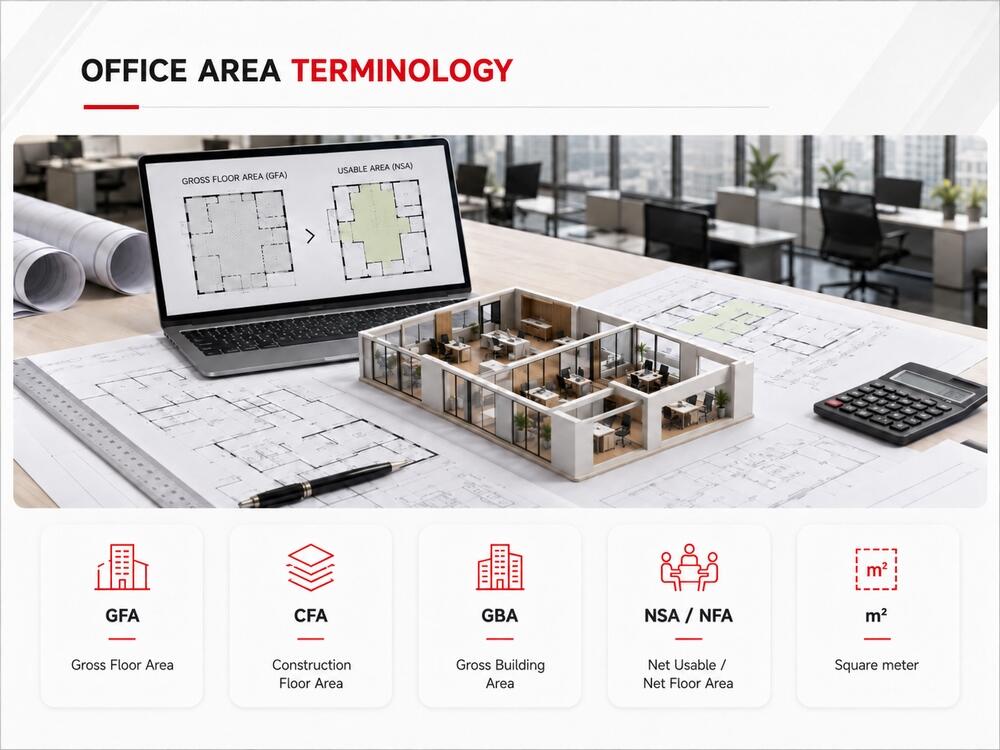
| GFA (Gross Floor Area) | Gross floor area | Total floor area of the entire building, including walls, columns, and technical areas |
| CFA (Construction Floor Area) | Construction floor area | Floor area calculated according to design documents and building permits; commonly used in legal project files |
| GBA (Gross Building Area) | Gross building area | Total area of the entire building across all floors; similar to GFA but may differ depending on each developer’s conventions |
| NSA/NFA | Net usable area / Net floor area | Net Sellable Area/Net Floor Area — the area the business actually occupies, excluding perimeter walls, structural columns, and shared technical zones |
| m² | Square metres | The standard unit of area measurement used in most office lease contracts in Vietnam |
Key Distinction
The difference between GFA/GBA/CFA (gross areas, typically used in legal filings and project planning) and NSA/NFA (net usable areas, typically the basis for rent calculation) is a point businesses must pay close attention to. When receiving a quote, businesses should ask explicitly which type of area the unit price is based on — because two buildings with the same price per m² but measured on different area types can result in significantly different actual costs. This concept is also closely related to “Load Factor” discussed in the building structure section — the factor that reflects the gap between these two area types.
Lease contract terminology
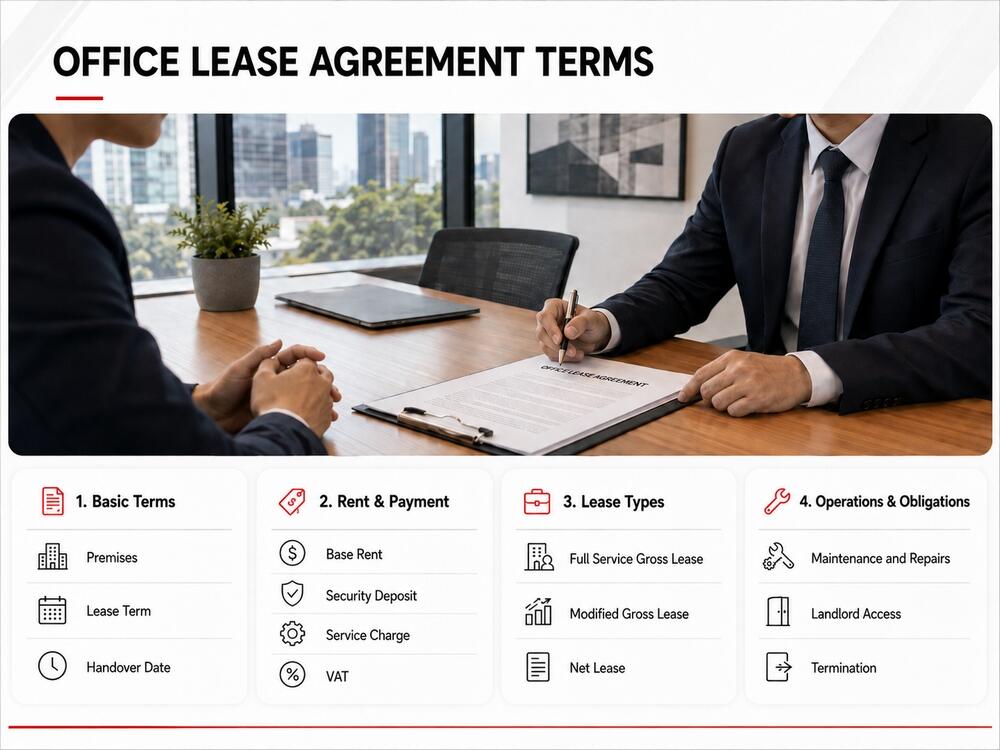
This group appears most frequently and carries the greatest importance throughout the entire leasing process, as it is directly tied to the legal document that binds the rights and obligations of both parties for the full duration of the lease. Unlike the previous terminology groups — which help businesses identify and assess spaces — this group appears at the final decision-making stage, when businesses must read each clause carefully before signing. Due to the volume of terms, the content is divided into four sub-groups by theme: basic contract terms, rent and payment, contract types, and operational obligations — to help businesses look up terms easily when cross-referencing against actual documents.
Group 1: Basic Contract Terms
| Term | Vietnamese Meaning | Brief Explanation |
|---|---|---|
| Premises | Premises | The specific space being leased, usually described with its location and area in the contract |
| Use of Premises | Permitted use | A clause specifying that the premises may only be used for the agreed purpose (e.g. office use) and may not be converted without consent |
| Lease Term / Contract Period | Lease term | The period during which the contract is in effect, from the start date to the end date |
| Renewal Option | Renewal option | A clause granting the tenant the right of first refusal to renew the lease upon expiry, usually with specified conditions |
| Annex Contract | Contract annex | A supplementary document attached to the main contract, providing additional detail on specific clauses |
| Contract Transfer | Contract transfer | The assignment of rights and obligations under a lease to another party; typically requires landlord consent |
| Handover Date | Handover date | The date on which the landlord formally hands over the premises to the tenant, marking the start of the fit-out period or the lease term depending on the agreement |
Group 2: Rent and Payment
| Term | Vietnamese Meaning | Brief Explanation |
|---|---|---|
| Base Rent | Base rent | The base rental rate, excluding any additional fees or charges |
| Additional Rent | Additional rent | Charges beyond the base rent, such as management fees or service charges |
| Effective Rent | Effective rent | The actual rent payable after accounting for incentives such as an initial rent-free period |
| Rent-free Period | Rent-free period | A period during which the tenant is not required to pay rent, typically applicable during the fit-out phase |
| Security Deposit | Security deposit | A sum paid by the tenant to the landlord to secure performance of contractual obligations |
| Rent Adjustment | Rent adjustment | A clause governing rent increases or changes at agreed intervals |
| Service Charge | Service charge | A fee for shared building services; may be separate from or bundled with the management fee depending on the building |
| Management Fee | Management fee | A fee paid to the building’s property management operator |
| VAT | Value Added Tax | Tax applied to rent and service fees in accordance with current regulations |
| Holdover Rent | Holdover rent | A penalty charge applied when the tenant continues to occupy the premises after the lease has expired without renewal |
Group 3: Lease Types
| Term | Vietnamese Meaning | Brief Explanation |
|---|---|---|
| Full Service Gross Lease | Full service gross lease | A lease structure in which most operating costs are bundled into a single all-inclusive rental rate |
| Modified Gross Lease | Modified gross lease | An intermediate structure where some costs are bundled into the rent and others are charged separately |
| Net Lease | Net lease | A lease structure in which the tenant pays base rent separately from other operating costs such as management fees, taxes, and insurance |
Group 4: Obligations, Rights, and Operations
| Term | Vietnamese Meaning | Brief Explanation |
|---|---|---|
| Insurance | Insurance | A clause specifying insurance obligations for the leased premises or related liabilities |
| Improvements and Alterations | Improvements and alterations | A clause defining the tenant’s rights and limitations when making changes or renovations to the premises |
| Leasehold Improvements | Leasehold improvements | Fixed improvements made by the tenant to the leased premises; typically subject to restoration obligations at lease expiry |
| Maintenance and Repairs | Maintenance and repairs | A clause allocating maintenance and repair responsibilities between tenant and landlord for specific items |
| Landlord Access | Landlord access right | A clause specifying the circumstances and conditions under which the landlord may access the leased premises |
| Termination/Contract Termination | Contract termination | A clause governing the circumstances and procedures for early or end-of-term contract termination |
| Occupancy Rate | Occupancy rate | The percentage of total leasable area that has been leased, reflecting the building’s ability to attract tenants |
Green building certification terminology
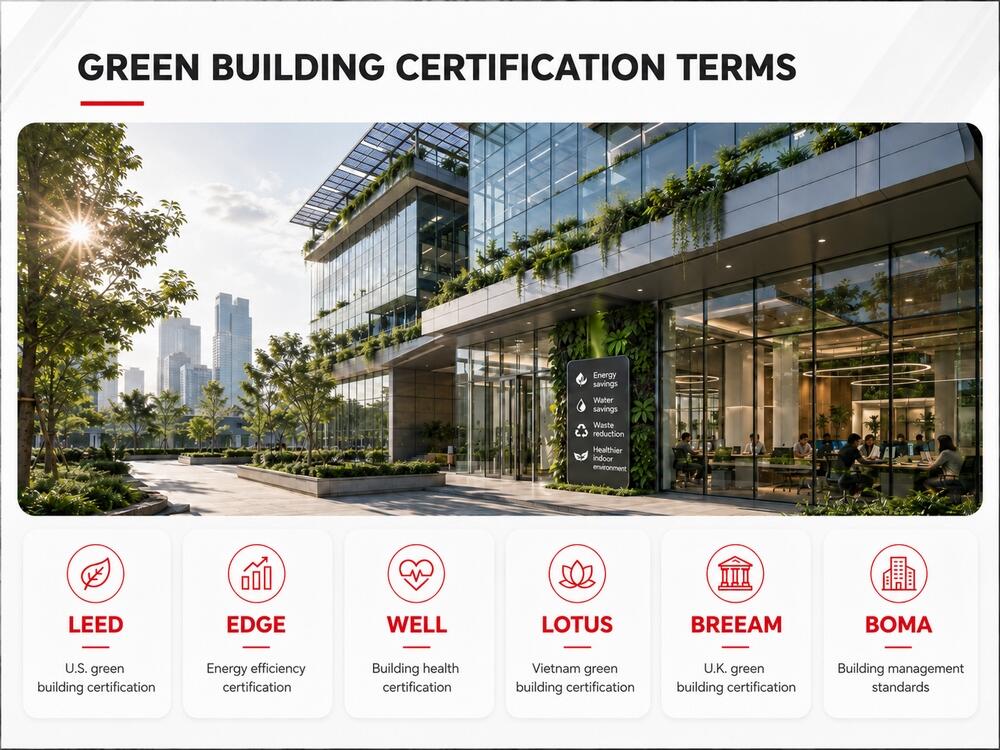
The green building certifications below typically appear when an office building promotes its sustainability credentials — each certification is issued by a different organisation and assessed against different criteria. Businesses should distinguish clearly between them to accurately understand the credibility of each certification when reviewing building information.
| Term | Vietnamese Meaning | Brief Explanation |
|---|---|---|
| LEED | LEED green building certification | Leadership in Energy and Environmental Design; issued by the U.S. Green Building Council (USGBC) and one of the most widely recognised green building certifications globally |
| EDGE | EDGE energy efficiency certification | Excellence in Design for Greater Efficiencies; developed by the International Finance Corporation (IFC), focusing on energy, water, and materials efficiency |
| WELL | WELL building health certification | Assesses buildings based on their impact on occupant health and wellbeing, including air quality, lighting, and acoustics |
| LOTUS | LOTUS Vietnam green building certification | Issued by the Vietnam Green Building Council (VGBC); a green building certification developed specifically for Vietnam’s climate and construction conditions |
| BREEAM | BREEAM green building certification | Building Research Establishment Environmental Assessment Method; a green building certification originating from the United Kingdom, widely used in European markets |
| BOMA | Building Owners and Managers Association | An international organisation that sets standards for building operations management and commercial floor area measurement |
Key Distinction
LEED, EDGE, and LOTUS are the three most prevalent certifications in the Vietnamese market, while WELL focuses specifically on occupant health rather than purely technical building performance, and BREEAM is primarily associated with projects with European investment or design standards. BOMA is not a green building certification — it is an organisation that sets management and area measurement standards. Businesses should distinguish this clearly to avoid confusing it with the green certifications listed above.
Frequently asked questions on office leasing terminology
What is the difference between Lease and Rent?
Lease and Rent both mean “to hire a space,” but Lease refers specifically to a long-term arrangement with a binding contract, while Rent carries a broader meaning applicable to both short- and long-term arrangements. “Office for Lease” is typically used in formal commercial transactions with 3–5 year contracts, whereas “Office for Rent” is more common in flexible, non-binding listings. Businesses can use this distinction to get an initial sense of the nature of a transaction before reviewing contract details.
How do Management Fee and Service Charge differ?
Management Fee and Service Charge are sometimes used interchangeably, but Management Fee typically refers to the fee paid to the building’s property management operator, while Service Charge covers specific services in common areas. Depending on the building, these two items may be bundled together or billed separately in the contract. Businesses should ask the landlord to clarify how each is calculated and what it covers, to avoid confusion when comparing total costs across different options.
What is the difference between GFA, NFA, and NSA?
GFA (Gross Floor Area) is the total construction floor area, including walls, columns, and technical zones, while NFA/NSA is the net usable area that the tenant actually occupies. The gap between these two figures is what is reflected in the “Load Factor.” When comparing rental quotes, businesses should confirm whether the unit price is based on GFA or NFA — because the same price per m² applied to different area types will result in significantly different actual costs.
Is Net Lease advantageous for tenants?
Net Lease is not inherently advantageous or disadvantageous — this structure separates base rent from other operating costs, which suits businesses that prefer to monitor each expense line individually. Compared to a Full Service Gross Lease (where costs are bundled into a single rate), a Net Lease requires the tenant to track more line items, but may allow for cost optimisation with good financial controls. Businesses should evaluate this based on their internal financial management capabilities before making a choice.