If employees can work from anywhere, what is the purpose of the office?This is no longer a hypothetical question. It is steadily becoming a core component of many businesses’ strategies as they re-evaluate the role of their physical workspaces.
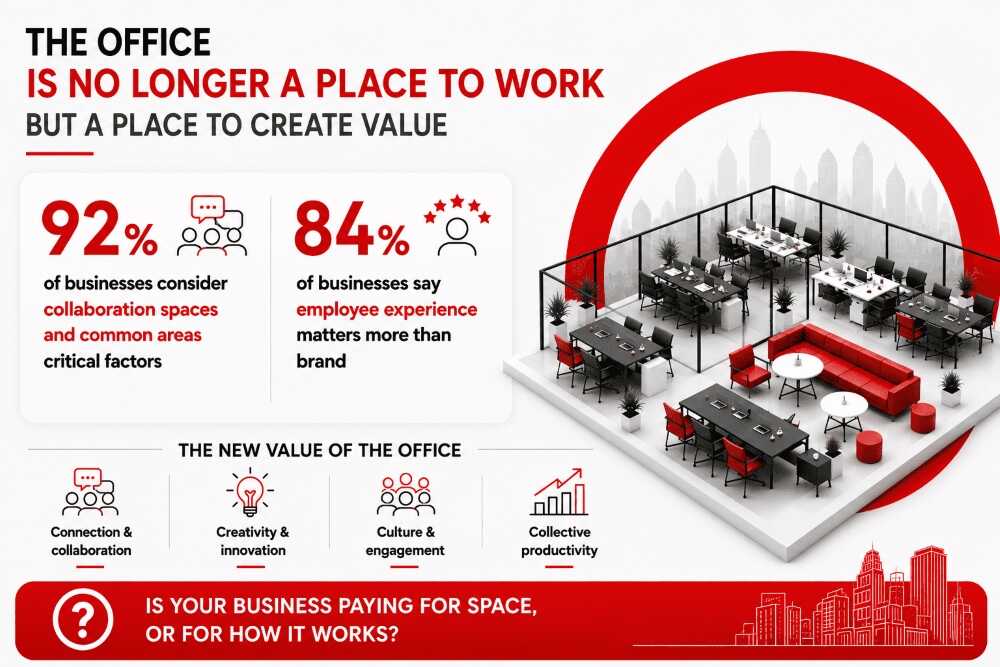
According to data published by Forbes, an overwhelming 92% of businesses view collaborative spaces and common areas as the most critical factors in building corporate culture and boosting productivity. Furthermore, 84% believe that the employee experience now has a greater impact on shaping organizational culture than brand image itself.
But The true takeaway doesn’t lie in the numbers. What truly matters is that the logic behind the value creation of an office is fundamentally shifting.
For decades, the office was viewed simply as a workplace – a centralized location where people gathered to get tasks done. Consequently, leasing decisions typically revolved around familiar questions:
- How many square meters are needed?
- How many desks/seats?
- What is the rental rate?
For a long time, that approach made perfect sense. But now that technology has solved the “where to work” equation, the value of an office no longer stems from being a mere location. Instead, it lies in its ability to foster interactions that virtual environments struggle to replicate.
An office’s value is no longer dictated by headcount capacity, but by its capacity to facilitate irreplaceable face-to-face connections. Therefore, businesses must pivot from optimizing occupancy to maximizing the purpose of presence. If we continue to measure the office using outdated metrics, every square meter will simply become an overhead cost for a function that technology has already automated.
It’s not just the office layout that’s changing.
Observations from recent projects reveal that many companies are no longer prioritizing expanding or downsizing. Instead, they are focusing on space reallocation: reducing dedicated, fixed desks while increasing collaborative zones and multifunctional areas. This goes beyond mere design changes; it reflects a fundamental shift in the office’s role-from a place designed to optimize individual productivity to a platform built to drive collective synergy.
This shift is also transforming how the market values a building.
Historically, competitive advantage was primarily driven by location, rental rates, or floorplate size. In the new landscape, spatial adaptability has become an intrinsic part of an asset’s value. A workspace that can be flexibly reconfigured to accommodate various work models holds a distinct advantage over a large, but rigid, floor plan.
Businesses will likely no longer solely focus on optimizing “cost per square meter.”
The critical question is no longer “What does each square meter cost?”, but rather, “How much value is each square meter generating for the organization?”-in terms of productivity, collaboration, innovation, and talent retention.
Today, an office is not merely a real estate expense; it is a strategic investment in a company’s competitive edge. How about your business? Are you assessing your office based on its sheer size, or by the value the space creates?