Hybrid working is a work model that lets employees split their time between the office and a remote work location. It differs from work from home and remote working in that the office remains the place for face-to-face meetings and collaboration. Hybrid working has four common models: flexible, fixed, office-first, and remote-first. This article explains why the model is growing in Vietnam, its benefits for employees and businesses, the challenges of implementation, a formula for effective implementation, and suitable office space solutions.
What is hybrid working?
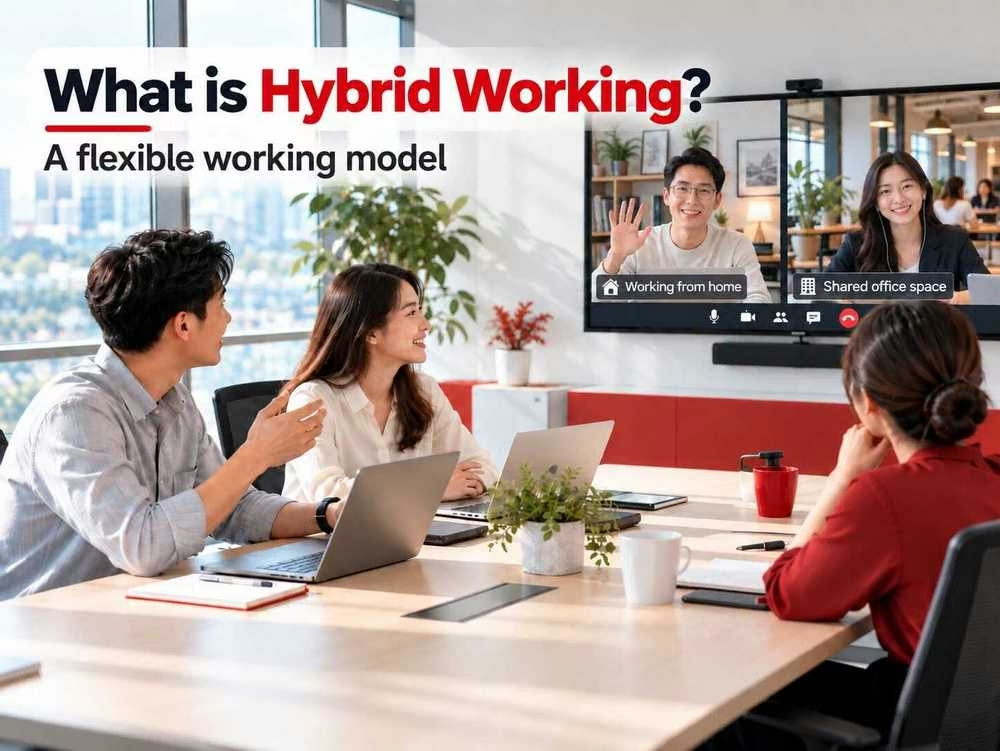
Hybrid working is a work model that lets employees split their time between the company office and a remote location, most commonly their home. The business sets the number of days or the time frame employees must be in the office. For the rest of the time, employees work remotely and coordinate with colleagues through online tools such as email, video conferencing software, and work management platforms.
Hybrid working sits between full-time office work (onsite working) and fully remote work (remote working). Employees gain flexibility in where they work while keeping face-to-face interaction with colleagues on office days. In the hybrid working model, the office is therefore no longer the only place of work, but a space for activities that require meeting in person, such as team meetings, training, and client work.
How is hybrid working different from work from home and remote working?
Hybrid working, work from home, and remote working differ in work location, the role of the office, and how team members coordinate with each other. Hybrid working combines the office with remote work, work from home replaces the office with the employee’s home, and remote working does not depend on an office at all. Work from home is a form of remote working in which the remote location is the employee’s home.
Hybrid working vs. work from home
Hybrid working differs from work from home (WFH) in that a hybrid working schedule includes office days, while WFH takes place entirely at home. Hybrid working allows employees to work remotely from many locations, such as home, a coworking space, or a satellite office… WFH defines a single location: home.
| Criteria | Hybrid working | Work from home (WFH) |
|---|---|---|
| Work location | The office and one or more remote locations | Home |
| Office days | Yes, on a fixed or flexible schedule, e.g. 2-3 days per week | Not part of the work schedule |
| Face-to-face interaction | Meeting colleagues on office days | Communication mainly through online meetings, email, and messaging |
| Work infrastructure | Company equipment and connection on office days, the employee’s own infrastructure on remote days | The employee’s own equipment, internet, and home workspace |
| Role of the office | A place for team meetings, training, and client work | Not part of the work schedule |
Hybrid working vs. remote working
Hybrid working differs from remote working in that hybrid working requires employees to be in the office on certain days, while remote working has no mandatory office days. Remote workers work from anywhere with an internet connection, including a different city or country from the company headquarters.
| Criteria | Hybrid working | Remote working |
|---|---|---|
| Office attendance requirement | Yes, as set by the business | Not required |
| Geographic limits | Employees live within commuting distance of the office | No limits |
| Work location | The office and remote locations near the office | Home, a coworking space, a café, or anywhere with internet |
| Role of the office | The shared workplace of the whole team | Optional, some businesses have no physical office |
| Coordination | A mix of in-person and online | Relies on online communication tools |
Common hybrid working models
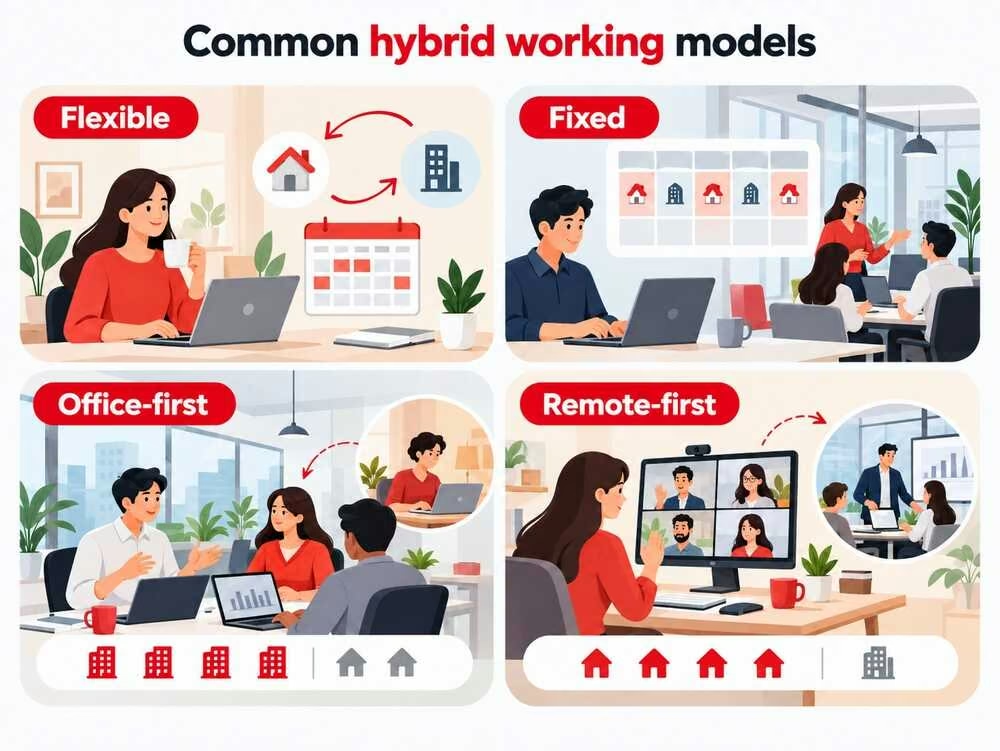
Hybrid working has 4 common models: flexible hybrid work, fixed hybrid work, office-first hybrid work, and remote-first hybrid work. The models differ in how much the business dictates the work schedule and where employees spend most of their time.
Flexible hybrid work
Flexible hybrid work is a model that lets employees decide for themselves which days to work in the office and which days to work remotely. The business sets no mandatory number of days, and employees decide based on work requirements and agreement with their manager. This model suits businesses with a culture that values autonomy and evaluates employees by results.
- Benefits: employees take more initiative and find it easier to balance work and life.
- Challenges: the business finds it hard to arrange office seating and to hold in-person meetings with full attendance without advance planning.
Fixed hybrid work
Fixed hybrid work is a model in which the business specifies the days employees work in the office, with the remaining days worked remotely. For example, employees are in the office on Monday and Wednesday. This schedule applies company-wide or separately to each employee or department.
- Benefits: the whole team is present on the same days, which makes team meetings, training, and project coordination easier. The business can forecast how many people will come to the office and plan seating and meeting rooms accordingly.
- Challenges: employees have less choice than with flexible hybrid work.
Office-first hybrid work
Office-first hybrid work is a model that makes the office the main workplace, with employees working remotely only a few days a week. This model suits businesses that prioritize face-to-face interaction and company culture, where remote work is an added benefit.
- Benefits: company culture, team spirit, and in-person collaboration are maintained.
- Challenges: the business saves less on office space costs and finds it hard to forecast daily attendance without specifying fixed days.
Remote-first hybrid work
Remote-first hybrid work is a model that makes remote work the default, with employees coming to the office only when they need to meet, train, or connect as a team. The office serves as a collaboration hub rather than a daily workplace.
- Benefits: the business cuts office space costs and widens its recruitment pool to more regions, as long as employees can reach the hub when needed.
- Challenges: employees can easily feel isolated, the business finds it harder to maintain its culture, and standardized technology infrastructure and workflows are required.
Why has hybrid working become a trend in Vietnam?
Hybrid working has become a trend in Vietnam because workers want flexibility, and businesses shifted to a hybrid model when bringing employees back to the office after social distancing. The trend began with a broader shift in the global labor market after the COVID-19 pandemic and was then reinforced by the specific context of Vietnamese businesses.
The global hybrid working trend
Hybrid working became a global trend after the COVID-19 pandemic, when businesses and workers found that remote work was workable and wanted to keep that flexibility alongside face-to-face interaction in the office. The trend shows in four points:
- Forecast: McKinsey forecasts that 66% of businesses will adopt a hybrid work model by 2030.
- Employee expectations: 73% of workers want to keep flexible remote work options, and 67% want more in-person time with colleagues, according to Microsoft’s 2021 Work Trend Index covering more than 30,000 people in 31 countries.
- Actual uptake: 87% of workers offered flexible work took it, working from home an average of 3 days a week, according to McKinsey’s 2022 survey of 25,000 Americans.
- Talent retention: 49% of remote or hybrid employees in the US would look for a new job if forced back to the office full-time, according to a 2021 Fortune-Momentive survey.
The adoption context in Vietnam
Hybrid working is growing in Vietnam thanks to the young workforce’s need for work-life balance, commuting pressure in major cities, and technology infrastructure that is sufficient for remote work. This context shows in four points:
- Worker demand: according to Microsoft’s 2021 Work Trend Index, 81% of Vietnamese workers want to continue working under this model, especially Gen Z.
- Urban traffic: rush-hour congestion in Hanoi and Ho Chi Minh City leads employees to favor companies that allow them to work from home a few days a week.
- Technology infrastructure: widespread internet access and tools such as Zoom and Microsoft Teams make remote work easy to implement.
- Business adoption: VNG, ELSA Speak, and MoMo let employees work from home and come to the office on certain days of the week.
Benefits of hybrid working
Hybrid working brings 4 main benefits: higher employee productivity thanks to a flexible schedule, better work-life balance, lower operating costs for businesses, and a wider talent recruitment reach. Employees control their working time and location, while businesses optimize costs and human resources and still maintain face-to-face interaction in the office.
Higher productivity and flexibility for employees
Hybrid working raises productivity because employees match the right type of work to the right place. Reports, data analysis, and programming require deep focus, so they suit remote days, when there are fewer interruptions. Team meetings, brainstorming, and training require face-to-face interaction, so they are reserved for office days.
Employees also have more control over their working hours. Those who work best early in the morning and those who are more productive in the evening can both schedule their most productive hours for important tasks.
A study by Stanford and Trip.com of 1,612 employees, published in Nature in 2024, found that the group working 3 days in the office and 2 days at home had productivity and promotion rates equal to the group working in the office full-time. Flexibility therefore does not reduce work performance.
Better work-life balance
Hybrid working helps employees balance work and life by saving commuting time and giving them more control over their personal schedule. On remote days, employees use commuting time to take children to and from school, care for family members, exercise, or rest. In Ho Chi Minh City and Hanoi, where rush-hour traffic jams are frequent, employees also experience significantly less stress when they don’t have to commute every day.
This balance helps employees stay longer with the business. In the same study, the resignation rate of the hybrid group was 33% lower than that of the full-time office group. The business thereby reduces the cost of recruiting and training new staff.
Lower operating costs for businesses
Hybrid working helps businesses save on operating costs because fewer employees are in the office each day, which reduces the space needed. The savings include:
- Rent: the business leases a smaller area, especially in central areas with high rents. This is the largest saving.
- Operating costs: electricity, water, cleaning, and maintenance fall in line with the area used.
- Fixed furniture and equipment: with hot desking, employees share desks by day, so the number of seats is lower than the total headcount, for example 60 seats for 100 employees.
- Commuting allowances: the business adjusts allowances when employees come to the office on fewer days.
Talent recruitment without geographic limits
Hybrid working widens the recruitment reach because candidates only need to be in the office a few days a week, not every day. The business is no longer limited to candidates who live near the office. Professionals in neighboring provinces and cities and in areas outside the center can take the job without relocating or facing a long daily commute.
A flexible schedule also attracts candidates who prioritize work-life balance, a group that usually has many job options. The business both recruits high-quality staff and improves its ability to retain them.
Challenges of implementing hybrid working
Hybrid working poses 4 main challenges for businesses: inequality between office-based and remote employees, disrupted communication and collaboration, data security risks, and uneven suitability across industries. A business that correctly identifies each challenge before implementation can build a hybrid work policy that fits its own operations.
Inequality between office-based and remote employees
Inequality arises when managers tend to favor employees who are regularly in the office, a phenomenon known as proximity bias. Remote employees therefore have fewer chances to be seen and recognized, even when they contribute equally. The gap shows in four points:
- Promotion opportunities: remote employees have less face-to-face interaction with managers, so they are overlooked for rewards, promotions, or important projects.
- Participation in decisions: many decisions take shape through quick exchanges in the office, so remote employees often receive information after things are settled and have little say in the final outcome.
- Access to resources: specialized equipment, licensed software, or documents stored at the company create difficulties for people working from home, making them slower to get work done than office-based colleagues.
- Gaps between roles: receptionists, warehouse staff, and technicians must be on site, while marketing, programming, and data analysis staff may work remotely. The group required to come to the office develops a sense of comparison and internal resentment.
Businesses reduce inequality by evaluating employees on output rather than presence, and by recording important decisions so everyone has equal access.
Disrupted communication and collaboration
Disrupted communication and collaboration occur when the team works across multiple locations, causing fragmented information, slow responses, and difficult coordination between office-based and remote staff. This challenge shows in five ways:
- Out-of-sync information: content is not updated promptly, so remote staff struggle to keep track of project progress.
- Hard-to-schedule coordination: the team spends a lot of time scheduling joint meetings and agreeing on response windows when each person works in a different place at a different pace.
- Misunderstandings in written communication: messages and emails lack body language and tone of voice, so recipients easily misread the intent.
- Fewer spontaneous discussions: the team loses the casual conversations in the office, which are where ideas emerge, problems get solved quickly, and new employees get guidance.
- Online meeting overload: the team adds more online meetings to make up for less face-to-face interaction, tiring employees out while still failing to replace spontaneous exchanges.
Businesses need to standardize internal chat tools, video conferencing software, and work management platforms to narrow the gap between the two groups.
Data security risks
Data security risks increase when employees access company systems from outside the office, through networks and devices that lack the layers of protection available at the company. The risks concentrate in four points:
- Unsecured networks: employees use home Wi-Fi or public Wi-Fi to access systems, making it easier for attackers to intercept data or install malware.
- Uncontrolled devices: personal computers without security software, computers shared with family members, or company computers taken to public places increase the risk of malware infection, loss, and theft.
- Hard-to-monitor access: the business struggles to track who accesses which data, from where, and how well each employee complies with information security rules.
- User error: employees working alone may click phishing emails or share data through unauthorized channels with no one to warn them in time.
Businesses need a security policy covering all three layers (devices, connections, and access rights), along with an IT team capable of continuous operation and monitoring. Common measures include VPN, multi-factor authentication (MFA), role-based access control, and information security training for employees.
Not suitable for every industry
Hybrid working only works well in industries where most work can be done on a computer and is not tied to a fixed location. Suitability falls into three groups:
- Highly suitable industries: IT, marketing, design, consulting, and accounting split schedules between the office and remote work fairly easily.
- Industries requiring physical presence: manufacturing, logistics, healthcare, education, hospitality, food service, and retail require employees to be on site. Hybrid working mainly applies to the administrative and HR functions of these industries.
- Strictly regulated industries: banking, securities, and insurance have rigorous processes and security regulations, so they usually apply hybrid working only to certain positions.
A formula for effective hybrid working implementation
The formula for effective hybrid working implementation has 3 elements: people, processes, and technology. People determine how well the model is accepted, processes help all employees operate consistently, and technology keeps office-based and remote employees connected. Without any one of the 3 elements, the model becomes unbalanced and hard to sustain in the long term.
People – the key to success
People are the deciding factor in whether hybrid working succeeds, because the model relies on employee autonomy and on managing by results rather than presence. Businesses need to prepare four points:
- Listen to needs: the business surveys and discusses with employees to understand their preferences for a suitable hybrid format, then gathers regular feedback to adjust the policy.
- Evaluate by results: the business uses KPIs or OKRs instead of time spent at the desk.
- Train skills: employees learn time management, independent work, and online collaboration. Managers learn to coordinate teams working across multiple locations and to assign work by results.
- Maintain engagement: the business organizes regular team-building activities so remote employees don’t become isolated from the team.
Processes – a foundation for transparency
Processes make hybrid working transparent and consistent because all employees follow the same set of rules, whether they work in the office or remotely. Businesses need to establish four points:
- Clear policy: the business sets the number of office and remote days, rights, obligations, and evaluation criteria for each position.
- Core hours: the business sets fixed time slots during the day, for example 10:00 – 12:00 and 14:00 – 16:00, when all members are online, meet, and handle shared work.
- Progress reporting rules: members update progress and document their work on a fixed schedule, helping the whole team stay informed without relying on constant meetings.
- Purpose of office days: the business reserves days with full attendance for team meetings, training, and team building, the activities that require meeting in person. Work requiring individual focus moves to remote days.
Technology – a launchpad for connection
Technology is the infrastructure that keeps teams working across multiple locations connected and coordinated as one unified group. Businesses need to equip 4 groups of solutions:
- Online communication: Microsoft Teams, Slack, and Zoom get information to the right people at the right time.
- Work management: Trello, Asana, and Monday.com track project progress in real time.
- Data security: virtual private network (VPN), two-factor authentication (2FA), access control, and data encryption.
- Office meeting equipment: cameras and microphones for meetings with remote participants.
Office space solutions for the hybrid working model
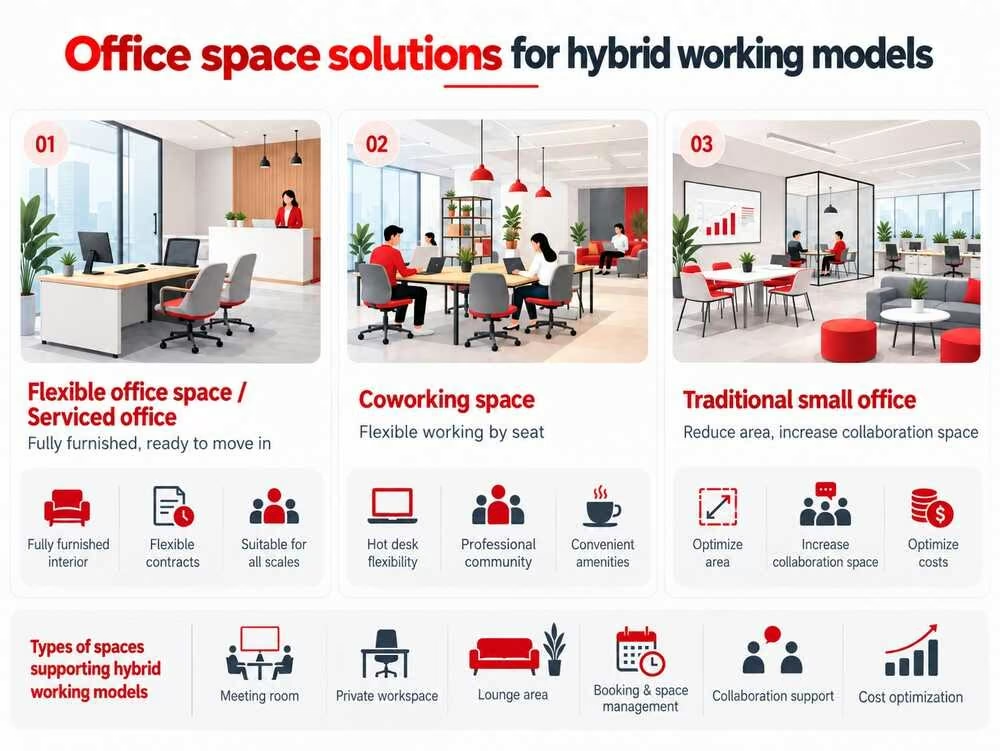
Hybrid working businesses have 3 office space solutions: serviced offices for teams of 10-30 people who need a ready-to-use private office, coworking spaces for groups of fewer than 10 people who need seats by the day or month, and downsizing a traditional office for businesses that already lease their own office. All three solutions address the same problem: the number of employees present each day is lower than the total headcount, so a fixed seat for every person becomes wasteful.
Flexible office / serviced office
A flexible office (serviced office) is a fully furnished space that comes with reception, cleaning, maintenance, and shared amenities. Hybrid working businesses use this solution to keep a professional workplace for the days employees come to the office, without investing in fit-out. This solution shows in four points:
- Suitable size: teams of 5-30 people.
- Lease term: typically 6 months to 2 years.
- Budget: no upfront fit-out or furniture costs, but the cost per seat is higher than a traditional office on a long-term lease.
- Limitations: the space offers little customization to reflect the brand identity.
Coworking space
A coworking space is a shared workspace where many individuals and businesses share work areas, meeting rooms, and amenities. Hybrid businesses rent by the seat rather than leasing an entire floor, so they pay only for the days employees actually use it.
Coworking has 3 types of plans: hot desk (non-fixed seat), dedicated desk (fixed seat), and small private rooms within the shared space.
- Suitable size: groups of fewer than 10 people.
- Lease term: by the day or month, with no long-term commitment.
- Budget: the lowest upfront commitment of the 3 solutions, with costs rising and falling with the number of seats used.
- Limitations: limited privacy, not suitable for work that frequently involves receiving clients formally or handling sensitive data.
Downsizing a traditional office
Downsizing a traditional office means keeping a private office but reducing the leased area to match the number of employees present at the same time. The business drops the one-desk-per-employee model, switches to hot desking, and devotes the remaining area to meeting rooms, group discussion areas, and reception areas. The office thus shifts from a daily workplace to a place for meetings, collaboration, and face-to-face contact.
- Suitable size: businesses that already have a private office, usually with 20 or more people.
- Lease term: traditional leases are typically 3-5 years, so reducing space mid-term depends on negotiation with the landlord.
- Budget: rent and operating costs fall with the area, but the investment already made in fit-out still has to be accounted for.
- Limitations: the space needs to be renovated, and the business remains bound by a long-term lease.
Frequently asked questions about hybrid working
This section answers two common questions: what remote working is, and whether hybrid working suits small businesses.
What is remote working?
Remote working is a form of work in which employees complete their work outside the business’s traditional office, at home, in a coworking space, at a café, or anywhere with a stable internet connection. Unlike hybrid working, remote working does not require employees to come to the office on a schedule.
Is hybrid working suitable for small businesses?
Hybrid working suits many small businesses because the model helps reduce space costs and increases appeal to candidates. How suitable it is depends on the nature of the work and how much the team needs to meet in person. Small businesses can consider three points:
- Space costs: the business leases a smaller office or uses a serviced office or coworking space, thereby reducing related costs such as electricity, water, and internet.
- Recruitment: a flexible work policy is a benefit that helps small businesses compete with large ones on salary and attract candidates from many locations.
- Implementation: a small headcount lets the business adjust policies and adopt online work management tools faster.
Hybrid working (a model that combines office-based and remote work) is no longer a stopgap solution. It has become a long-term way of operating for many businesses. When employees no longer need to be in the office every day, the workspace has to be rethought as well: more compact, more flexible, and well equipped enough for teams to collaborate effectively on in-person days. The next step is choosing a location that suits that model.
If your business is looking for office for lease in Hanoi or office for lease in Ho Chi Minh City, RSQUARE Vietnam can support you from defining the floor area and budget to selecting a building and negotiating the lease. With experience brokering offices in both major cities, RSQUARE helps businesses find a space that meets today’s needs and is flexible enough to adapt as working models continue to evolve.