A Home Office is an office set up inside an individual’s residence to serve business activities or regular work. This model increases productivity, saves time and costs, and offers flexible working hours. A Home Office also demands a high level of self-discipline, makes it hard to separate work from personal life, and makes it hard to monitor performance. This article compares the Home Office with a leased office, and outlines when to move to a leased office, which groups of businesses it suits, and the alternative types of offices.
What is a Home Office?
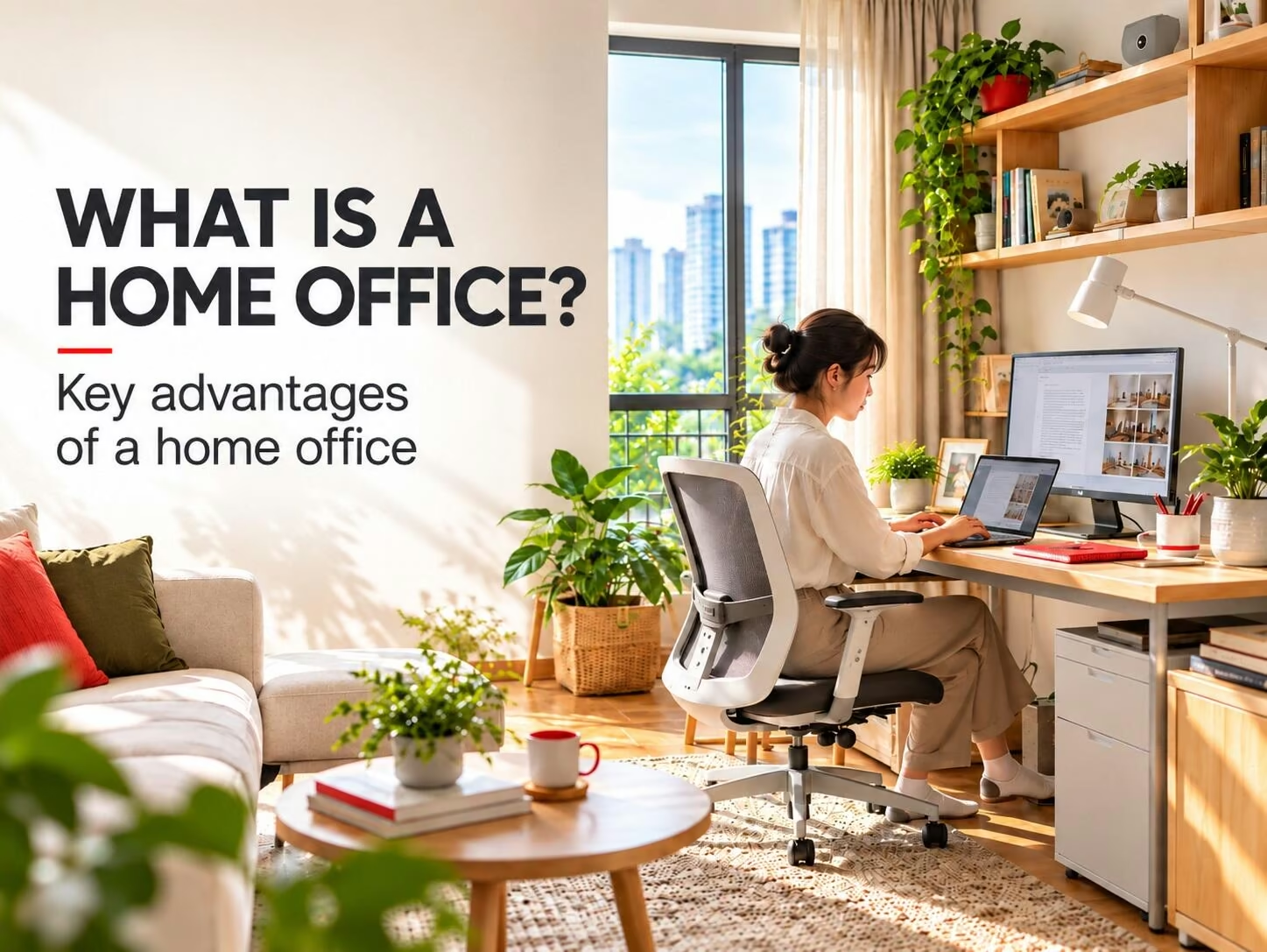
A Home Office (home-based office) is a space set up right inside a residence for working or running a business. It can be a work corner in the living room, or a separate room fully equipped with a desk, chair, computer, and office equipment.
Many people confuse a Home Office with Work From Home, but the two concepts describe different things:
- Home Office: A place of work, meaning a specific space in the home. Small business owners use this space to run daily operations, receive orders, and work with partners.
- Work From Home: A way of working in which employees work remotely instead of going to the company’s office. When working from home, employees can sit anywhere in the house, or use a Home Office if they already have one.
A Home Office suits newly established businesses, teams of fewer than 5 people, or work done mainly on a computer, because it saves on rental costs in the early stage. When a business adds staff and needs a meeting room, a reputable business address, and a space to receive customers, many business owners start looking to lease a dedicated office in order to operate more professionally.
Characteristics of the Home Office model
The Home Office model has 4 main characteristics: low operating costs, a flexible workspace, a compact scale, and suitability for certain specific industries.
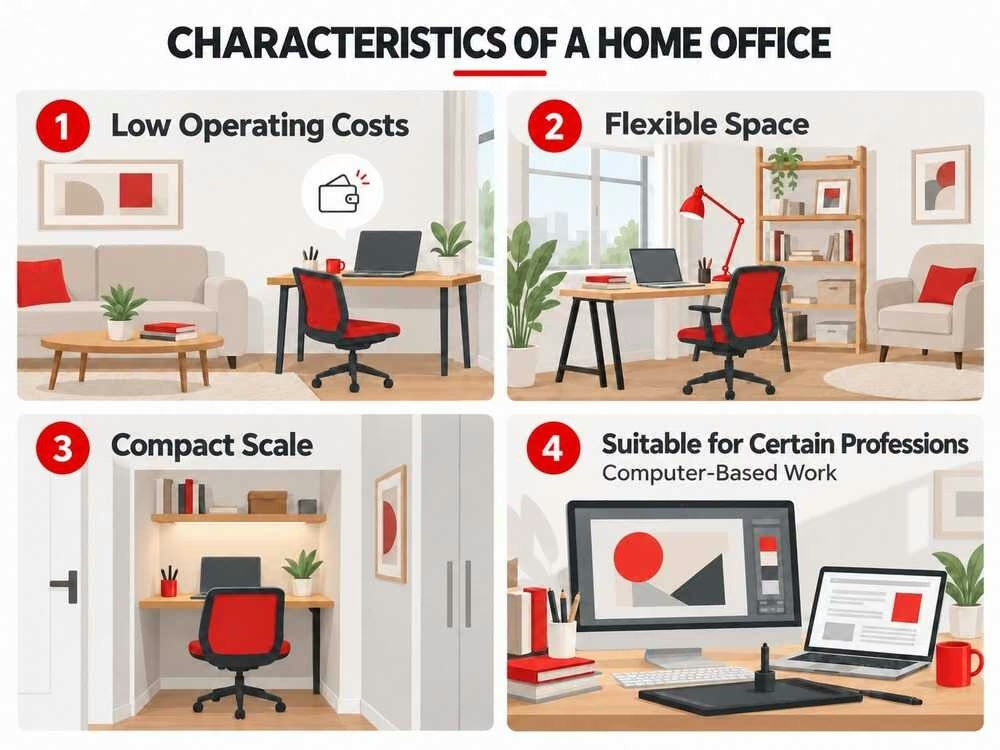
- Low operating costs: Businesses make use of existing space in the home, so they pay no monthly rent, management fees, or parking fees. Desks, chairs, laptops, and Internet are mostly already available, so setting up an office at home is fast and requires little initial investment. This is why many business owners choose this model as office rental prices in major cities keep rising.
- Flexible, self-directed space: Business owners arrange their work corner to suit their needs and set their own working hours. With no daily commute, the time available for work is used more effectively.
- Compact scale: Space in a residence is usually only enough for one to a few people to work. Large meetings, frequent customer visits, or expanding the team are difficult to carry out, and this is also why many businesses consider moving to a leased office as they grow.
- Suitable for certain industries: Jobs done mainly on a computer or independently, such as accounting, law, real estate agency, design, and consulting, are well suited to a Home Office. For these industries, a home space is enough to work in and can also host customers for small meetings.
What are the advantages of a Home Office?
A Home Office offers 3 main advantages for small businesses and independent workers: higher productivity, savings in time and costs, and flexible working hours.
Higher productivity
A Home Office increases productivity when workers control their own environment, with less noise and fewer of the interruptions common in a shared office. Workers choose the desk, chair, lighting, and sound that fit their personal habits. With no colleagues chatting or phone calls around, it is easier to stay focused for longer.
Saving time and costs
A Home Office helps a business save on rental costs and the expenses that come with them, and also removes commuting time. A business only needs to equip a laptop, Internet, and basic printing equipment to operate.
- Rental costs: You do not pay office rent or a security deposit. For a newly established business, this capital can go to products, advertising, or recruitment.
- Service, management, and parking fees: The monthly charges of an office building no longer apply. A business only needs a laptop, Internet, and basic printing equipment to operate.
- Commuting costs: You save on fuel, ride-hailing fares, or public transport tickets every day.
- Commuting time: In Ho Chi Minh City and Hanoi, rush hours often last a long time. Without traveling between home and the office, you can spend that time on work, rest, or family.
Flexible working hours
A Home Office lets you arrange your working hours according to your daily rhythm and business needs, instead of fixed office hours. You can start early to handle important tasks, extend your lunch break, or work later when you need to close an order or a contract, or meet partners in a different time zone.
This flexibility makes it easier to balance work and personal life, especially when you have young children or need to spend time with family.
What are the disadvantages of a Home Office?
A Home Office has three main disadvantages: it demands a high level of self-discipline, it is hard to separate work from personal life, and it is hard to monitor performance, while also not suiting every business.

Demands a high level of self-discipline
A Home Office demands that workers keep their own discipline because no one supervises them directly. Household chores, the TV, social media, and noise from the family are always close at hand, and every lapse in focus interrupts work and slows progress. Working alone, with little direct exchange with colleagues or partners, motivation fades gradually and tasks that are not urgent get pushed to the next day.
Hard to separate work from personal life
A Home Office makes it hard to separate work from personal life because both take place in the same space. With no clear clock-in and clock-out time, checking email in the evening stretches into working until late at night. Working many hours continuously causes stress, affects health, and reduces effectiveness the next day. Conversely, family matters intrude on working hours, interrupting work and taking time away from loved ones.
Hard to monitor performance and not suitable for every business
A Home Office makes performance hard to monitor because each person works in a separate environment, and the business owner cannot directly track each person’s progress and working hours. Inconsistent schedules and work habits lead to delays, and the larger the team, the clearer the problem becomes.
This model is also unsuitable for businesses that frequently receive customers or partners, or meet in person with many people, because a home has no meeting room or dedicated reception area. For industries that need to build credibility, such as law, finance, or consulting, a residential address reduces trust from the very first meeting, while customers value businesses with a clear office and business address.
How does a Home Office differ from a traditional leased office?
A Home Office differs from a traditional leased office in business address and image, facilities, costs, headcount, and the way work is organized. A Home Office is an office set up inside an individual’s residence, while a traditional leased office is a workspace rented in an office building.
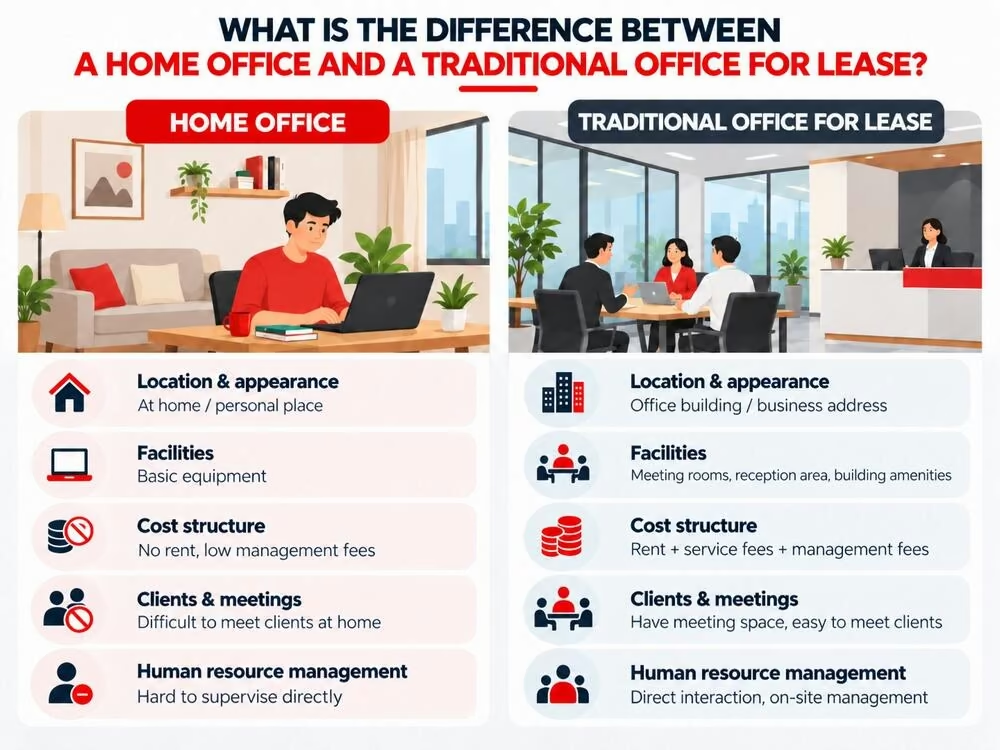
| Criteria | Home Office | Traditional leased office |
|---|---|---|
| Business address and image | Uses a residential address, with no signage or reception lobby | Located in a commercial building with a clear business address, creating a professional impression from the very first meeting |
| Facilities and customer reception | Uses the family’s desks, equipment, and Internet. With no dedicated meeting room or receptionist, the business owner meets clients at cafes or rents a meeting room elsewhere | Comes with a meeting room, receptionist, high-speed Internet, central air conditioning, and a fire protection system, and hosts customers right at the office |
| Costs | No rent, building management fees, or parking fees. Electricity, Internet, and equipment purchases still apply | Rent is charged by area each month, plus service fees and management fees. Fixed costs are higher, in exchange for ready-made infrastructure with no need to invest in it yourself |
| Headcount | Suits teams of fewer than 5 people. When more people are hired, the home runs out of seating and the family loses its privacy | Expands with the number of employees: move to a larger area or lease additional floors |
| Work organization | Self-directed hours and no commuting time. Workers keep their own discipline and separate work from family life themselves | Brings the whole team together in one place, with direct exchange, a fixed working rhythm, and progress managed on the spot |
A Home Office suits the starting stage, when a business prioritizes saving costs. A leased office suits the stage when a business hires more staff, receives customers, and needs a reputable business address.
When should a business move from a Home Office to a leased office?
A business should move from a Home Office to a leased office when headcount grows, the need to receive customers and partners becomes frequent, or work performance at home begins to decline.
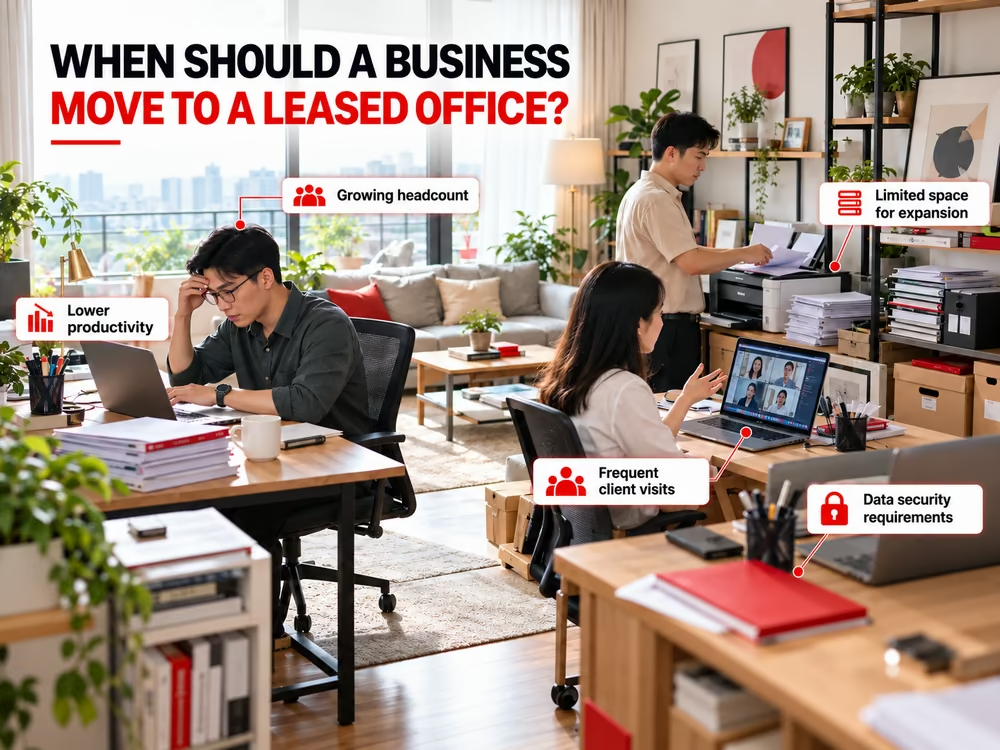
- Growing headcount: When the team adds people, each employee needs a fixed seat with matching desks, chairs, and equipment, which residential space cannot provide. A leased office brings the whole group into one shared space, so training, team meetings, and work discussions happen in person instead of through a screen.
- Receiving customers: When every week includes meetings with customers and partners or interviews with candidates, and the business has to meet at a cafe or rent a venue elsewhere, that is when a dedicated reception space is needed. A leased office has a meeting room and a customer reception area, helping the business create a professional impression from the very first meeting.
- Brand address: A private home address printed on contracts, business cards, and websites does not build as much trust as an address in an office building. Leasing an office gives a business a clear business address in a central area, while also keeping the business owner’s residence private.
- Infrastructure and security: A business that handles financial data or customer information needs dedicated infrastructure: a stable Internet connection, high-capacity printers and scanners, lockable cabinets for storing records, and access control. A leased office provides all of these, while the network and space at home are shared with family members.
- Work spilling into family life: When noise, schedules, and shared space affect each other, the business owner loses focus during work hours and loses rest time after work. A dedicated office separates work from living space, making progress and work discipline more stable.
Which businesses suit a Home Office?
A Home Office suits small businesses whose products or services are delivered mainly on a computer, with independent workflows and little need to receive customers in person at the office.
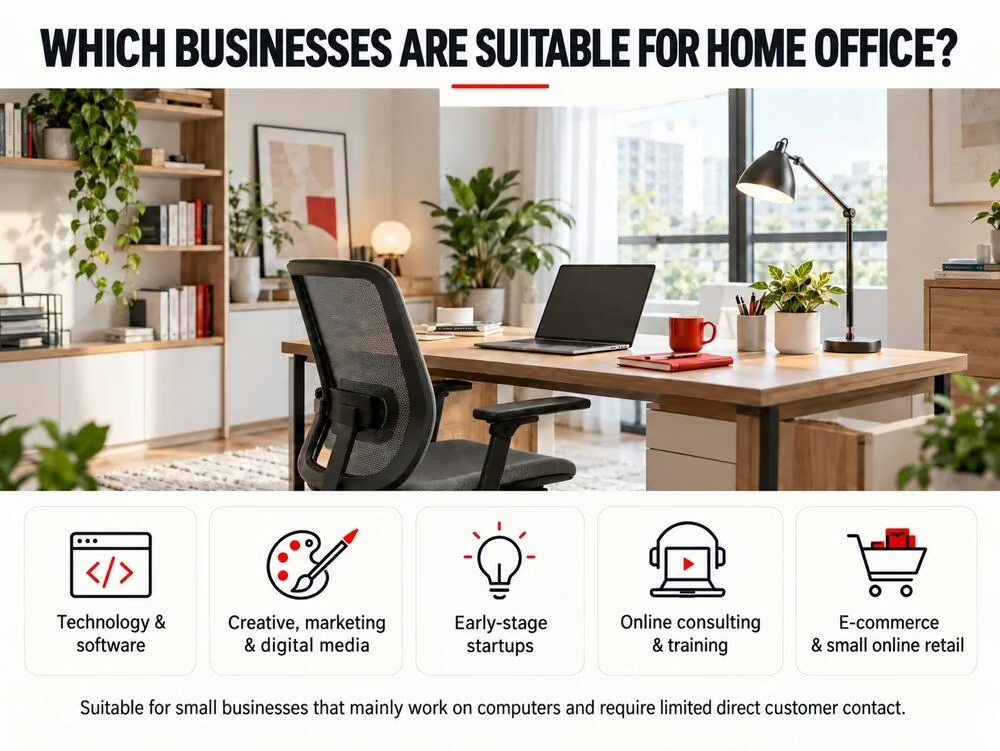
Typical groups of businesses include:
- Technology and software: companies that develop software, apps, and websites, and software outsourcing companies, because the work takes place on computers and online project management tools
- Creative, marketing, and digital media: marketing agencies, content, graphic design, video editing, and SEO, because the output is digital files
- Early-stage startups: small teams testing a product that need to keep fixed costs low
- Online consulting and training: remote consulting, translation, tutoring, and online learning centers, because they work with customers over Zoom or Google Meet
- Lean e-commerce: online business, dropshipping, and selling on e-commerce platforms that use third-party warehousing and delivery services
Types of leased offices that can replace a Home Office
There are 3 types of leased offices that can replace a Home Office: Coworking Space, serviced office, and shared office. Each type addresses a different need of a business working from home, from address and image to seating and a private working room.
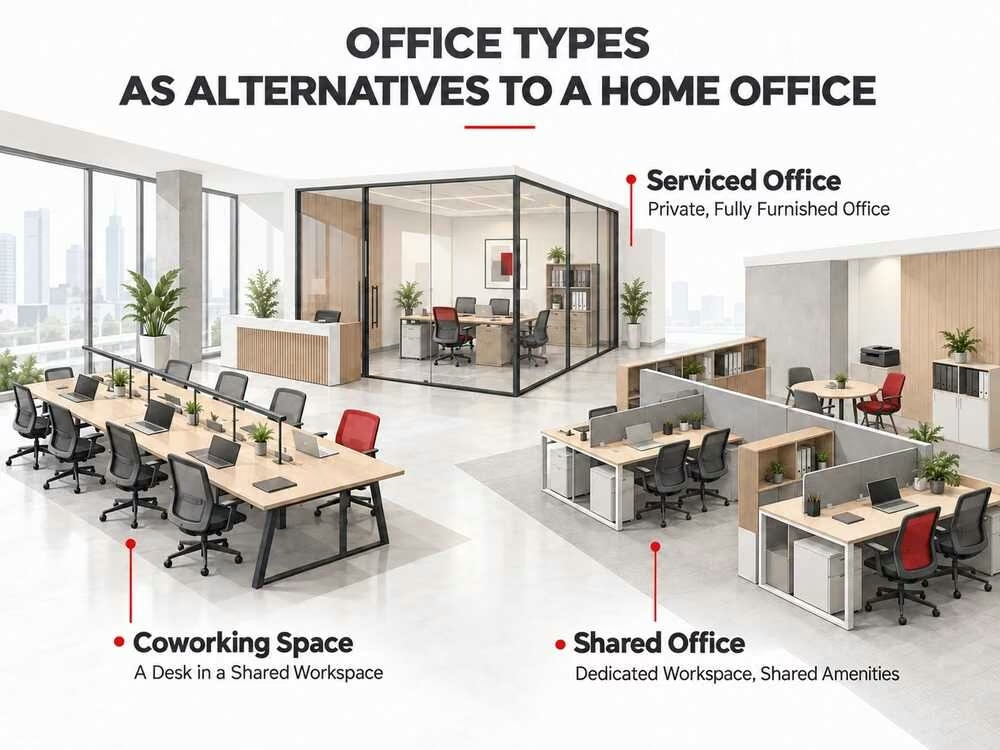
- Seats (Coworking Space): A business rents a flexible or fixed seat in a shared workspace, sharing Internet, printers, and meeting rooms. Costs are lower than renting a private room, suitable for freelancers and small teams who need a working environment outside the home.
- Shared Office: A business rents a floor area together with another business, each side has its own fixed working area and shares the costs of common areas. Unlike a Coworking Space, a business does not sit mixed with other companies, suitable for small teams that need their own area but do not yet need to lease a whole office.
- Serviced Office: A private working room that is already furnished and comes with operating services such as reception, cleaning, and Internet, so a business brings its computers and starts working right away. Contracts are shorter than for a traditional office, suitable for businesses that have just left a Home Office and need a private working room for their team.
Frequently asked questions about Home Office
The three questions businesses commonly ask when running a Home Office concern the business address, electricity, water and Internet costs, and the relationship with hybrid working.
Do I need to register a business address when running a Home Office?
Yes, a business still has to register a head office address when working from home, because this address is mandatory information in the business registration dossier. The address must be clearly identifiable, and not every type of residence can be used as a head office, for example an apartment in a residential condominium building. A business that does not want to use a residential address can lease an address in an office building.
Can electricity, water, and Internet costs of a Home Office be counted as company expenses?
Electricity, water, and Internet costs of a Home Office can be counted as business expenses when the following conditions are met:
- Invoices and documents: there are invoices and supporting documents for the expense
- Relevance to business activities: the expense is tied to the business’s operations
- Service contract: a contract in an individual’s name, or one shared with household use, needs to be clarified before it is recorded in the accounts
Is a Home Office the same as hybrid working?
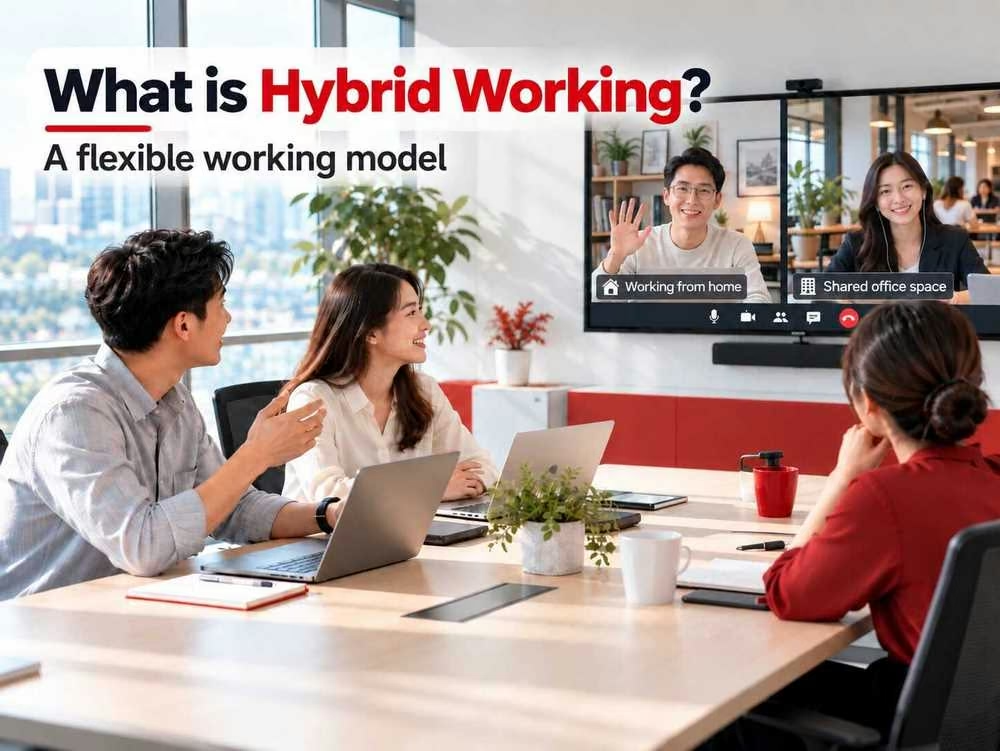
No, a Home Office is a place of work located in a residence, while hybrid working is a working model that combines the office and remote work. A Home Office can be part of a hybrid arrangement when staff alternate between the company office and their own homes.
A Home Office, or home-based office, suits small businesses, early-stage startups, and independent workers. The advantages of this model are saving costs and controlling your own time, in exchange for requiring a high level of self-discipline and accepting limits on space for receiving customers as well as on managing a team. When headcount grows, customers need to meet in person more often, or work performance at home declines, that is the time to move to a leased office. A business can start with a virtual office, a Coworking Space, or a serviced office. If you are looking for a leased office in Ho Chi Minh City or a leased office in Hanoi, RSQUARE Vietnam is ready to advise on a choice that fits your business’s scale and stage of development.