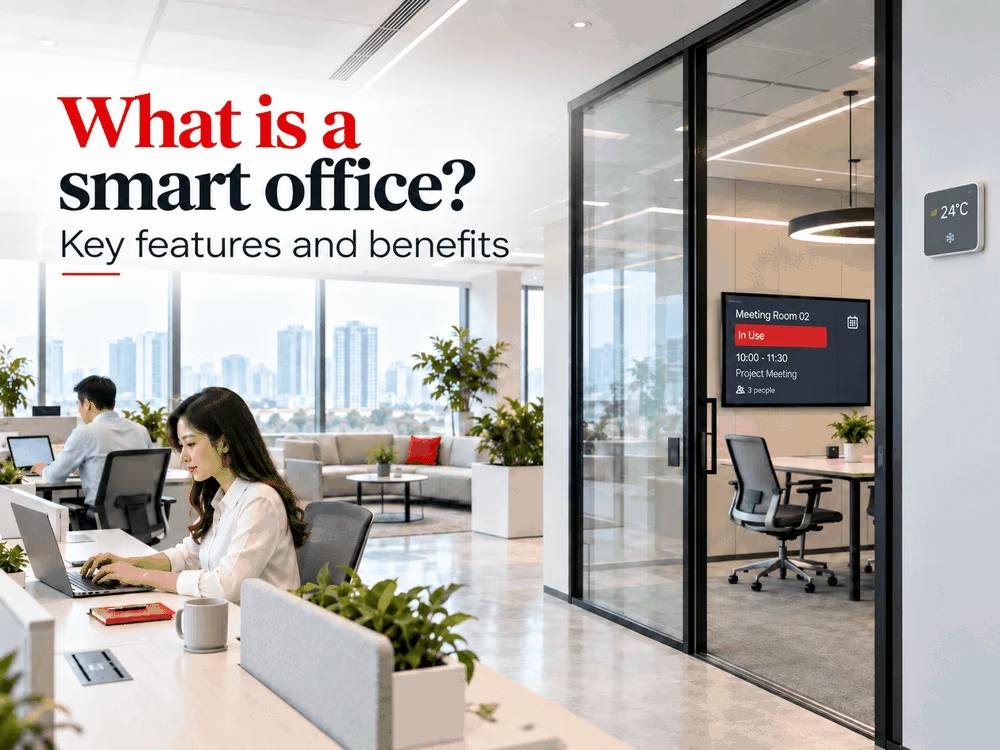
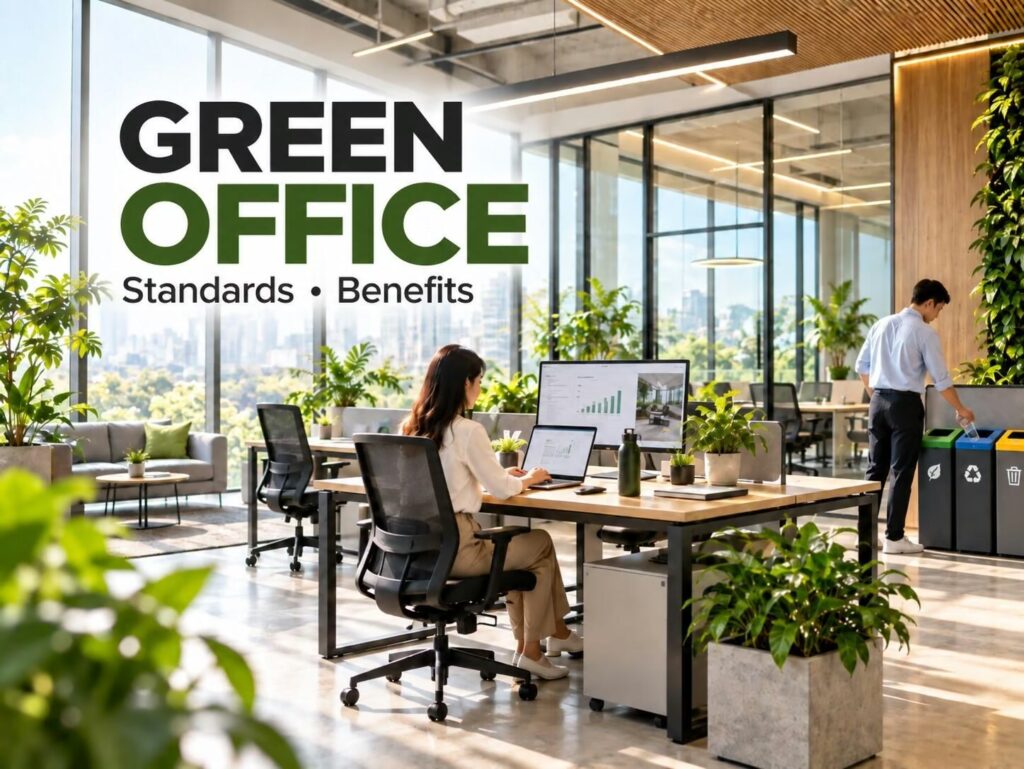
A modern office is a workspace that is organized and designed to be flexible and comfortable, using modern technology to boost employee productivity and experience. This article explains what a modern office is, what its features are and how it differs from a traditional office. It also covers 5 types and 5 popular design styles, then looks at the benefits, drawbacks, design principles and how to choose the right office for your business.
What is a modern office?
A modern office is a workspace that is organized and designed to be flexible and comfortable, using modern technology to boost employee productivity and experience.
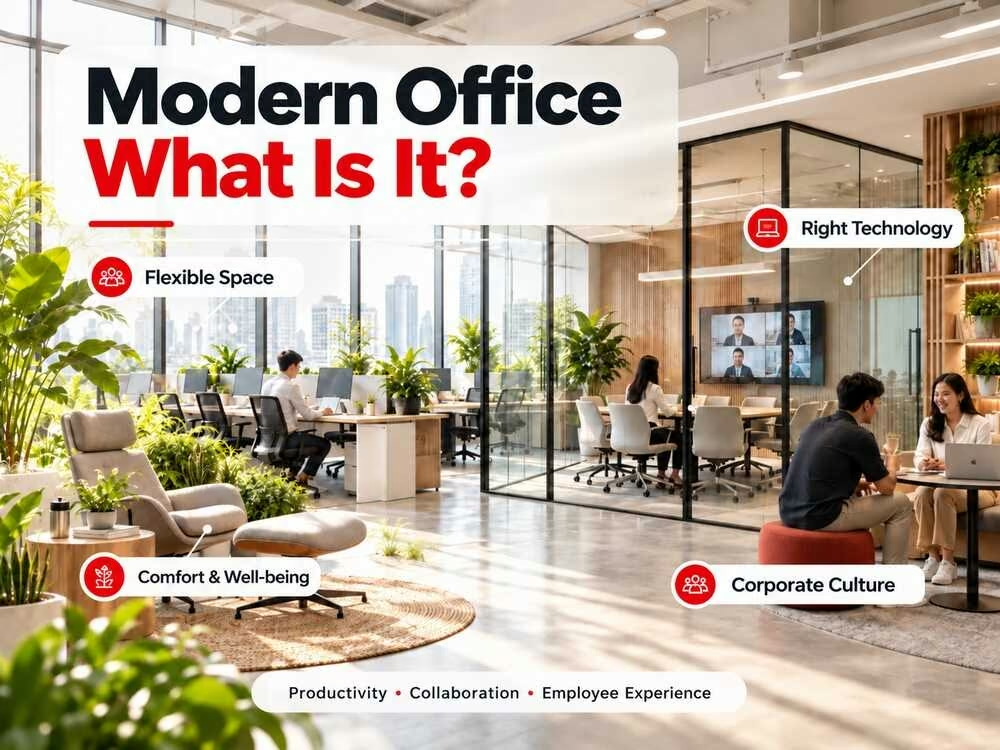
A modern office has 3 components:
- Flexible space: a flexible layout with shared work areas, team meeting rooms and focus areas. Employees choose where to sit based on the type of task, and businesses can easily adjust the layout as headcount changes.
- Modern technology: stable network infrastructure, video conferencing equipment and access control systems. Work runs smoothly, even when part of the team works remotely.
- Comfort and well-being: natural light, greenery and good ventilation. A pleasant environment helps employees work more comfortably and stay focused.
These components serve 3 goals: boosting productivity, supporting collaboration between teams and improving the employee experience. Technology is only one component, so a modern office can start with basic equipment. The level of investment depends on headcount, the nature of the work and the business’s budget.
What are the features of a modern office?
A modern office has 5 key features: flexible space, digital technology infrastructure, comfort and well-being, aesthetic multifunctional furniture, and hybrid work support.
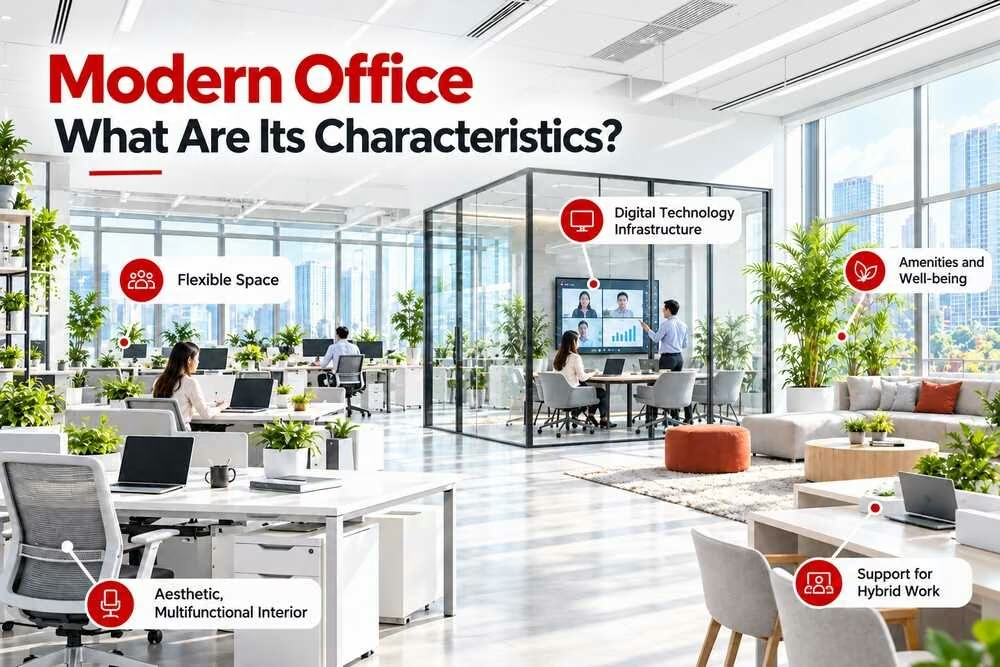
- Flexible space: an open layout with focus areas, team meeting areas and relaxation areas, along with movable partitions and easily rearranged furniture. Businesses can adjust the layout to their headcount and way of working without major renovation.
- Digital technology infrastructure: a stable network and video conferencing equipment let employees meet remote colleagues and external partners without interruption, while access control systems make it easier for businesses to manage who comes and goes.
- Comfort and well-being: natural light, ventilation, greenery and soundproofing for work areas. A pleasant environment helps employees stay focused and comfortable throughout the long workday.
- Aesthetic multifunctional furniture: desks and chairs matched in color and style, combined with sit-stand desks, ergonomic chairs and built-in charging ports at desks. The furniture makes a good impression on clients and candidates while supporting daily work.
- Hybrid work support: shared desks, desk booking systems and lockers for staff on rotation. A hybrid model combining office and remote work helps businesses use their space efficiently when employees are not all in at the same time.
How is a modern office different from a traditional office?
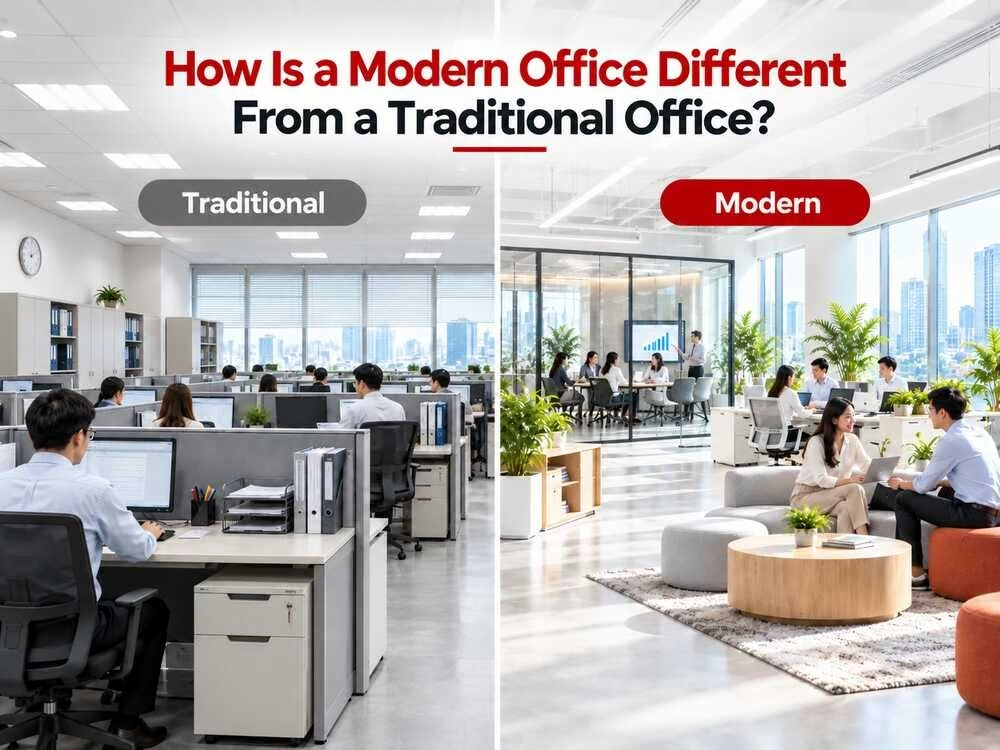
A modern office differs from a traditional office in 5 criteria: space layout, work model, technology infrastructure, interaction culture and employee experience. Both types need enough space, equipment and people, but they are organized differently.
| Criteria | Traditional office | Modern office |
|---|---|---|
| Space layout | Private rooms, partitions, fixed desks by department | Open space with functional zones: focus areas, team meeting areas, relaxation areas, phone booths |
| Work model | Fixed seating, working at the office during business hours | Flexible seating (hot-desking), combining on-site and remote work |
| Technology infrastructure | Standalone equipment, many processes still paper-based | Equipment and software connected via a stable network, collaboration software, video conferencing rooms |
| Interaction culture | Communication within each department, mainly through in-person meetings | A mix of in-person meetings, email and video meetings across departments |
| Employee experience | Focused on work functions | Emphasis on well-being and comfort: natural light, ventilation, greenery, ergonomic furniture |
What types of modern offices are there?
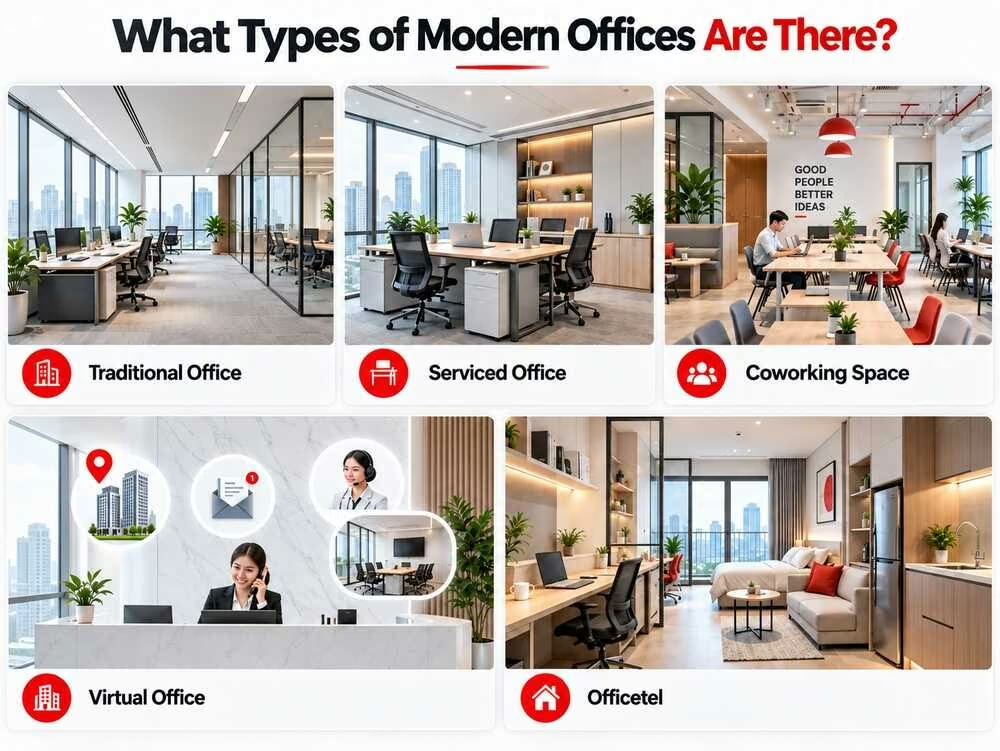
There are 5 types of modern offices: standard leased offices, serviced offices, co-working spaces, virtual offices and officetels.
Standard leased office
A standard leased office is where a business leases its own floor space in an office building under a long-term contract. The business invests in its own furniture and equipment and lays out the space to suit how it operates. A private space lets the business express its brand identity clearly, so this type suits companies with a stable team and long-term plans at one location.
Serviced office
A serviced office is a private office that comes with furniture, internet, reception and cleaning services, so the business can move its staff in and start working right away. The business pays one fee for all amenities, without having to set things up or find each service provider. Unlike a co-working space, the business still has its own private space, which makes it suitable when it needs to start operating quickly.
Co-working space
A co-working space is a shared workspace where many businesses and individuals rent seats or meeting rooms as needed. Everyone shares high-speed Wi-Fi, meeting rooms, lounges and a kitchen, so costs are much lower than leasing a private space. It is a familiar choice for startups and fast-growing small and medium-sized businesses, with the added advantage of connecting to the surrounding community.
Virtual office
A virtual office is a service that provides an address for business registration and receiving mail, with no fixed workspace. Providers usually include call answering, mail forwarding and hourly meeting room rentals for client meetings. Employees work elsewhere, so small businesses save significantly on space costs while keeping a professional image.
Officetel
An officetel is an apartment that combines workspace and living space, with a name formed from “office” and “hotel”. These units usually come furnished, making it easy for employees to move between work and rest in the same place. Since one unit serves both functions, it helps small businesses with limited budgets cut costs.
What benefits does a modern office bring to businesses?
A modern office brings 5 key benefits to businesses: higher productivity, attracting and retaining talent, optimized leasing costs, stronger collaboration and a stronger brand image.
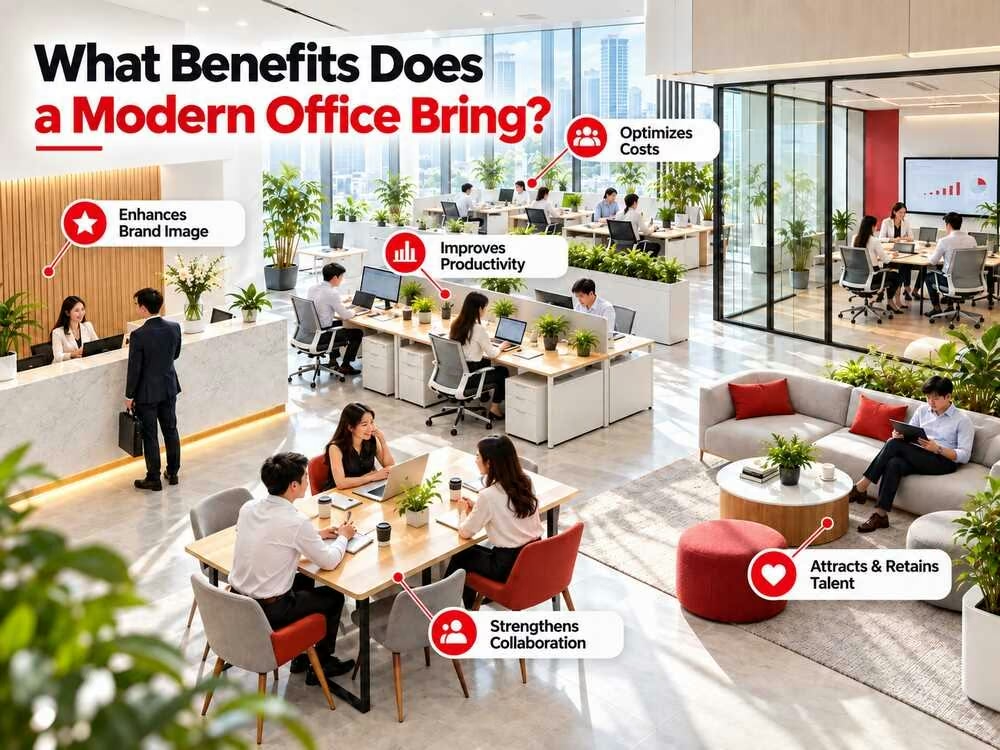
- Higher productivity: The office is divided into functional zones such as focus areas, team meeting areas and private phone booths. Employees are less distracted, and video conferencing equipment keeps work running when some staff work remotely.
- Attracting and retaining talent: A well-designed space with plenty of natural light, greenery and ergonomic furniture (which supports proper sitting posture) helps employees feel less tired after each workday. A pleasant environment makes employees want to stay longer and gives the business an edge in recruitment.
- Optimized leasing costs: Flexible seating allows employees to share desks by shift or by day. When staff work on rotation or partly remotely, the business does not need to lease space for its entire headcount at once.
- Stronger collaboration: The pantry and lounge give employees from different departments a place to meet and talk naturally. Issues between teams are resolved faster as a result.
- Stronger brand image: The office is where clients and partners interact with the business in person. A professional space makes a good impression from the very first visit.
What drawbacks of a modern office should you consider?
A modern office has 5 drawbacks businesses should consider: investment and operating costs, noise and distraction, lack of privacy, weaker team bonding and management challenges.
- Investment and operating costs: flexible furniture, video conferencing equipment and access control systems require an upfront budget, plus regular maintenance costs. Costs grow with the scale of adoption, so businesses should factor this into their leasing budget from the start.
- Noise and distraction: open spaces let conversations, phone calls and typing carry widely. Roles that need deep focus, such as accounting, programming or content editing, are easily interrupted.
- Lack of privacy: fewer partitions make sensitive matters such as contracts, HR and client data hard to keep confidential during discussions. Businesses need small meeting rooms or private phone booths to handle these matters.
- Weaker team bonding: with hot-desking, employees have no fixed place for personal belongings and see colleagues in person less often. Lockers and regular team meetings help reduce this problem.
- Management challenges: flexible work means employees meet in person less often, so managers find it harder to track work by seeing who is present. Businesses need to shift to results-based evaluation, set clear goals and hold regular team meetings.
How do you choose the right modern office for your business?
Businesses choose a modern office based on 7 criteria: employee experience, work model, area, budget, building location, infrastructure and scalability.
- Employee experience: Employees spend most of their day at the office, so ventilation, natural light and ergonomic furniture directly affect their comfort and motivation. This is the core criterion of a modern office.
- Work model: Businesses need to determine whether employees work at the office or in a hybrid model. Departments such as accounting, programming and legal need quiet work areas, while marketing, sales and design need collaboration areas with team meeting rooms.
- Area: Area is calculated based on current headcount and growth plans, plus functional spaces such as meeting rooms and reception areas. Getting it right from the start helps businesses avoid leasing too little or too much space.
- Scalability: As headcount grows, businesses need to lease additional space in the same building without relocating. Businesses should ask in advance about the building’s remaining vacant space.
- Budget: Costs include monthly rent, service fees, upfront furniture and technology, and long-term operating costs. Businesses with a tight budget can still choose a modern office with a minimalist design that keeps the model’s core advantages.
- Building location: Convenient transport links for employees and clients make daily commuting easier. Basement parking, elevators, dining areas and green certifications such as LEED or LOTUS are amenities that improve the quality of work in the building.
- Infrastructure: Internet, power supply and 24/7 security ensure work is not interrupted and the business’s assets are protected.
Modern office design principles
Modern office design follows 6 principles: putting people at the center, flexible space layout, making use of natural light, adding greenery, balancing open and private spaces, and integrating technology.
Modern office design follows 6 principles: putting people at the center, flexible space layout, making use of natural light, adding greenery, balancing open and private spaces, and integrating technology.
grating technology and multifunctional furniture, and expressing brand identity.
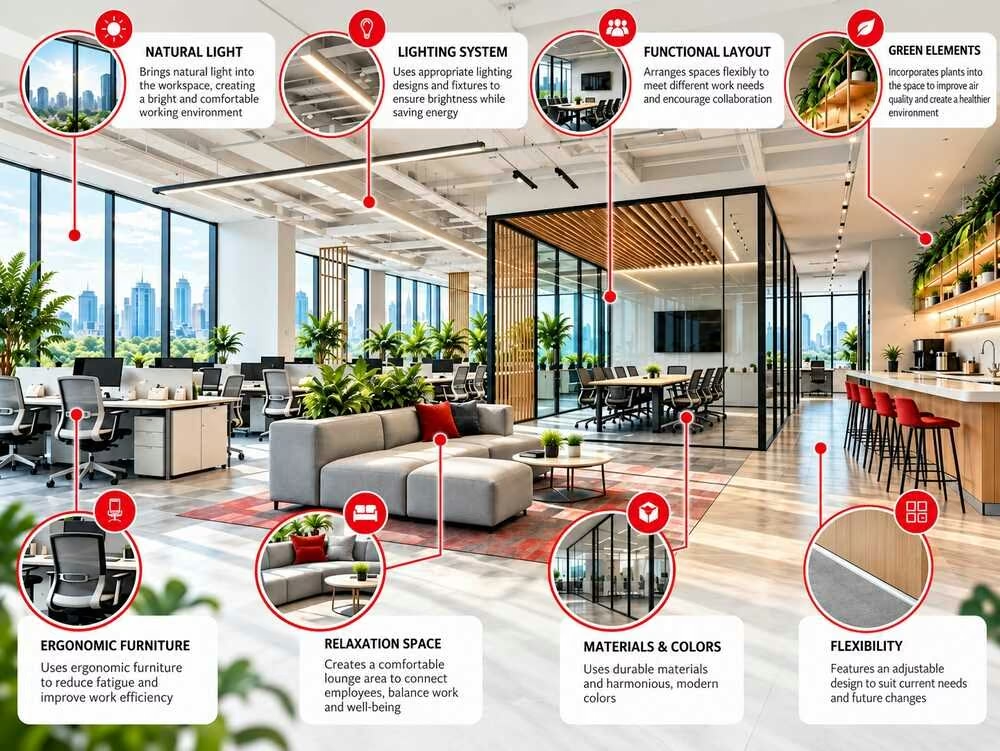
- Putting people at the center: Sit-stand desks, ergonomic chairs and clear walkways help employees work comfortably and move around easily. Employees feel less tired when working long hours.
- Flexible space layout: Quick discussion corners, phone booths, relaxation areas and multipurpose meeting rooms support many different ways of working. Movable furniture lets businesses change the layout as headcount changes without major renovation.
- Making use of natural light: Large windows, high ceilings and desks placed near windows let light reach deep into the office. Natural light makes the space airier and more pleasant, while reducing the time lights are on during the day.
- Adding greenery: Plants placed in shared work areas, corridors and relaxation areas help improve air quality. Greenery also helps employees reduce stress and relax between working hours.
- Balancing open and private spaces: Carpets, acoustic partitions and sound-absorbing ceilings reduce noise in shared work areas. Quiet zones are reserved for work that requires deep concentration.
- Integrating technology: Stable Wi-Fi, pre-installed power outlets, underfloor cabling and video conferencing screens keep work seamless while keeping desks tidy. A building management system (BMS) helps save operating energy.
Notable examples of modern offices
Several modern offices around the world show how businesses are organizing their workspaces in increasingly diverse ways. Microsoft in Amsterdam, Eneco in Rotterdam and W. L. Gore in Maryland are three typical examples of flexible work models, collaborative spaces and open design.
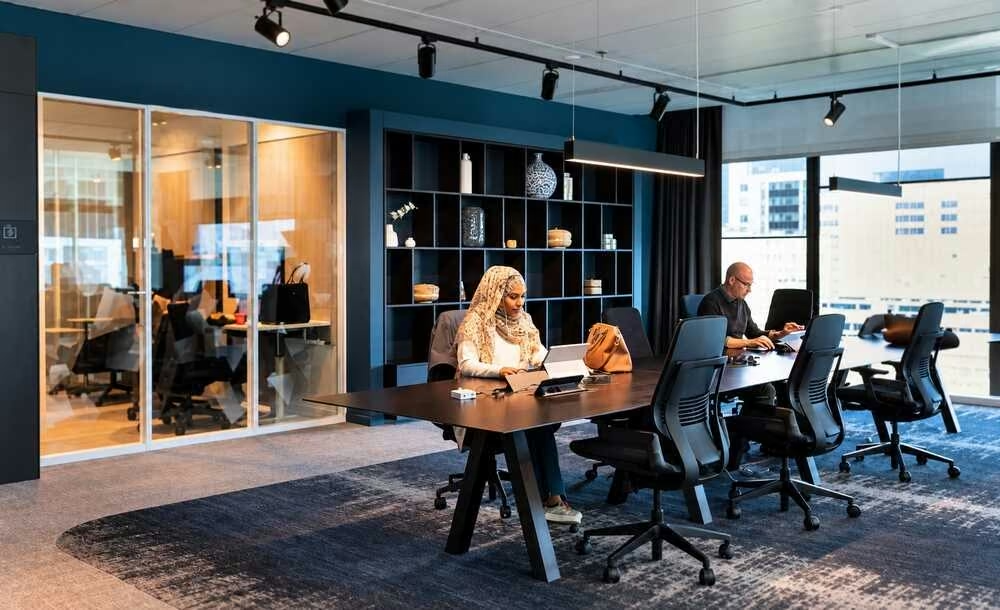
- Microsoft office in Amsterdam: developed by Sevil Peach and Veldhoen + Company based on the activity-based working model. Employees do not use fixed desks but choose the area that suits each activity, such as focused work, team meetings or discussions. The office also provides meeting rooms, a café area and personal lockers instead of each employee having their own desk.
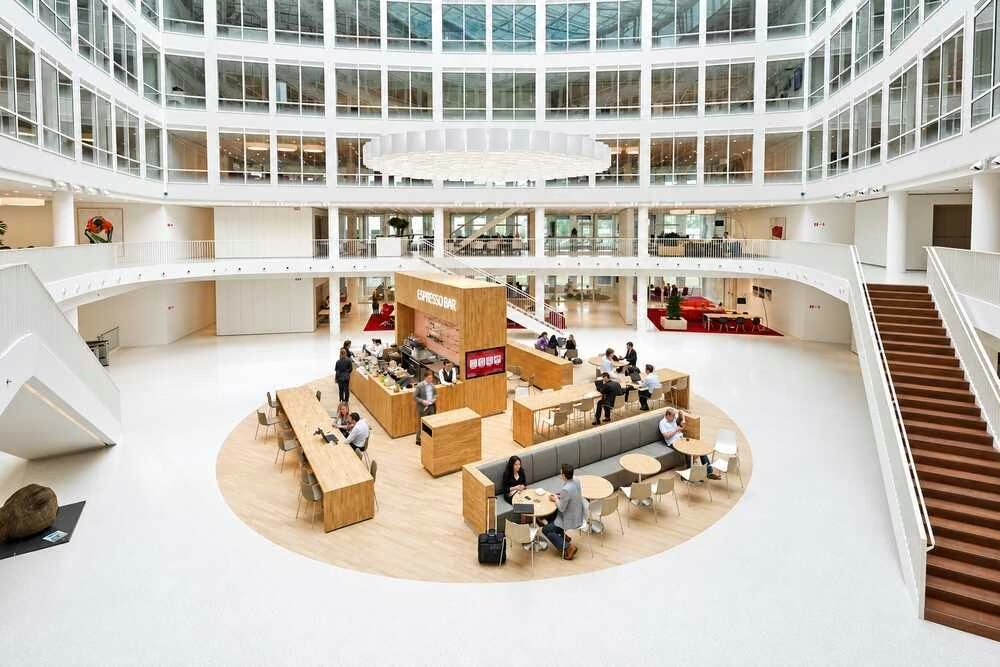
- Eneco headquarters in Rotterdam: designed with a central atrium connecting work areas, meeting rooms, reception areas and shared social spaces. The office uses a flexible work model, with about 1,500 workstations serving about 2,100 employees. This layout reflects the trend of using space based on actual needs rather than assigning one desk to each person.g one fixed desk to each person.
- W. L. Gore office in Elkton, Maryland: uses an open and flexible floor plan, combining individual work areas with meeting rooms and collaborative spaces. The design brings natural light deep into the office and reduces reliance on private offices. The project also received an interior design award from IIDA PA/NJ/DE in 2011.
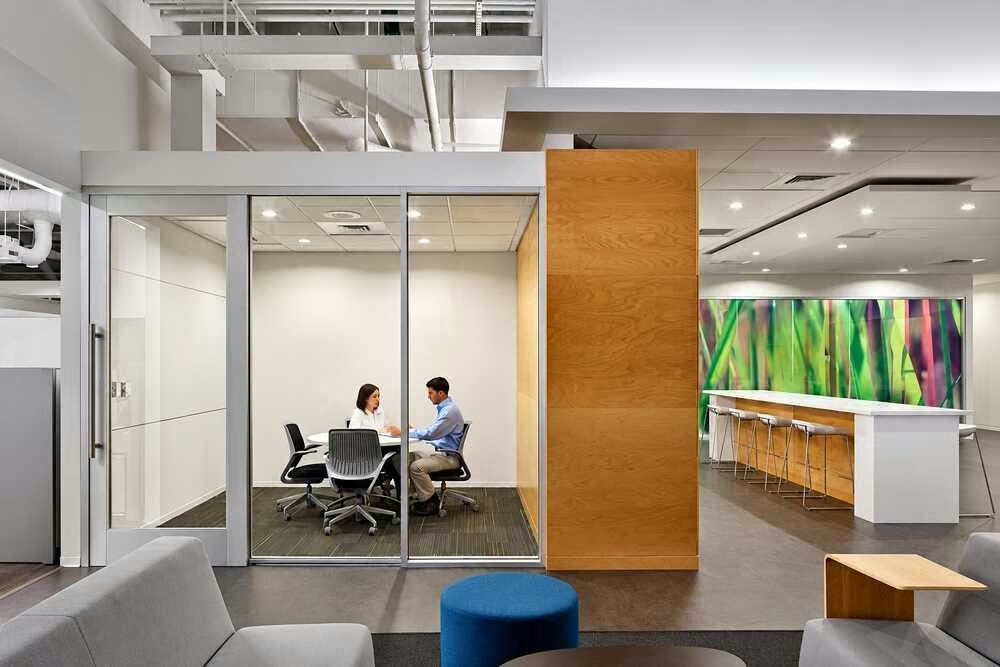
The three examples above show that there is no single layout model for a modern office. What they share is less fixed space, more choice of work areas and a floor plan organized around each employee activity.
Frequently asked questions about modern offices
Businesses often ask 3 questions about modern offices: whether leasing costs are higher than for a traditional office, whether small businesses should choose one, and whether to lease a new office or redesign the existing one.
Is leasing a modern office more expensive than a traditional office?
A modern office is not necessarily more expensive than a traditional office, because rent depends mainly on location, building grade and office type. Upfront investment rises when the business equips its own furniture and technology, while a serviced office already includes the infrastructure in its monthly fee. Businesses should compare total costs rather than rent alone, including:
- Monthly rent and service fees
- Upfront furniture and technology costs
- Long-term operating and maintenance costs
Should small businesses choose a modern office?
Small businesses should choose a modern office when they pick the right type for their budget and headcount. They do not need to invest in every technology, because what makes an office modern is how the space is organized, and it can start with a minimalist design. Suitable options include:
- Virtual office: suits newly established businesses that only need an address and support services.
- Co-working space: suits startups and small teams that need seats and meeting rooms as needed.
- Serviced office: suits businesses that need a private office that is already furnished and operated.
Should you lease a modern office or redesign your existing office?
Businesses should lease a modern office when they need to start operating quickly and limit upfront investment, and should redesign their existing office when they need control over the layout and brand identity. According to Cushman & Wakefield (2025), fitting out a new office in Ho Chi Minh City costs about 656 USD/m² (about 16.7 million VND/m²), while upgrading an existing office costs about 344 USD/m². Three factors to compare:
- Time to move in: a fully finished office is ready sooner, while renovation needs time for design and construction.
- Upfront cost: leasing an office with existing infrastructure reduces capital investment, while renovation requires a budget for design, furniture and technology.
- Level of design control: renovation allows a layout tailored to the business’s needs and brand identity.
A modern office is a flexible, comfortable workspace that applies suitable technology to boost productivity and reflect company culture. Businesses can choose from 5 types (standard leased, serviced, co-working, virtual offices and officetels) and 5 design styles (green, smart, minimalist, industrial and high-tech). Each option brings its own benefits, along with drawbacks in cost, noise and privacy. The right office depends on your work model, headcount and budget.
To make that happen, the first step is choosing the right building in the right location. If you are considering office for lease in HCM, you will find plenty of options in central districts with modern technical infrastructure, ready to support a smart working model. If your business is expanding northward, the office for lease in Hanoi market also has many buildings upgrading their management systems and amenities to keep up with this trend.
If you are not sure where to start, you can talk to RSQUARE Vietnam. RSQUARE’s advisory team supports businesses from defining requirements and comparing buildings to negotiating lease terms, helping you find a space that fits your budget and has the foundation to build a truly smart office.