Signing an office lease agreement determines a business’s costs and stability for years to come, yet many tenants only discover unfavorable clauses after they have moved in. This article helps you choose the right office lease agreement template, whether for a floor lease, a serviced office, a coworking seat, a house used as an office or a bilingual English – Vietnamese version. You will also learn which clauses the agreement should contain, which appendices to attach, how a broker can support you, and find answers to common questions before signing.
Standard office lease agreement templates
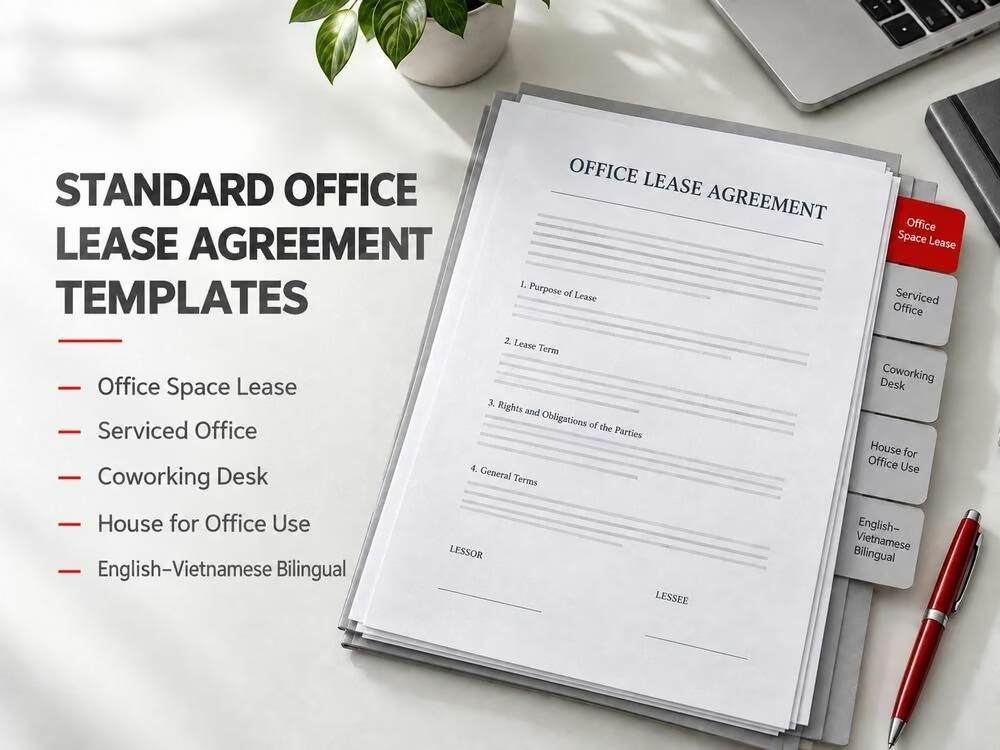
Depending on how you plan to use the space, your business can choose from several office lease agreement templates, from floor leases, serviced offices and coworking seats to houses used as offices and bilingual English – Vietnamese agreements. Who is each type suited to, and what needs to be clarified before signing?
Office floor lease agreement template
The office floor lease agreement template suits businesses leasing an entire floor or a large area in an office building, designing their own interior and running their own operations. When signing, you should clarify the following 4 groups of content:
- Area and how the leasable area is measured: depending on the building, the leasable area may include only the floor space you use exclusively, or it may also include an allocated share of common areas such as the lobby, corridors or shared restrooms. The agreement should state the area figure and calculation method, and attach a floor plan. This way you know exactly how many square meters you are paying for and how much you can actually use.
- Costs beyond rent: in addition to the rental rate, you also need to account for the management fee, VAT, electricity and water, after-hours air conditioning, parking fees and other services. The agreement should list each item, how it is calculated and which party bears it, so your total costs do not exceed expectations.
- Fit-out period and rent commencement date: a floor lease usually requires time for interior construction before you can move in. The agreement should lock in the handover date, the fit-out period, whether rent is waived during this period and the date rent starts being charged.
- Building operation rules: tenants must comply with the building’s regulations on operating hours, security, fire safety and construction conditions. These rules should be attached as an appendix so you understand them before signing, instead of only discovering the limits after you have moved in.
Download here
Serviced office lease agreement template
The serviced office lease agreement template suits businesses that need to start working quickly in a room that comes with furniture, internet, reception, meeting rooms and operating services. Since prices are usually quoted as a package, you should check carefully that the agreement clearly shows the following 4 points:
- What the rent includes: the agreement should list exactly what the package price covers, such as furniture, internet, reception, cleaning, electricity and water or meeting rooms. Any item not included in the price must be stated clearly so you are not charged unexpectedly.
- Amenity limits within the package: many amenities can only be used up to a certain level, such as meeting room hours, the number of visitors or the number of parking slots. The agreement should state these limits and how overuse is charged.
- Additional charges: beyond the package price, there may be extra charges such as after-hours air conditioning, printing, additional seats or private services. The agreement should list each additional charge and how it is calculated, making it easier to budget monthly costs.
- Deposit refund policy upon expiry or early termination: the agreement should specify the conditions for refunding the deposit, the deductible items and the refund deadline, both when the lease expires and when you wish to terminate early.
Download here
Coworking seat lease agreement template
The coworking seat lease agreement template suits freelancers, project teams and startups that need flexible monthly or daily rentals. Since the space is shared with many other occupants, the agreement should clearly describe the following points:
- Seat type and rights to use common areas: you should know whether you are renting a fixed or flexible seat, which common areas you can use such as the pantry, reception area or team rooms, and during which hours. These rights should be stated clearly in the agreement to avoid disputes during use.
- Meeting room policy and visitor rules: the agreement should explain how meeting rooms are booked, whether there are time limits or separate fees, and the rules for your visitors, so meetings with partners go smoothly.
- Confidentiality clause: since you work in a shared space, you should check whether the agreement covers information confidentiality, how documents are stored and the operator’s responsibility in the event of a leak.
- Rules on personal belongings and security: the agreement should clarify who is responsible if personal belongings are lost or damaged, whether lockers are provided, and the access and security rules of the area.
Download here
House-as-office lease agreement template
The house-as-office lease agreement template suits businesses leasing a townhouse or an entire house to use as a company office. Before signing, you should check whether the property meets the conditions under Clause 1, Article 14 of the 2023 Law on Real Estate Business and the regulations on apartment buildings:
- Certificate: the house must have a Certificate of land use rights, ownership of houses and other assets attached to land. You should ask the landlord for a copy to cross-check against the person signing the agreement.
- Disputes: the house must not be subject to a dispute over land use rights or house ownership that is being handled by a competent authority, or the dispute must have been resolved by an effective judgment. This helps you avoid having your lease rights affected midway.
- Distraint: the house must not be distrained to secure judgment enforcement, as this is an asset with restricted transactions.
- Prohibited or suspended transactions: the house must not fall under cases where transactions are prohibited by law or currently suspended.
- Public disclosure of information: information about the rental property must have been disclosed as required, so you have enough data before deciding.
- Not an apartment in a residential-only building: under the 2023 Law on Housing, apartments in buildings constructed for residential purposes cannot be used as offices. If you want to lease space in an apartment building, choose an area designed for office use in a mixed-use building, and check this purpose in the building’s documents.
In addition to the basic clauses, a house-as-office lease agreement should include the following specific content:
- Condition report and handover asset list: record the condition of the house and accompanying equipment, and take photos at handover as a basis for comparison when returning the house.
- Renovation rights and reinstatement: specify the extent to which you may repair or renovate, whether the landlord’s written consent is required and the condition in which the house must be returned at the end of the lease.
- Responsibility for infrastructure repairs: define which party handles the electrical and water systems, roof, walls and major damage, and which party handles minor damage during use.
- Declaration and payment of rental tax: determine whether the landlord declares and pays the tax or the tenant pays on their behalf, so the agreement and payment documents are consistent from the start.
Download here
Bilingual English – Vietnamese office lease agreement template
The bilingual English – Vietnamese office lease agreement template suits cases where the tenant or landlord has a foreign element and both parties need an agreement they can read and understand. When using this template, you should pay special attention to the following two points:
- Governing language clause: the agreement should state clearly whether the English or Vietnamese version prevails when the two versions differ. Without this provision, both versions are generally considered equally valid, which can lead each party to interpret it differently when a dispute arises.
- Consistent terminology across both versions: content on area, service fees, deposit and termination should be translated consistently. This way, whichever version is read, both parties understand the same rights and obligations.
Download here
Essential clauses in an office lease agreement
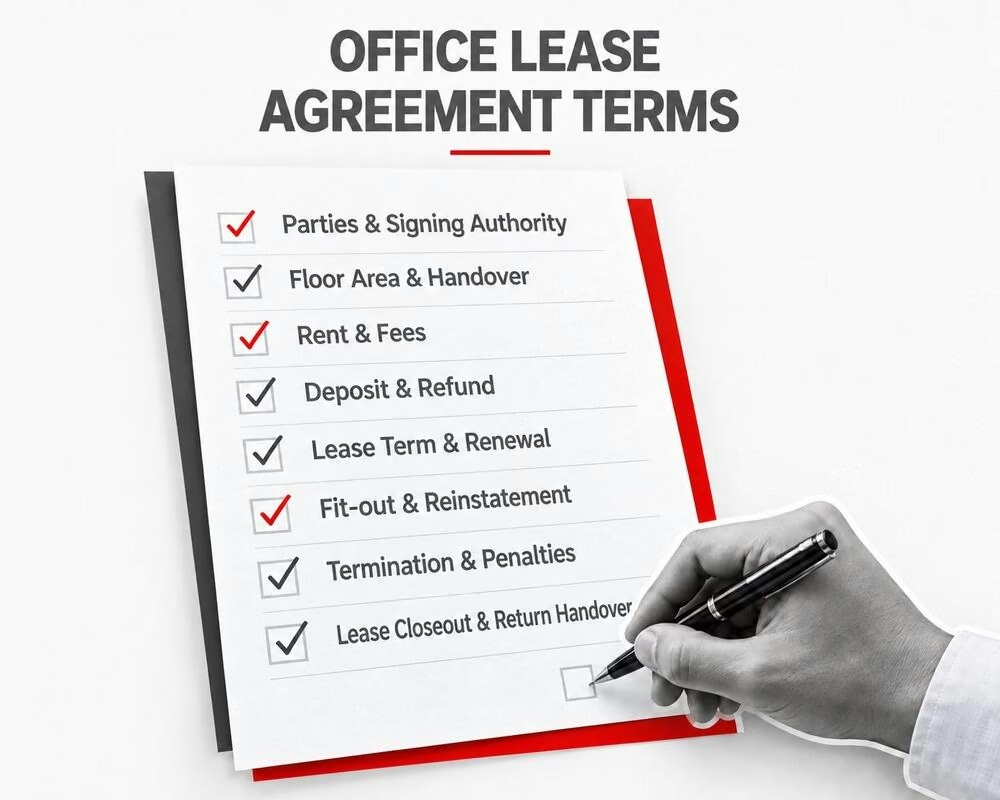
Which clauses on party information, area, rent, deposit, lease term, fit-out, termination and liquidation does an office lease agreement need so your business can sign with confidence?
Party information and signing authority
Before discussing rent or lease term, you should check that the office lease agreement records the correct legal information of both parties and that the signatory has proper authority. Mistakes at this step can leave later agreements without validity or create risks once your business has moved into the space.
- Party information
The agreement should include the full business name, tax code, head office address, phone number and bank account of both parties. This information is used throughout for payments and invoicing.
You should cross-check this information against the business registration certificate, as even one mismatched detail can cause problems with invoicing or bank transfers.
- Signing authority
The agreement should state the full name and title of the legal representative, so you know exactly who has the right to sign on behalf of the business.
If the signatory is only an authorized person, the agreement must be accompanied by a valid power of attorney stating the scope of signing authority, to avoid cases where the signatory exceeds their authority.
The landlord must also prove their right to lease the space, through a certificate of ownership or use rights, or a leasing authorization from the owner. You should request a copy to cross-check before signing.
Leased area, handover condition and purpose of use
These three points should be settled from the start, as they determine which area your business pays for, the condition in which you receive the space and what the space can be used for.
- Leased area
The agreement should clearly state the leased location, including floor, room or unit number, along with a floor plan, so both parties share the same understanding of the leased scope.
The leasable area should be stated in square meters along with the measurement standard. This way you know exactly what you are paying for and avoid discrepancies with the actual usable area.
- Handover condition
The agreement should describe whether the space is handed over as a bare shell or fitted out, along with the condition of the ceiling, air conditioning, fire safety system, lighting and electrical and network connections.
The more specific the description at handover, the easier it is to use as a basis for comparison when you return the space.
- Purpose of use
The space should only be used as a working office or business premises, not for residential purposes, polluting production or illegal business. You should read carefully to make sure your business activities fall within the permitted scope.
Some agreements also set limits on headcount, operating hours, signage rights or building rules. Check whether these limits suit the way your business operates before signing.
Rent, service fees and additional charges
When comparing offices, many businesses look only at the rental rate, while the actual total cost also includes service fees, taxes and various other charges. The agreement therefore needs to state each item clearly along with the payment schedule; otherwise this becomes the part most prone to disputes.
- Rent
In Grade A and B buildings, rent is usually quoted in USD/m²/month. The agreement should state the unit price, payment currency and exchange rate if applicable, so you can compare buildings accurately and avoid discrepancies when paying.
The agreement should state whether the rent includes VAT, so you are not surprised when you receive the invoice.
If the landlord is an individual, the agreement should specify who is responsible for declaring and paying rental tax, whether the landlord does so or the tenant pays on their behalf, so payment documents are consistent from the start.
The agreement should also state the payment cycle, timing and method, helping your business manage cash flow proactively.
- Service fees
In addition to rent, you will pay a management fee and building operation service fee. Ask clearly which services this fee covers, as that is how you compare costs between buildings accurately.
- Additional charges
For electricity and water, ask clearly about the calculation method and unit price, ideally based on a separate meter if available, so you can control monthly usage costs.
If your business works outside office hours, ask in advance how after-hours air conditioning is calculated and charged so you can budget for it.
For parking fees, the agreement should state the number of allocated parking slots and the fee for exceeding them, which is especially important for businesses with many employees.
Other items such as internet, cleaning or fit-out costs should have their calculation method stated clearly. For serviced offices or coworking spaces, you should also ask what the service package includes and which amenities are limited, so you are not charged unexpectedly.
Deposit and refund conditions
Under Clause 1, Article 328 of the 2015 Civil Code, a deposit is when one party gives the other a sum of money or valuable asset for a period of time to secure the conclusion or performance of a contract. In an office lease, it is the sum the tenant pays the landlord, to be refunded under the agreed conditions at the end of the lease. This is a part prone to disputes if the deductions upon returning the space are not settled clearly.
- Deposit
The law does not set a specific deposit amount for office lease agreements, so whether a deposit is required and how much it is are both up to the two parties to agree.
The deposit is usually equivalent to about 2-3 months’ rent. You should clearly distinguish it from prepaid rent or service fees, as each has a different purpose and treatment.
The deposit helps ensure that you pay in full, maintain the space and fulfill your commitments. Under Clause 2, Article 328, when the contract is performed, the deposit is returned or offset against payment obligations. If the tenant refuses to perform the contract, the deposit is forfeited; if the landlord refuses, they must return the deposit plus an equivalent amount, unless the two parties agree otherwise.
- Refund conditions
The number of days for the deposit refund is agreed by both parties and is usually counted from the date of contract liquidation. You should state this milestone clearly in the agreement so you can track it at the end of the lease.
The landlord may deduct items such as unpaid rent, service fees, electricity and water or repair costs for damage from the deposit. You should ask for these to be listed specifically from the start, along with a condition report at handover, to avoid unexpected deductions when returning the space.
Lease term, renewal and rent adjustment
The lease term determines how long you can use the space stably and how costs change over time. The agreement should therefore settle the following three points clearly.
- Lease term
The agreement should state the effective date, handover date, start date and end date. Office lease terms are usually 2-3 years or longer, and Grade A buildings may require longer terms, but you can still negotiate according to your business plans.
If you need to carry out interior construction before moving in, ask the landlord whether rent is waived during this period. Service fees and electricity and water charges during the fit-out period should also be agreed clearly.
- Renewal
The agreement should state the deadline for written notice before expiry. Add this deadline to your business’s calendar so you do not miss the chance to continue leasing.
The principle for adjusting rent upon renewal should also be agreed in advance, so your business is not caught off guard at renewal time.
- Rent adjustment
The agreement may keep the rent fixed throughout the term, or provide for increases within an agreed range and cycle.
You should clarify this from the start to budget lease costs over several years.
Repairs, renovation (fit-out) and reinstatement
Most businesses need to renovate the space to suit the way they work, and at the end of the lease must return the space in the agreed condition. The agreement should therefore clearly specify the following three points.
- Repairs
Under Article 477 of the 2015 Civil Code, the landlord is responsible for keeping the space in the agreed condition and repairing damage, except minor damage that the tenant customarily repairs.
In practice, the landlord or building management usually handles common systems such as elevators, fire safety and central air conditioning, while your business is responsible for the furniture it installs or damages. The agreement should state this boundary clearly to avoid passing responsibility back and forth when issues arise.
- Renovation (fit-out)
Typically, you need to submit architectural, electrical and fire safety design drawings for approval by the landlord or building management before construction.
Renovation must not affect the building’s load-bearing structure. You should ask about the drawing approval process and processing time to plan construction properly.
- Reinstatement
At the end of the lease, you usually have to remove the partitions and furniture you installed to return the space to its original condition, known as bare shell. The two parties may also agree in writing to keep the space as is.
You should clarify this from the start, as removal costs can be significant and are usually deducted from the deposit if not carried out.
Early termination and penalties for breach
During the lease, your business may need to change plans, or the two parties may no longer be able to perform the agreement as committed. The agreement should therefore clearly specify the following two points so you are better prepared if you need to leave the office early.
- Early termination
The agreement should clearly state the cases of lawful termination, such as expiry of the lease, severe damage to the building from natural disasters or fire that cannot be remedied, or a serious breach of obligations by the other party. Reading this section carefully lets you know in which situations you may terminate without being considered in breach.
If your business wants to terminate for its own reasons, such as downsizing or relocating, you must send written notice within the agreed period. Under Article 428 of the 2015 Civil Code, a party that unilaterally terminates without grounds is considered the breaching party, so you should weigh this carefully and negotiate with the landlord first.
As for the deposit, it is usually handled under the forfeiture or compensation principle described in the deposit section, unless the two parties agree otherwise. Check which principle your agreement applies to know the potential loss.
- Penalties for breach
The penalty amount is agreed by both parties in the agreement but must be within the limits permitted by law. You should check whether the penalty is reasonable relative to the contract value, and ask whether the penalty is applied in addition to forfeiting the deposit.
For late payment, the agreement usually provides for late payment interest as agreed and the landlord’s right to unilaterally terminate if you are late beyond the stated number of days. Keep track of payment deadlines to avoid the risk of termination simply due to late payment.
The agreement should also state whether the two parties prioritize negotiation, mediation, or bringing the matter to court or arbitration in case of disagreement. Agreeing on this from the start makes disputes faster and less costly to resolve.
Contract liquidation and returning the space
Contract liquidation is the final step for both parties to close the lease relationship clearly and avoid later disputes. The process is usually completed with a report on the condition of the space, a settlement of outstanding debts and a refund of the remaining deposit.
- Contract liquidation
The landlord may deduct unpaid rent, service fees, electricity and water charges and repair costs for damage from the deposit. You should request a detailed breakdown of each deducted item to cross-check before confirming.
Once agreed, both parties sign the liquidation report and the landlord refunds the remaining deposit. You should only sign once you have received the full amount as agreed.
- Returning the space
Both parties inspect the space at return, compare it with the condition recorded at handover and record the electricity and water meter readings at that time.
You should take photos and keep the report as a basis in case of later disagreement.
Appendices to attach to an office lease agreement
Which appendices should an office lease agreement include so that describing the space, handing over assets, calculating fees, carrying out fit-out, renewing and liquidating are clear and easy to cross-check?
Appendix describing the space and leasable area
The space description appendix helps both parties share the same understanding of the location, scope of use and leasable area through a floor plan and specific calculation table. With this appendix, you will not have to argue over “which part is ours” once you have moved in.
- Space description
The floor plan shows the leased location on the floor layout, along with columns, entrances and emergency exits. This helps you visualize the actual space and plan a suitable workspace layout.
The appendix should clearly mark the areas for your business’s exclusive use and common areas such as corridors, elevator lobbies or restrooms. This helps avoid misunderstandings about the scope of use and the area you pay for.
- Leasable area
The appendix states the area in square meters, the unit of measure and the measurement standard. This is the figure used to calculate monthly rent, so you need to check it carefully against the actual area.
Both parties should agree on the measurement method and confirm it upon acceptance of the space, to avoid disputes over area discrepancies later.
Handover condition appendix and handover report
The handover condition appendix records the condition of the space at the time you receive it, along with the handover report, as a basis for comparison when returning the space. With this appendix, you will be better prepared when both parties need to determine which damage existed beforehand and which arose during use.
- Construction condition: you should inspect in person and record the condition of the floor, walls and ceiling, including any scratches, cracks or deterioration.
- Technical systems: the condition of the air conditioning, fire safety system, electrical and network systems should be checked carefully, as these are items prone to disputes over repair responsibility.
- Electricity and water meter readings, keys, access cards and handed-over items: record these in full as the baseline for calculating usage costs from the handover date.
- Actual photos: both parties should take photos of the space’s condition and attach them to the appendix, as images are the clearest evidence when comparing at return.
Appendix listing assets and equipment handed over
The asset list appendix lists the furniture and equipment included with the space and the tenant’s responsibility for each item. This appendix is especially useful for serviced offices or furnished spaces, as it helps you and the landlord both know exactly what has been handed over.
- Assets (furniture)
The appendix should list the desks, chairs, filing cabinets, meeting room furniture and partitions included. You should check these directly against reality at handover to make sure nothing is missing.
- Equipment
Equipment such as meeting room projectors or TVs, printers and desk phones should be recorded clearly. You should check whether the equipment works properly upon receipt, to avoid being held responsible for pre-existing damage.
- Details and responsibility
Each item should state the quantity, brand, model number and current condition. The more detailed the information, the easier it is for both parties to cross-check and determine any damage.
Under Articles 479 and 482 of the 2015 Civil Code, the tenant must preserve, maintain and carry out minor repairs on the leased assets and compensate for any loss or damage. When returned, the assets must be in the condition as received or as agreed by both parties, except for natural wear and tear. The appendix should specify how each case is handled so you know exactly how far your responsibility extends.
Appendix with service fee and additional charge schedule
The fee schedule appendix gathers service fees and additional charges into a single table, making it easy for you to budget and control total lease costs.
- Service fees
The appendix should state the management fee and list the services it covers, such as security, cleaning of common areas or maintenance of common systems. This way you know what you are paying for.
- Additional charges
For electricity and water, state the calculation method and applicable unit price, ideally based on a separate meter if available, to track monthly usage costs.
For after-hours air conditioning, you need to know the charging hours and specific rate, especially if your business often works outside office hours.
Car and motorcycle parking fees and the number of allocated parking slots should be stated clearly, including the fee for exceeding the allocated slots.
Items such as internet, cleaning and construction fees should have their rates and calculation methods listed, to avoid unexpected charges.
- Fee adjustment
The appendix should state when and how the landlord may adjust fees, along with the effective date. You should ask about this carefully so you are not surprised when costs change mid-lease.
Appendix on building rules and fit-out regulations
The building rules and fit-out regulations appendix refers to the building’s operating regulations, so you understand what you must comply with from handover, instead of discovering the limits only during construction or use.
- Building rules
The appendix should state access hours, visitor registration procedures, and security and fire safety regulations. These rules directly affect your business’s daily activities.
- Fit-out regulations
Construction usually must not change the load-bearing structure or function of use, and must meet fire safety requirements. Under Clause 2, Article 43 of the 2025 Law on Construction, interior repair and renovation works are exempt from a construction permit if they do not change the purpose or function of use, do not affect load-bearing structural safety, and meet requirements on fire safety, environmental protection and technical infrastructure connections. Even so, you still need to comply with the building’s regulations.
You usually have to submit design documents to the landlord or building management for approval before construction. Ask which documents are required and how long approval takes to plan properly.
The appendix should also state the permitted construction hours, permitted materials, and occupational safety and site cleanliness requirements, so your contractor prepares accordingly.
Finally, the appendix should restate the reinstatement requirement at the end of the lease, so you can anticipate removal and reinstatement costs.
Appendix for renewal or amendment of terms
The renewal or amendment appendix is used when both parties want to extend the lease term or change certain signed terms without drafting a new agreement. Under Article 403 of the 2015 Civil Code, an appendix must not contradict the main contract; any contradicting clause is invalid, unless the two parties agree otherwise.
- Renewal
The renewal appendix is used when both parties want to extend the lease term, saving time compared with redrafting the entire agreement.
The appendix should state the number and signing date of the main contract, to identify which agreement it renews.
- Amendment of terms
The appendix is also used when changing rent, area or service package, and should state both the old and new content of each amended clause, so both parties can compare easily and avoid misunderstandings.
The appendix should confirm that clauses not mentioned remain in effect as in the main contract, reassuring you that the agreed rights are not affected.
Appendix on liquidation and debt reconciliation
The liquidation appendix confirms the end date of the agreement, outstanding debts and the deposit amount refunded between the two parties, helping close the lease relationship clearly.
- Liquidation
The appendix should state the date the agreement officially ends, as the milestone for calculating final costs.
Both parties inspect the space, compare it with the condition at handover and record the results in a report. You should take photos and keep a copy as a basis in case of disagreement.
- Debt reconciliation
The reconciliation table lists the outstanding rent, service fees and electricity and water charges up to the handover date. Check each item carefully before confirming.
The appendix should state the original deposit, deducted items, remaining amount and the agreed refund deadline. You should only sign once these figures match what both parties have agreed.
The role of brokers in drafting and negotiating an office lease agreement
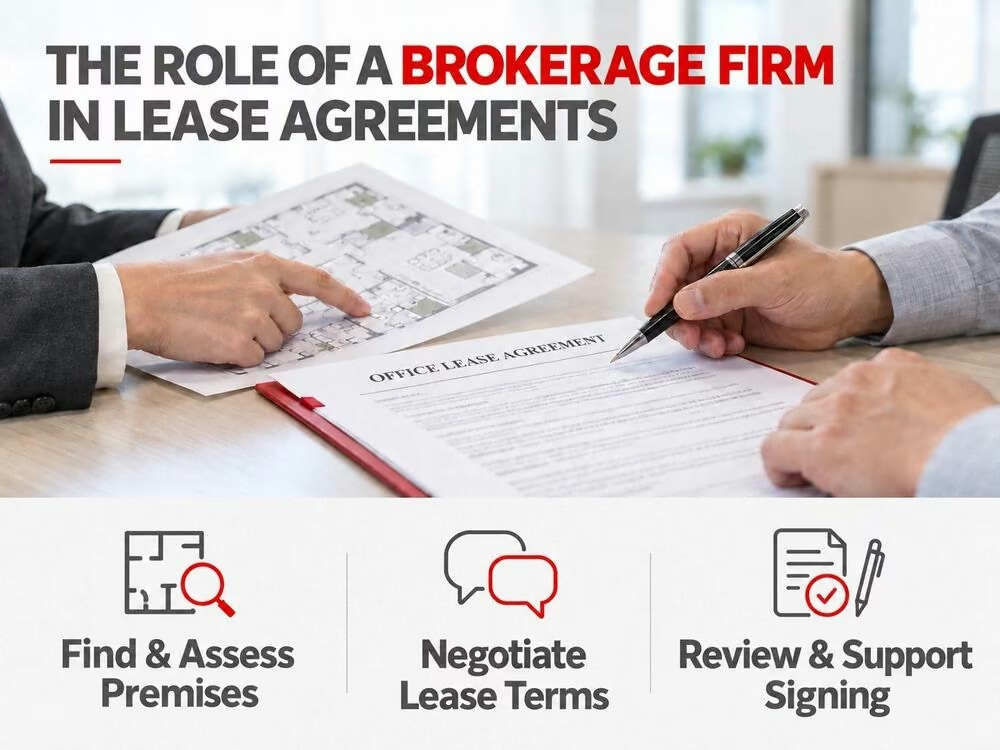
Instead of contacting each building and dealing with landlords on your own, your business can have a broker accompany you when leasing an office. A broker is a professional intermediary that supports businesses from searching for space until the office lease agreement is signed. In practice, this role covers the following three groups of tasks.
Searching for and evaluating space
The broker filters and proposes suitable offices by location, area, budget, building grade and expected move-in date. This gives you a ready shortlist to compare instead of searching each source yourself.
Beyond the rental rate, the broker helps you consider location, management fees, after-hours fees, building amenities and handover conditions, so options are compared on the same basis of information.
The broker can carry out a preliminary check of the landlord’s ownership or leasing rights, the construction permit and the building’s fire safety conditions. Under Point d, Clause 1, Article 64 of the 2023 Law on Real Estate Business, brokerage firms have the right to refuse to broker real estate that does not yet qualify for business. This step reduces your risks before going deeper into the agreement, but does not replace a lawyer’s advice.
Negotiating the agreement
The broker provides market information and supports both parties in discussing rent, area, lease term, fit-out period, deposit and payment cycle. With comparison data in hand, you negotiate more easily and key points are settled clearly before being put in writing.
Drafting and signing the agreement
Once the terms are agreed, the broker works with the parties to ensure everything agreed is fully reflected in the agreement. You should ask the broker to review the clauses with you before signing so no detail is missed.
When authorized by the business, the broker can assist with certain lease-related procedures and continue to support you at handover if needed.
RSQUARE finds the right office for lease and supports you in completing the lease agreement
Finding a suitable office is hard enough, and closing a favorable office lease agreement requires even more experience. RSQUARE is a Korean-invested commercial and industrial real estate advisory firm. In Ho Chi Minh City and Hanoi, RSQUARE supports businesses with the two most important tasks when leasing an office: finding an office for lease that fits their needs, and completing the lease agreement smoothly.
Support in finding the right office for lease
Before the agreement, RSQUARE helps you find the right office based on your actual needs and market data:
- Understanding your needs: RSQUARE starts by listening to what you need in terms of location, area, budget and purpose of use, so the proposed options closely match how your business operates.
- Market price data: based on a database of more than 55,000 verified properties, RSQUARE provides price levels by area and building grade, helping you know whether the price you are considering is reasonable compared with the market.
- Calculating total occupancy cost: for each option, RSQUARE works with you to add up rent, service fees, fit-out costs and ancillary charges, so you compare actual costs instead of looking only at the rental rate.
- Site visits and selection advice: our consultants visit the space with you, analyze the pros and cons of each option and make recommendations, helping you choose the most suitable place.
Support in completing the office lease agreement
Once you have chosen a space, RSQUARE accompanies you through the agreement stage so the terms are settled clearly and in your business’s favor before signing:
- Support in negotiating terms: RSQUARE helps you negotiate key terms such as a rent-free fit-out period or a cap on annual rent increases, based on actual market transaction data.
- Reviewing the agreement: before signing, RSQUARE reviews the agreement with you to ensure everything agreed is fully reflected and your business’s interests are protected.
- Checking the building’s legal status: RSQUARE helps check the building’s transparency and related legal procedures, reducing your risks when signing.
- Support after signing: if issues arise with the landlord during the lease, RSQUARE continues to help resolve them, rather than stopping once the agreement has been signed.
RSQUARE’s office leasing advisory service is completely free for tenants. For foreign businesses, our team provides support in Vietnamese, English and Korean for smoother communication.
Frequently asked questions about office lease agreements
Does an office lease agreement need to be notarized, can you sign a ready-made template right away, and what should you note when terminating early, renewing or signing a bilingual English – Vietnamese version?
Is notarization mandatory for an office lease agreement?
No, an office lease agreement does not have to be notarized. Under Clause 4, Article 44 of the 2023 Law on Real Estate Business, if at least one party is a real estate business, the agreement is notarized or certified at the request of the parties. The mandatory notarization requirement in Clause 5, Article 44 only applies to contracts for the sale or lease-purchase of houses and construction works between individuals, not to lease agreements. Even so, both parties should consider notarizing or certifying signatures in the following cases:
- The landlord is an individual, the lease term is long or the contract value is large.
- Leasing a house as an office with handed-over assets, renovation and reinstatement requirements.
- Both parties have agreed in the agreement that the document must be notarized.
Can you use a ready-made template and sign it right away?
Businesses can use a ready-made template as a starting point, but should not sign it right away without reading and discussing it. If the landlord is a developer or real estate business, under Clause 2, Article 45 of the 2023 Law on Real Estate Business, sample contracts must be publicly disclosed before use, so you can review it in advance or ask the landlord to send the template early. Before signing, you should note:
- Ready-made templates are usually generic and do not specify additional charges such as management fees, parking fees or after-hours air conditioning, so they need to be supplemented to match the building you are leasing.
- Templates drafted by the landlord may lean toward protecting the landlord, so read the clauses on deposit, termination and penalties carefully.
- The handover condition, reinstatement conditions and payment schedule should be filled in specifically in the agreement and appendices.
- For high-value or long-term agreements, you should consult a lawyer to ensure legal validity.
How should you handle early termination of the agreement?
The first step is to follow the early termination clause in the office lease agreement, such as the written notice period, the deposit and any compensation. Depending on the reason for termination, your business can proceed as follows:
- Due to the other party’s fault or a case permitted by the agreement, such as force majeure: send written notice within the agreed period. Under Article 428 of the 2015 Civil Code, the party unilaterally terminating must notify the other party in advance.
- For your own reasons such as downsizing or relocating: negotiate with the landlord to minimize losses, for example by helping find a replacement tenant if the landlord agrees.
- No agreement reached: if termination has no grounds, your business is considered in breach of the agreement, may forfeit the deposit and must pay compensation as committed.
Therefore, if you plan to relocate, your business should clarify these clauses from the time of signing, and discuss early with the landlord to agree on termination in writing.
What should you note when renewing an office lease agreement?
Your business should proactively discuss renewal early, before the office lease agreement expires, because upon expiry the landlord has the right to request the return of the space. When renewing, you should note:
- Notice deadline: send a written renewal request before the deadline set in the agreement. After this deadline, the landlord may lease the space to someone else.
- Rent for the new term: check the rent increase range committed in the previous agreement; if none, both parties negotiate based on market rates at the time of renewal.
- Renewal appendix: clearly state the new term, rent, management fee, deposit, effective date and confirm that the remaining clauses stay unchanged.
- Major changes: if there are significant adjustments to area or operating conditions, both parties should sign a new agreement instead of an appendix.
Your business should avoid continuing to use the space after the agreement has expired without a written renewal, as this can easily lead to disputes.
Is a bilingual English – Vietnamese office lease agreement legally valid?
Yes, a bilingual English – Vietnamese office lease agreement is as legally valid as a regular agreement, provided its content does not violate prohibitions under Vietnamese law. What matters is stating clearly in the agreement which version prevails when the two versions are interpreted differently. If the two parties do not specify this, both versions are generally considered equally valid. When a dispute arises in a Vietnamese court, Vietnamese is the language of proceedings, so your business needs a Vietnamese version and should compare both versions carefully before signing, especially the clauses on rent, fees, term and termination.
A well-drafted office lease agreement lets your business use the space with confidence and avoid costs or disputes later. Before signing, you should choose the right template for the type of office, carefully check the clauses on area, rent, deposit, lease term, fit-out, termination and liquidation, and attach all necessary appendices so every agreement has a basis for comparison. If your business is looking for an office in Ho Chi Minh or office in Hanoi, RSQUARE is ready to accompany you from finding the space to completing the agreement, with free advisory services for tenants.