A smart office is an office model that applies the Internet of Things (IoT), artificial intelligence (AI), and sensors to automate operations and enhance the employee experience. This model has 4 features: system automation, data-based space management, smart connectivity and security, and employee experience. As a result, businesses increase operational efficiency, attract talent, optimize costs, and support sustainable development. This article covers the concept, features, benefits, leasing considerations, notable buildings, and trends in Vietnam.
What is a smart office?
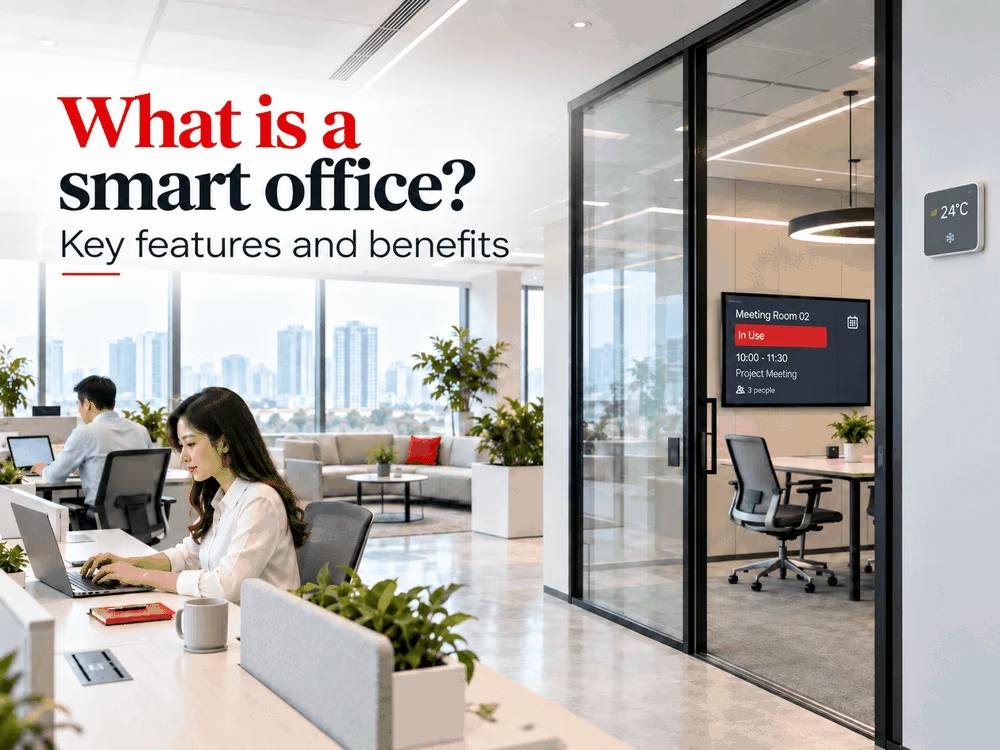
A smart office is an office model that applies the Internet of Things (IoT), artificial intelligence (AI), sensors, and digital management platforms to automate operations, optimize the workspace, and enhance the employee experience. The technology connects people, equipment, and building infrastructure within a unified management system.
This model is based on 4 core technologies: IoT is a network of internet-connected devices and sensors that collect and exchange data. AI analyzes data to make adjustments. Cloud computing stores and synchronizes data, allowing access from multiple devices. Automation systems control equipment according to pre-set schedules or sensor data.
These technologies operate in a sequence: sensors collect data, a platform analyzes it, and equipment self-adjusts. For example, lighting, temperature, and meeting room status change based on the actual number of people in an area.
A smart office differs from a traditional office in how it is controlled and managed. A traditional office relies on manual operations and manages each system separately. A smart office self-adjusts based on real-time data and manages systems on a single platform.
Notable features of a smart office
A smart office has 4 notable features: system automation, data-based space management, smart connectivity and security, and employee experience. These four features are built on a shared data foundation, so systems within the building work together instead of operating separately. The first feature is system automation.
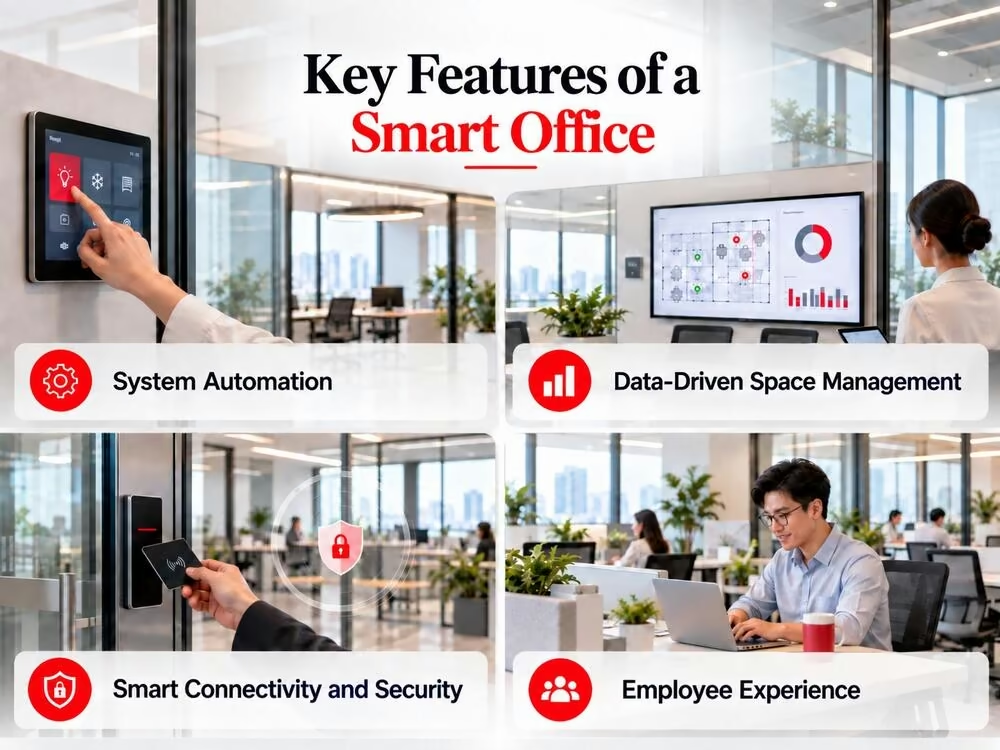
System automation
System automation is the feature that allows equipment in the office to operate automatically according to a pre-set schedule or employee presence, instead of being switched on and off manually.
The automation system controls the following equipment and functions:
- Lighting: automatically turns on, off, or adjusts brightness based on presence sensors and working hours
- Temperature: automatically adjusts based on occupied areas and usage time slots
- Curtains: automatically close or open based on outdoor light intensity or a pre-set schedule
- HVAC (air conditioning and ventilation): adjusts output based on occupant density and air quality, running on a schedule before and after working hours
- Access control and meeting room booking: linked within a single system
Data-based space management
Data-based space management is the feature that uses sensors and software to measure real-time usage levels of desks, meeting rooms, and common areas.
The mechanism works in 3 steps: sensors record presence, software consolidates the data, and managers view reports. For example, a sensor in a meeting room indicates whether the room is occupied or vacant.
This data serves 3 main purposes:
- Usage frequency analysis: identifies heavily used areas versus underused areas
- Meeting room tracking: shows occupied or vacant status
- Energy monitoring and equipment alerts: detects issues early and supports maintenance
Smart connectivity and security
Smart connectivity and security is the feature that links all devices into a unified network while controlling who can enter the building and who can access data.
Connectivity:
- Wi-Fi coverage throughout the office
- IoT connects devices and shares data between them
- Integrated video conferencing in meeting rooms
Physical security:
- Contactless access using QR codes or NFC
- Temporary access codes for visitors
- Surveillance cameras linked to the central system
Data security: Since IoT devices collect data, the system needs access authorization and data protection. Access rights are granted based on each user’s role.
Employee experience
Employee experience is the feature that brings daily tasks — such as booking, meetings, and adjusting the work environment — into a single app or a simple action.
Employees use the following amenities in their daily work:
- Internal app: booking meeting rooms, clocking in/out, and borrowing equipment
- Workspace customization: lighting and temperature at their own desk
- Online meetings and quick screen sharing: no manual setup required
Unlike the features above, employees are the direct users of this feature, not the management team.
Operational optimization and energy savings
Operational optimization and energy savings are the result of a smart office using data to adjust furniture and space according to actual usage needs. Equipment only operates when in use, and space is only used to the extent actually needed, so electricity consumption and operating costs decrease. This effect comes from 2 main directions: smart furniture and flexible space design.
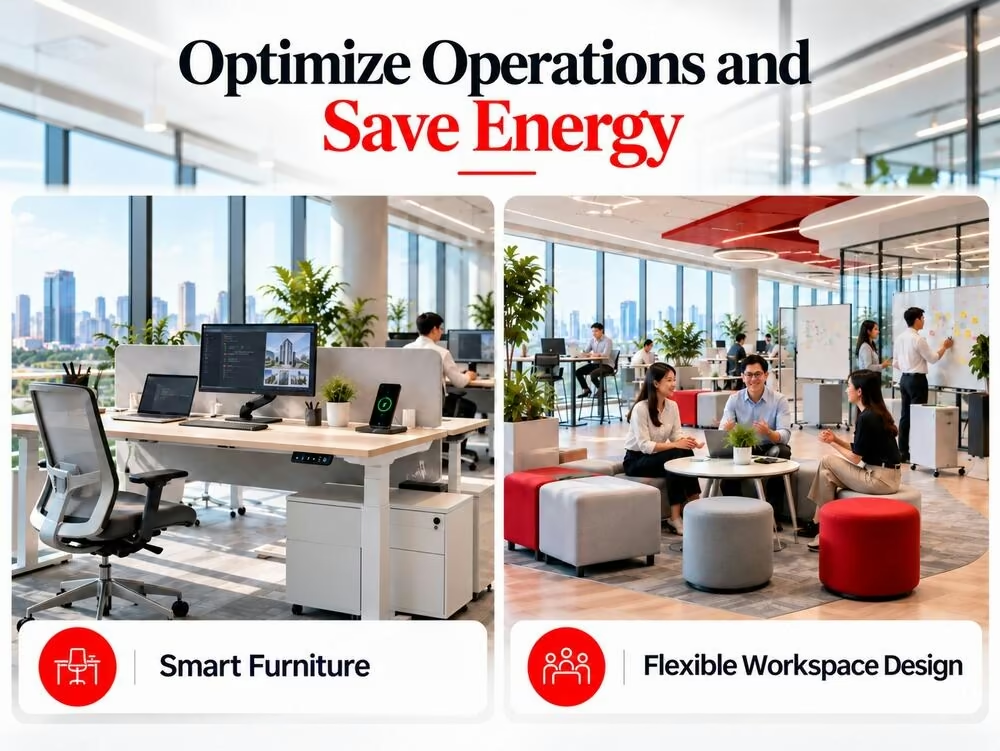
Smart furniture
Smart furniture refers to desks, chairs, and work equipment that can be adjusted for each user or connected to the office’s central management system.
A smart office uses the following 3 types of furniture:
- Automatic height-adjustable desks: adjust height based on posture, controllable through a personal app
- Ergonomic chairs: support each individual’s sitting posture
- Wireless charging pads built into the desktop: charge devices right at the workstation
Furniture connected to the app allows each person’s settings to be saved. Each time an employee changes desks, they can reapply their saved settings without manual adjustment. This reduces repetitive actions and ensures each workstation immediately fits the user.
Flexible space design
Flexible space design is a layout approach that allows function and seating capacity to change according to actual usage needs, based on usage frequency data.
This design includes the following 4 solutions:
- Hot-desking: employees have no fixed seat and instead book a desk as needed through an app
- Flexible meeting rooms: pre-booked, auto-cancel, and revert to vacant status when no one shows up (the wait time before cancellation depends on each system’s configuration)
- Group work areas and private work areas: the office is divided into zones by work type (focus, collaboration, calls and online meetings, socializing), and usage data determines how much space each zone needs
- Flexible workspace model: the floor plan changes according to team size and working style
Benefits of a smart office for businesses
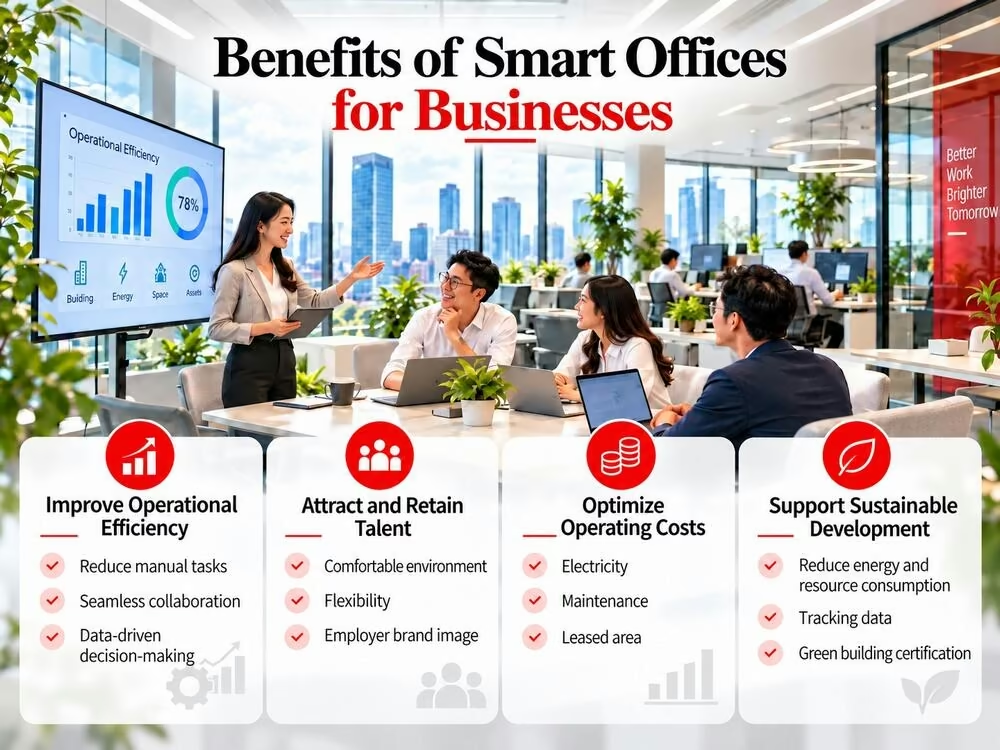
A smart office brings 4 benefits to businesses: increased operational efficiency, talent attraction and retention, optimized operating costs, and support for sustainable development. Data and automation within the building help businesses reduce manual work, use resources appropriately, and make decisions based on actual data. The first benefit is increased operational efficiency.
Increased operational efficiency
A smart office increases operational efficiency when daily tasks such as booking meeting rooms, finding a seat, access control, and printing are handled on a single platform instead of manually.
Businesses see this efficiency in the following 3 areas:
- Reduced manual work: booking meeting rooms, clocking in/out, and borrowing equipment through a single app saves employees time for their core work
- Seamless collaboration: online meetings and data sharing help on-site and remote employees connect easily
- Data-driven decisions: management views reports on space and equipment usage to adjust processes
Attracting and retaining talent
A smart office helps businesses attract and retain talent thanks to a modern, flexible, and convenient work environment for employees.
This environment supports recruitment and retention in the following 3 areas:
- Comfortable environment: lighting, temperature, and air quality are automatically adjusted, reducing fatigue during work
- Flexibility: booking desks and meeting rooms through an app, suited to a hybrid work model
- Employer branding: a technology-driven environment helps businesses create a professional impression on candidates
Optimizing operating costs
A smart office helps businesses optimize operating costs in 3 areas: electricity, equipment maintenance, and leased space.
These three areas are improved as follows:
- Electricity: lighting and air conditioning systems operate based on actual usage levels, reducing wasted electricity
- Maintenance: early detection of issues reduces major damage and unexpected repair costs
- Leased space: usage data helps businesses determine actual space needs, avoiding oversized leases
The amount of savings a tenant receives depends on how the building calculates electricity and service fees under the lease agreement.
Supporting sustainable development
A smart office supports sustainable development by reducing electricity and resource consumption while providing environmental data for businesses.
- Reduced energy and resource consumption: systems automatically adjust electricity and water use based on actual consumption
- Tracking data: real-time electricity data serves as input for emissions reporting from purchased electricity. Tenants should ask whether the building has separate metering by floor or leased area.
- Green building certification (LEED, LOTUS): both systems have energy criteria, and LEED requires building-level energy metering. A smart building’s metering system provides the underlying data for this group of criteria.
What should businesses consider when choosing a smart office to lease?
When leasing a smart office, businesses should check 5 areas: technology infrastructure, security and data, cost, customization and scalability, and incident handling and support. Businesses should confirm each area with the building management before signing the lease.
Technology infrastructure
- Does the internet and Wi-Fi have a backup plan in case one connection is interrupted?
- Can the building’s smart systems (booking, access control, energy management) integrate with the software the business is already using?
- Is the backup power supply (UPS, generator) sufficient to keep the smart systems running continuously?
Security and data
- Network segmentation: is the network for IoT devices (sensors, cameras, access control systems) separated from the tenant’s own network?
- Data protection: is data encrypted in transit and at rest, who has access to the system, and does the building conduct periodic security checks?
- Personal data: if the building uses facial recognition cameras or employee access data, does its data handling policy comply with the 2025 Law on Personal Data Protection (effective from January 1, 2026)? This policy includes notifying data subjects and enhanced protection for biometric data.
Cost
- Does the rental price already include software and smart infrastructure maintenance fees, or are there separate surcharges?
- Does the building management share electricity data and its measurement method?
- Does the building have separate electricity metering by floor or leased area, since if only total consumption is measured, the business has no dedicated data to track?
Customization and scalability
- Can the business adjust lighting, temperature, and booking arrangements on its own according to its own needs, or must it rely on building management each time?
- Does the building allow expanding the leased area or adding equipment as headcount grows?
Incident handling and support
- When the network, power, or software is interrupted, can the building switch to manual operation (mechanical keycards, traditional switches)?
- Is there a technical team on-site at the building to handle sensor, equipment, and software issues?
- Is the employee-facing app easy to use, and is there guidance or initial training?
With this set of questions in hand, businesses can compare against notable smart office buildings in Ho Chi Minh City and Hanoi.
Notable smart office buildings in Ho Chi Minh City and Hanoi
Deutsches Haus, OfficeHaus, and Viettel Tower in Ho Chi Minh City, along with TechnoPark Tower in Hanoi, are notable office buildings with smart or green building features.
Ho Chi Minh City
Ho Chi Minh City has 3 notable buildings: Deutsches Haus in Saigon Ward (former District 1), OfficeHaus in Tan Son Nhi Ward (former Tan Phu), and Viettel Tower in Hoa Hung Ward (former District 10).
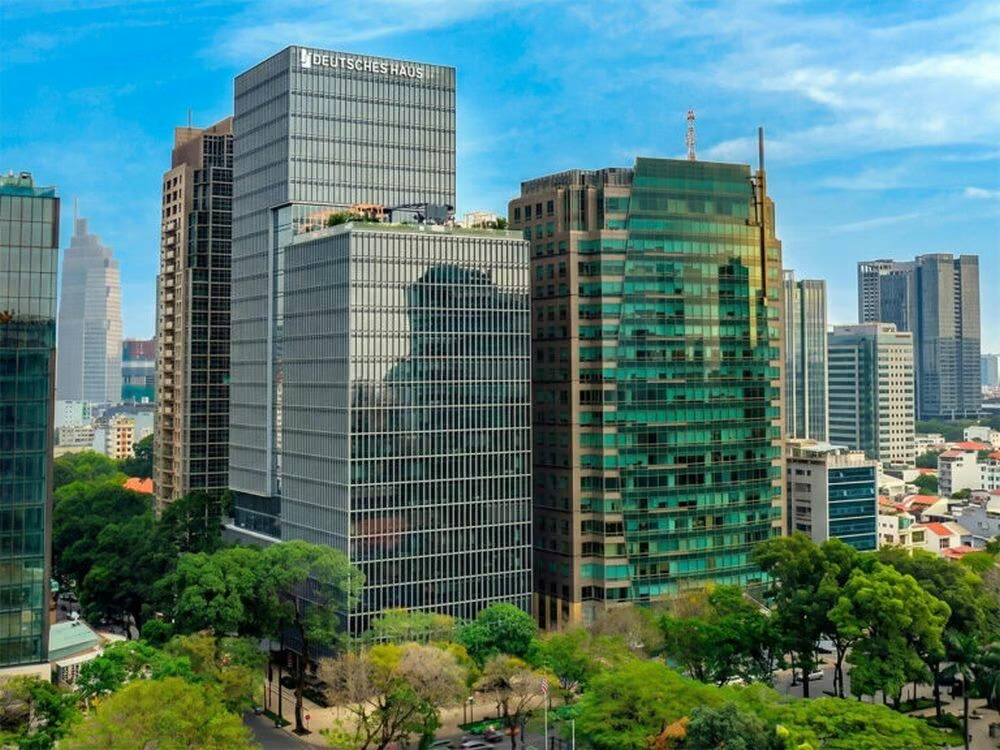
Deutsches Haus
Deutsches Haus is a 25-story Grade A+ office building at 33 Le Duan, Saigon Ward, holding both LEED Platinum and DGNB Gold certifications.
- Specifications: Grade A+, 25 floors, typical floor plate of 1,500–1,600 m², 2.75 m ceiling height
- Certification: LEED Platinum for both Building Design and Construction (BD+C) and Operations and Maintenance (O+M)
- Smart features:
- An Intelligent Building Management System (IBMS) supports operations and energy savings
- Double-glazed curtain wall with integrated automated blinds, making use of natural light
- Access control at the lobby
- Best suited for: businesses prioritizing green building certification and large floor plates in the city center
OfficeHaus
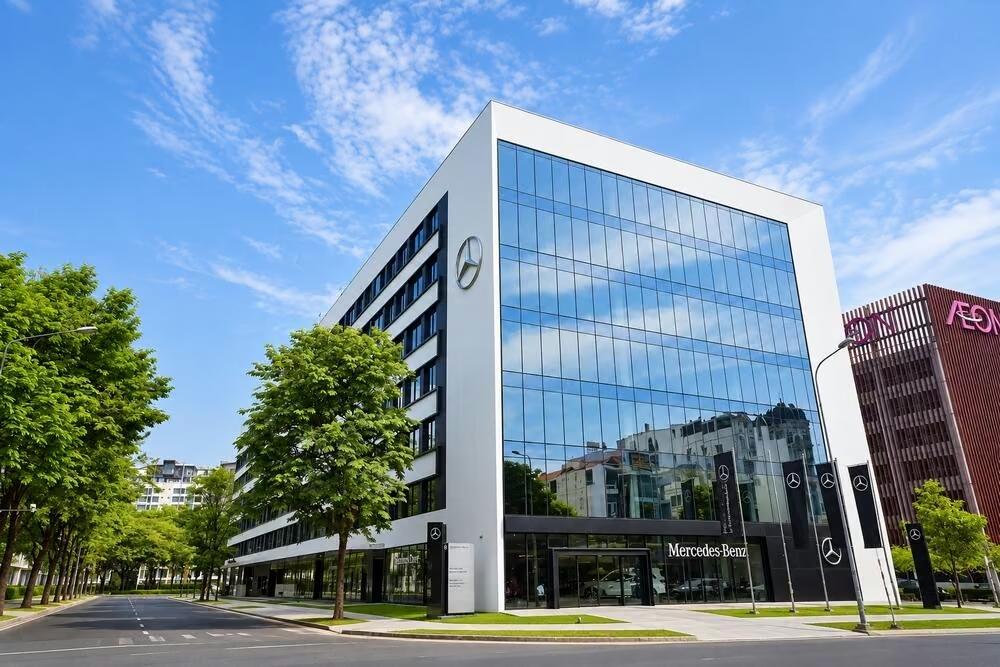
OfficeHaus is a 7-story office building within the Celadon City urban area, Tan Son Nhi Ward (former Tan Phu), designed by Korn Architects and developed by BRG Capital.
- Specifications: Grade B, 7 floors
- Smart features: “touchless” technology
- Touchless elevators
- Kitchen and restroom areas with no hand-touch points
- Access via a personal card or smartphone
- QR codes used throughout the building
- Best suited for: businesses seeking an office outside the city center, within an urban area with existing amenities
Hanoi
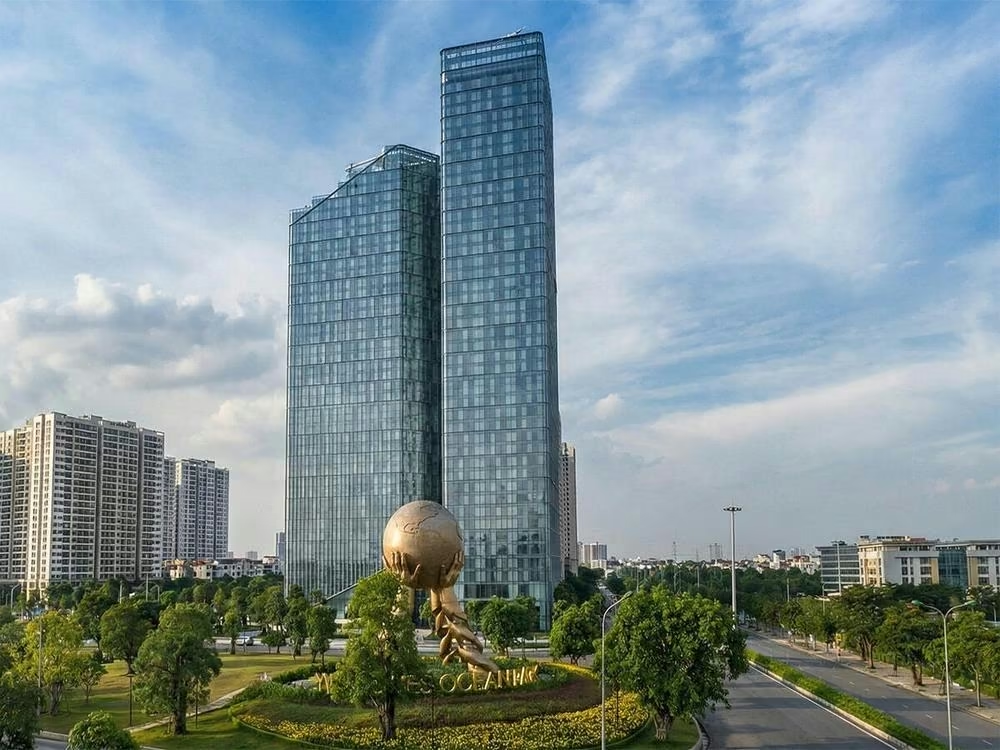
Hanoi has TechnoPark Tower, an office tower located within the Vinhomes Ocean Park mega-urban development in Gia Lam, the capital’s eastern gateway.
TechnoPark Tower
TechnoPark Tower is a 45-story office tower at Vinhomes Ocean Park, Gia Lam, developed by Vingroup, holding LEED Platinum certification and designed with smart building features.
- Specifications: Grade A, 45 floors above ground, 3 basement levels, completed April 2021
- Smart features:
- IoT sensors adjust lighting and air conditioning based on weather and occupancy
- Integrated access control, video surveillance, and network security
- Best suited for: technology and manufacturing companies needing connectivity to the Bac Ninh, Hai Duong, and Hai Phong industrial zones
Smart office trends in Vietnam
Smart offices in Vietnam are developing along 4 trends: alignment with green certification, a dedicated legal framework for smart buildings, adaptation to the hybrid work model, and the application of operational technology within buildings.
Trend 1: Alignment with green certification
Tenants increasingly prioritize new, high-quality buildings with green certifications. In Hanoi, leasing demand is concentrated in projects with green certification. In Ho Chi Minh City, many Grade A projects are developing toward green standards.
Trend 2: A legal framework for smart buildings
Decree 269/2025/ND-CP dated October 14, 2025, defines a smart building as a structure that applies advanced technology, management systems, and technical equipment in its design, construction, and operation. The requirements include:
- Environmentally friendly and energy-efficient
- Secure connectivity and data sharing
- Application of Building Information Modeling (BIM)
- A Building Management System (BMS) ensuring a comfortable, secure, and safe environment
- Information security and personal data protection
Trend 3: Hybrid work and the demand for office upgrades
As the hybrid work model becomes more stable, demand for flexible office space with clearer structure is growing. Many businesses are moving to better buildings with a comparable amount of space, rather than expanding their footprint.
Trend 4: Operational technology within buildings
Many new Grade A projects apply modern operational technology from the design stage onward. The IT, pharmaceutical, and banking sectors place particular emphasis on smart solutions when choosing office space.
Frequently asked questions about smart offices
Two questions businesses commonly ask when considering a smart office are about leasing costs and suitability for small and medium-sized businesses.
Is leasing a smart office more expensive than a traditional office?
Not necessarily. Rental price depends mainly on the building’s grade, location, and amenities, not solely on smart features. Smart buildings are typically newer, higher-quality buildings, so the base rental price may be higher, but costs such as electricity and maintenance may be lower. Businesses should compare total cost, including rent, service fees, electricity, and software surcharges.
Is a smart office suitable for small and medium-sized businesses?
Yes, if the right leasing approach is chosen. Small and medium-sized businesses don’t need to invest in their own infrastructure, since the building operates the smart systems, and they can lease space according to their needs. What needs to be checked is whether the service fee and software surcharges fit within budget. Businesses with a limited budget can consider a Grade B building with smart systems or a serviced office.
A smart office helps businesses operate efficiently, reduce wasted electricity and space, and improve the employee experience. Businesses should check infrastructure, data security, cost, and customization capability when surveying a building.
Smart offices are no longer a trend of the future but are becoming the new standard of the modern working environment. From access control systems and automated energy management to room booking platforms and space tracking, technology helps businesses cut operating costs, improve the employee experience, and adapt more flexibly to changes in headcount. More importantly, a smart office only delivers value when it fits the business’s actual needs, budget, and growth plans.
If you are considering a move to a more modern workspace, RSQUARE Vietnam is ready to support you. With experience advising on office real estate and a clear understanding of each local market, the RSQUARE team helps you compare buildings, check technology amenities, and choose the most cost-effective option. Whether you are looking for an office for rent in HCM to reach the most dynamic economic hub in the country, or an office for rent in Hanoi to place your headquarters close to major agencies and partners, RSQUARE can suggest options that fit your needs.