Desk plants are commonly used to introduce greenery into individual workstations, reception areas, and meeting rooms. For compact spaces, businesses should prioritize plants that adapt well to indoor environments, occupy limited desk space, and require a manageable level of care.
This article introduces eight common desk plants and the main factors businesses should consider before placing them in the workplace.
Why are plants commonly used in offices?
Greenery is a familiar element in office interior design. Depending on the floor area, lighting conditions, and operating model, businesses may place plants on workstations, storage cabinets, reception desks, or arrange them in groups across shared areas.
Adding color to the workplace
Most offices use neutral colors such as white, grey, brown, and black. Green foliage creates a visual transition between furniture, partitions, and finished surfaces, making the space appear less monotonous.
Plants with small leaves are generally suitable for individual workstations. Plants with broader foliage or more distinctive colors are often placed in reception areas, meeting rooms, and client-facing spaces.
Introducing natural elements into indoor spaces
Office employees spend a large portion of the day in air-conditioned environments under artificial lighting. Adding plants introduces a natural element to the workspace, particularly in offices with limited windows or external views.
However, plants do not replace ventilation systems, air filtration equipment, or the building’s technical standards. Businesses still need to maintain appropriate airflow, temperature, and indoor air quality based on actual operating conditions.
Defining small functional areas
In addition to decoration, plant pots can be used to define boundaries between different areas. A group of low plants positioned between workstations and circulation routes provides a degree of separation without requiring permanent partitions.
In offices with limited space, pot sizes should be selected carefully to avoid obstructing walkways, equipment areas, or employees’ usable work surfaces.
Incorporating feng shui preferences
Some businesses select office plants based on their names, forms, or symbolic feng shui meanings. Pachira aquatica, the ZZ plant, and Aglaonema are commonly found in offices because their Vietnamese names are associated with wealth and business growth.
These beliefs are subjective and depend on each company’s culture. Lighting conditions, maintenance requirements, and safety should remain the primary selection criteria.
8 common desk plants for offices
Each plant has different requirements regarding light, moisture, and placement. Businesses should assess the conditions of each area rather than using the same plant throughout the entire office.
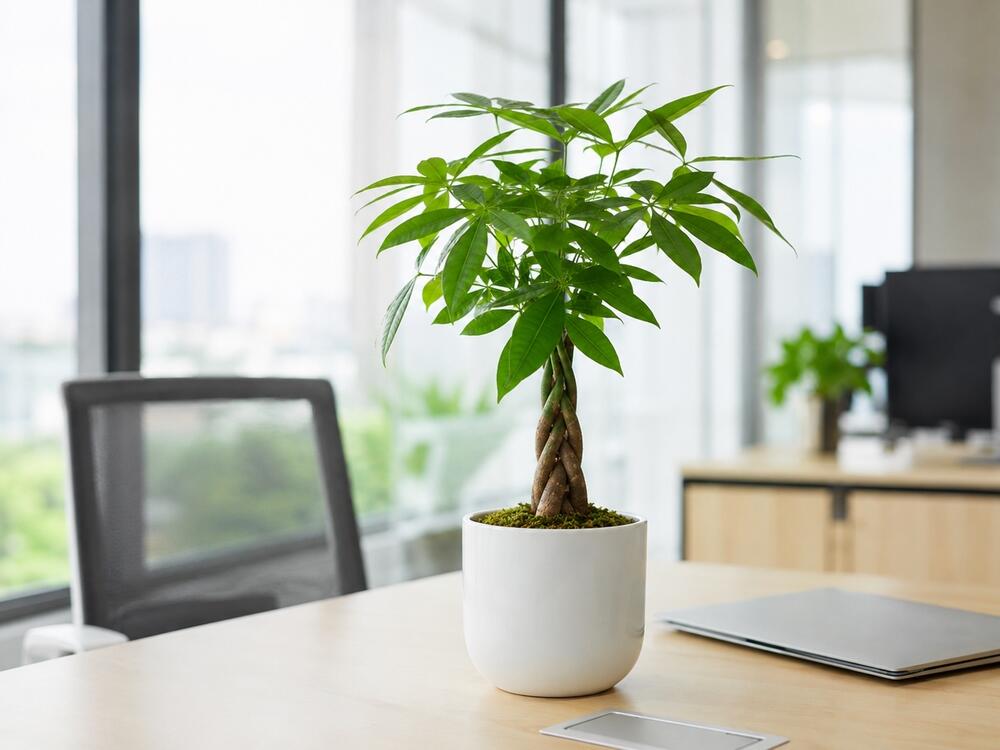
1. Pachira aquatica
Pachira aquatica, commonly known as the money tree, often has a braided or twisted trunk with foliage concentrated near the top. Its vertical form limits the amount of horizontal space it occupies, making it suitable for reception desks, client meeting tables, and other areas that require a medium-height plant.
The plant should be placed in an area with indirect light and away from continuous air-conditioning airflow. The pot size should correspond to the desk surface to reduce the risk of the plant being knocked over when employees move documents or equipment.
In feng shui practices, Pachira aquatica is often associated with financial prosperity and stability. This is one reason it is frequently selected for corporate offices.
2. ZZ plant
The ZZ plant has thick stems and glossy leaves that grow in upright clusters. Its compact and structured appearance makes it suitable for low cabinets, display shelves, or larger desk corners.
This plant is commonly selected for areas with indirect light. The soil should drain well because excessive watering may damage the stems and root system.
The sap of the ZZ plant contains calcium oxalate crystals and should not be directly handled by children or pets. Businesses should consider this factor when placing the plant in shared areas.
3. Snake plant
The snake plant has upright leaves, a narrow form, and limited horizontal spread. These characteristics make it suitable for desk corners, areas beside filing cabinets, or locations with restricted width.
It is commonly used indoors because it maintains a structured appearance and does not require frequent watering. However, the plant still needs suitable lighting, and its soil should not remain wet for extended periods.
Snake plants are available in different sizes, ranging from miniature desk varieties to large floor pots. Businesses should select the appropriate variety to maintain a balanced proportion between the plant, its pot, and the surrounding furniture.
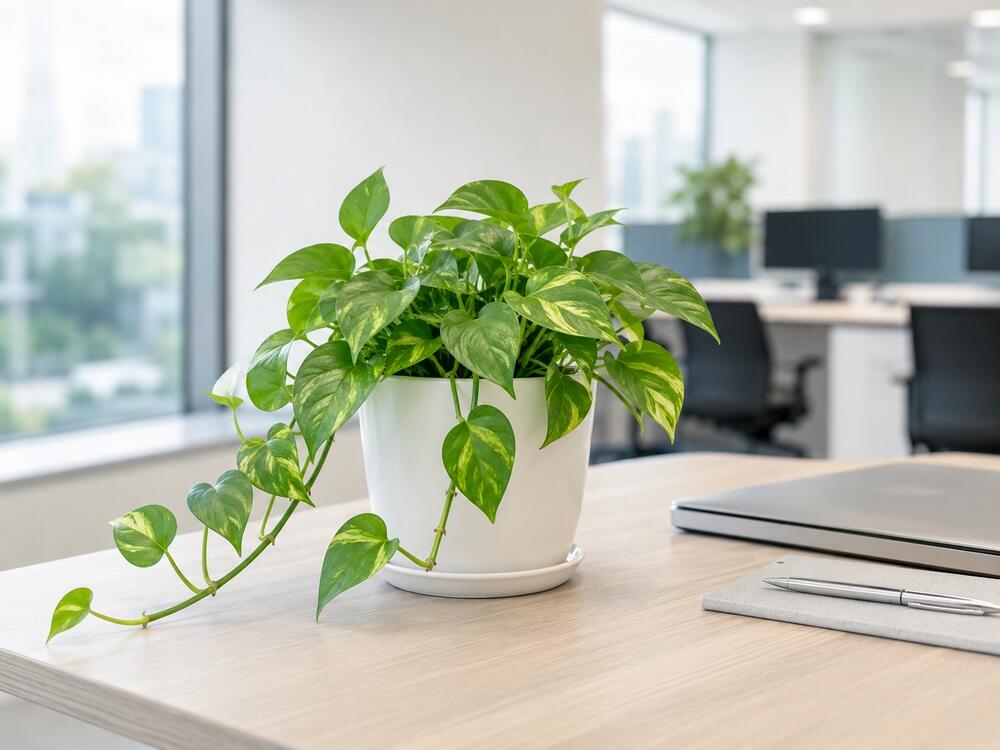
4. Pothos
Pothos is a trailing plant with heart-shaped leaves. It can be grown in soil, hanging pots, or water-based containers, depending on the intended placement.
For workstations, businesses should select a small variety and regularly trim the trailing stems. Excessive growth may interfere with electrical cables, documents, or employees’ movement around the desk.
Pothos leaves and stems contain calcium oxalate. The plant should be kept away from children, pets, and food preparation areas.
5. Rubber plant
The rubber plant has large, glossy, dark-green leaves, while new foliage often appears in red or reddish-brown tones. These colors provide a stronger visual accent than plants with entirely green foliage.
The plant is suitable for areas with relatively stable indirect light. Its large leaves collect dust easily and should be cleaned periodically to maintain their appearance.
Rubber plant sap may cause irritation for some individuals. Employees responsible for pruning should wear gloves and clean the tools after use.
6. Aglaonema
Aglaonema varieties often have green leaves with red or pink veins and edges. They are suitable for offices with neutral color palettes that require a small but visible color accent.
Their relatively low foliage makes them appropriate for reception tables, filing cabinets, and display shelves. The plant should be placed under indirect light to maintain its leaf color.
In Vietnam, this plant is commonly known as “Phú Quý,” a name associated with wealth and prosperity. It is therefore frequently selected for office openings or reception areas. Its symbolic meaning should be treated as a secondary consideration after practical maintenance conditions.
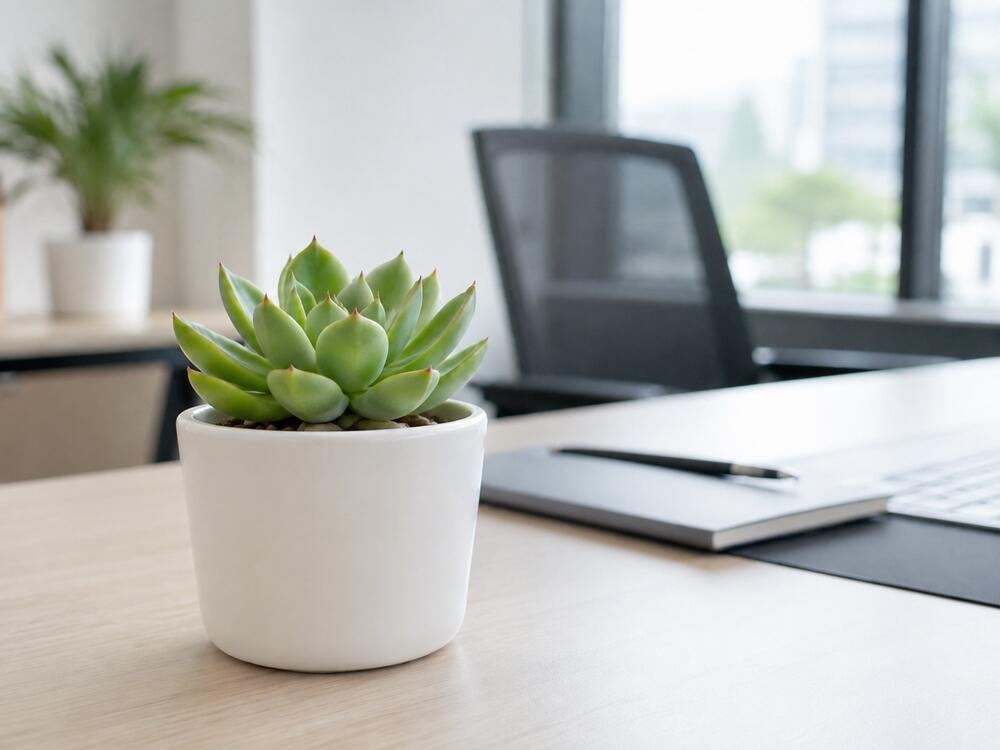
7. Succulents
Succulents are available in a wide range of forms, sizes, and colors. Some have rounded leaves, while others feature pointed leaves or rosette-shaped structures. Most succulent pots have a small diameter and fit easily on individual workstations.
These plants generally require adequate light and fast-draining soil. In offices with limited natural light, succulents may lose their shape or develop unevenly without an appropriate supplementary lighting solution.
Businesses should avoid placing succulents next to keyboards, electrical outlets, or areas used for handling documents. Water draining from the pot after watering may damage equipment and desk surfaces.
8. Dieffenbachia
Dieffenbachia has dense foliage, and different varieties feature distinctive patterns across the leaves. Depending on its size and placement, it may be grown in soil or water-based containers.
The plant is suitable for large desks, low cabinets, and reception areas. Its foliage should be trimmed periodically so that it does not block computer screens, nameplates, or items placed on the desk.
Some Dieffenbachia varieties contain substances that may cause irritation when touched or ingested. Businesses should identify the exact variety and review safety instructions before introducing it into the office.
Criteria for selecting plants for different office areas
Plant selection should not be based solely on appearance. The same plant may develop differently when positioned near a window, under artificial lighting, or directly below an air-conditioning vent.
Lighting conditions
Desks located near windows generally receive more light than areas situated deeper within the floor plate. Businesses should evaluate the window orientation, duration of sunlight exposure, and distance between the plant and the glass before selecting a species.
Prolonged direct sunlight may damage the leaves of certain indoor plants. By contrast, very dark areas are unsuitable for plants that require stronger light, including many succulent varieties.
Desk dimensions
Plant pots should not occupy areas required for computer monitors, keyboards, telephones, and documents. For standard workstations, narrow plants or pots with a small diameter are generally easier to arrange.
Larger pots should be placed on low cabinets, separate shelves, or directly on the floor. This arrangement reduces the risk of irrigation water coming into contact with electronic equipment.
Maintenance frequency
Offices without dedicated plant-care personnel should prioritize varieties that do not require frequent watering. For larger premises, businesses may appoint a maintenance provider to inspect the soil, prune foliage, and replace plants that are no longer suitable.
Maintenance schedules should account for weekends and extended holidays. Pots without trays or appropriate drainage systems may damage flooring, carpets, and furniture surfaces.
Safety requirements
Some ornamental plants contain sap that may cause irritation or present risks if ingested. This factor requires particular attention in offices with childcare areas, pets, or spaces used for eating.
Businesses should also avoid plants with thorns, fragile pots, and varieties that shed large quantities of leaves near walkways. Plants must not obstruct safety signs, fire protection equipment, or emergency exits.
Considerations when placing plants within an office floor plan
Desk plants should be positioned at an appropriate distance from electronic equipment and placed on trays that collect excess water. Employees should not water plants directly on desks unless the pots are properly sealed.
In offices that use central air conditioning, plants should not be exposed to a continuous flow of cold air. Changes in temperature and humidity may affect the foliage, soil conditions, and growth rate.
For new office design projects, plant locations should be determined alongside the furniture layout, lighting plan, and circulation routes. This approach prevents pots from obstructing walkways or becoming additional items introduced only after the office begins operation.
RSQUARE Vietnam provides office search, leasing advisory, and interior design and construction services based on each company’s requirements. Businesses seeking information on available units, rental rates, leasing options, or workplace layouts in Ho Chi Minh City and Hanoi may contact RSQUARE Vietnam to discuss their specific requirements.