2026 is regarded as an important milestone for Vietnam’s office market, as ESG (Environmental – Social – Governance) standards officially shift from being encouraged to being mandatory for FDI enterprises and multinational corporations that want to participate deeply in global supply chains. At the same time, the office markets in Hanoi and Ho Chi Minh City are showing a clear divergence in supply and demand, creating new trends in location selection, leasing models and cost structures.
1. The 2026 market picture: A divergence between the two hubs
In 2026, Vietnam’s office market is showing two sharply opposing extremes in the balance of supply and demand, requiring businesses to apply a separate approach and negotiation strategy for each geographic area in order to optimize their benefits.
Ho Chi Minh City: A market tilted in favor of tenants
In 2026, new office supply in Ho Chi Minh City continues to be added strongly, especially in Thu Thiem and South Saigon. Although the vacancy rate in the core central area has improved compared with the previous period, vacancy remains at around 19%.
This trend has driven a strong wave of relocation to premium buildings, often called “Flight-to-Quality”. Many businesses are proactively leaving old buildings to move to new Grade A offices, where the total leasing cost is competitive thanks to attractive incentive policies from developers.
Hanoi: Limited supply, speed of decision is the key factor
In contrast to Ho Chi Minh City, the Hanoi market continues to maintain a high occupancy rate, exceeding 85%. New Grade A supply in the western area and West of West Lake is quickly absorbed by the market, narrowing tenants’ range of choices more and more.
In this context, leasing decisions are often under heavy time pressure, as delays in internal approval can cause a business to lose a suitable location or have to accept adjusted rents that rise during 2026–2027.
2. Top 4 trends shaping the workplace in 2026
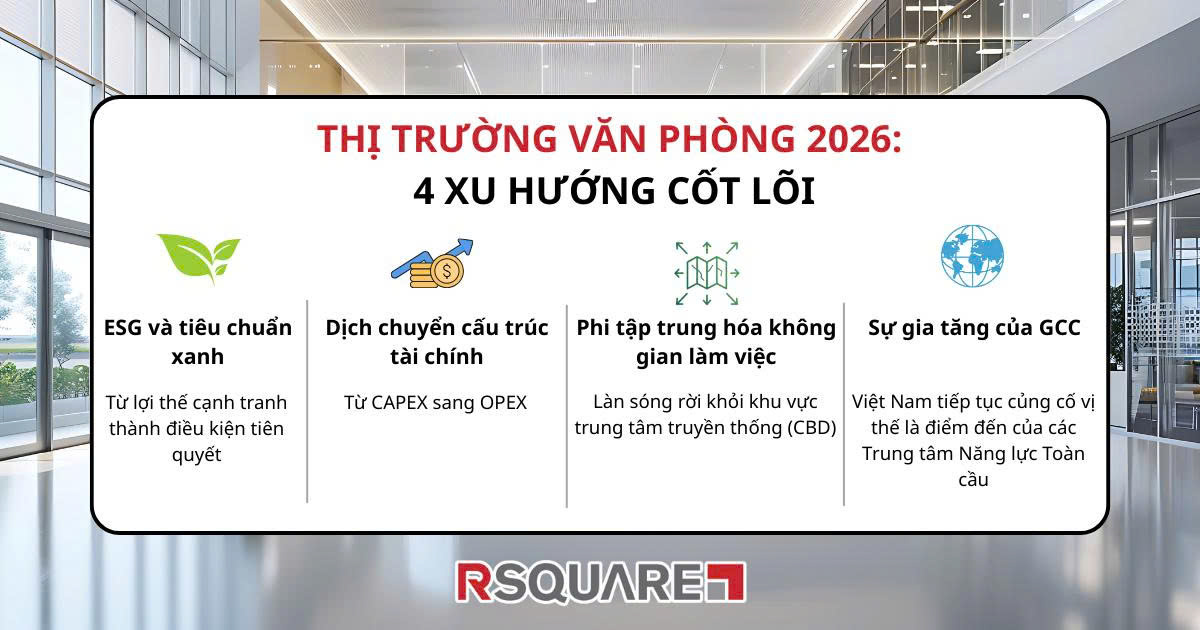
2.1. ESG and green standards: From a competitive advantage to a prerequisite
Green certifications such as LEED, Green Mark or LOTUS no longer carry only brand-image value but have become a prerequisite for attracting talent and foreign investment capital.
Market reports show that 76% of new Grade A office supply in Ho Chi Minh City has achieved international green standards. Notably, 78% of multinational corporations in Vietnam consider this a mandatory requirement in leasing dossiers in order to comply with the Net Zero emissions targets set by their head offices.
This is creating two clear streams of value in the market:
- Green investment, long-term savings (Green Premium): ESG-certified buildings may have higher rents, but help businesses save 15-30% of monthly operating energy costs.
- Risks of old buildings (Brown Discount): Old buildings with poor energy efficiency face the risk of declining value, difficulty retaining large tenants, and being removed from the shortlists of FDI enterprises.
2.2. Shift in financial structure: From CAPEX to OPEX
Facing global economic volatility, many businesses are limiting large investments in initial fit-out costs. Instead, the Serviced Office model or the hybrid “Core & Flex” model is attracting growing interest, allowing most fixed investment costs to be converted into flexible monthly operating costs.
This solution turns huge fixed-asset depreciation costs into monthly operating expenses (OPEX), lightening the burden on the company’s balance sheet and increasing its flexibility to adapt to headcount.
2.3. Decentralization of workspaces
The wave of moving away from the traditional central business district (CBD) continues to be clearly visible in 2026. Businesses prioritize newly developed areas with synchronized infrastructure and more competitive rents that still meet Grade A standards.
- In Ho Chi Minh City: A wave of relocation from District 1 to Thu Thiem (positioned as the new Pudong) and the District 7 area.
- In Hanoi: A strong shift from Hoan Kiem toward the west (Cau Giay, Nam Tu Liem) and especially West of West Lake (Starlake) – where ministries, agencies and new embassies are concentrated.
2.4. The rise of Global Capability Centers (GCC)
Vietnam continues to consolidate its position as a destination for Global Capability Centers, especially in technology and R&D. This tenant group needs large floor areas and has high requirements for technical infrastructure, information security and environmental standards, thereby helping to shape new standards for the premium office segment.
3. Cost traps and TCO (Total Cost of Ownership) analysis
A common mistake of many businesses is focusing only on the “listed rent” and surface-level incentives. In reality, the base rent accounts for only about 60-70% of the actual total cost a business has to pay over the entire lease cycle. From a risk-control perspective, RSQUARE analyzes the common hidden costs:
| Cost item | Common traps (Hidden Costs) | Control & optimization solutions from RSQUARE |
| Service fees & Overtime | Sky-high overtime AC charges, which greatly affect Tech/Agency companies that work late. | Check the cooling system’s performance (Energy Audit) and negotiate a lump-sum OT fee package. |
| Periodic rent increases | Rent escalation clauses tied to the CPI inflation index without a cap, leading to skyrocketing rents. | Negotiate a fixed increase range from the start (Capped rate, for example: maximum 3-5% per year). |
| Premises handback | Vague demolition and reinstatement costs, which landlords inflate at the end of the contract. | Clearly specify in the lease the scope, standards and acceptance party for the handback. |
| Measured area | A large gap between Gross area (wall centerline) and Net Leasable Area (clear internal dimensions) makes you pay for unused area (columns, corridors). | Carry out an actual laser measurement to determine the exact area to be paid for. |
4. Legal risks: Clauses that require “extreme vigilance”
In 2026, an office lease is no longer a simple agreement. The emergence of clauses related to green responsibility (Green Lease) makes thorough review before signing mandatory in order to protect the business from unfavorable obligations.
Early termination clause (Break Option):
In a business environment that can change unexpectedly, not having this right in the contract means a business may be “locked in” to an office that no longer suits it (too large or too small) for 3-5 years, leading to a huge waste of budget.
ESG commitments and responsibilities:
Today, many modern buildings include penalty clauses if tenants fail to comply with waste sorting regulations or fail to report energy consumption data periodically. Businesses need to clearly understand these obligations before signing to avoid unnecessary legal disputes.
Advice: Never sign any commitment document without a review by an independent advisory firm. At RSQUARE, we are ready to help businesses review contracts and negotiate commercial terms that protect tenants’ interests completely free of charge.
5. RSQUARE Vietnam: Data that guides – Absolute peace of mind
Amid the noise of information in the real estate market, with many inflated prices and fragmented data, businesses need an accurate “data compass” to make decisions.
RSQUARE has established a distinctive position thanks to owning the largest exclusive real estate database on the market, with verified information on more than 27,200+ buildings, updated regularly and continuously. As a result, businesses not only find a suitable office but also receive comprehensive support through a “One-stop” service:
- TCO analysis & comparison: Clarifying all actual costs, helping you make decisions based on total cost of ownership rather than the surface rent.
- In-depth legal negotiation: We negotiate directly to protect your interests, optimizing every term from commercial to legal.
- Design & construction consulting: Connecting you with reputable partners, helping you control the budget and construction quality from A to Z.
Conclusion
2026 is not a year to gamble with risk through emotional decisions. The market demands Quality, Compliance and a Long-term Vision. The right office is not just a place to work, but a strategic asset that helps a business optimize operations and affirm its commitment to sustainable development.