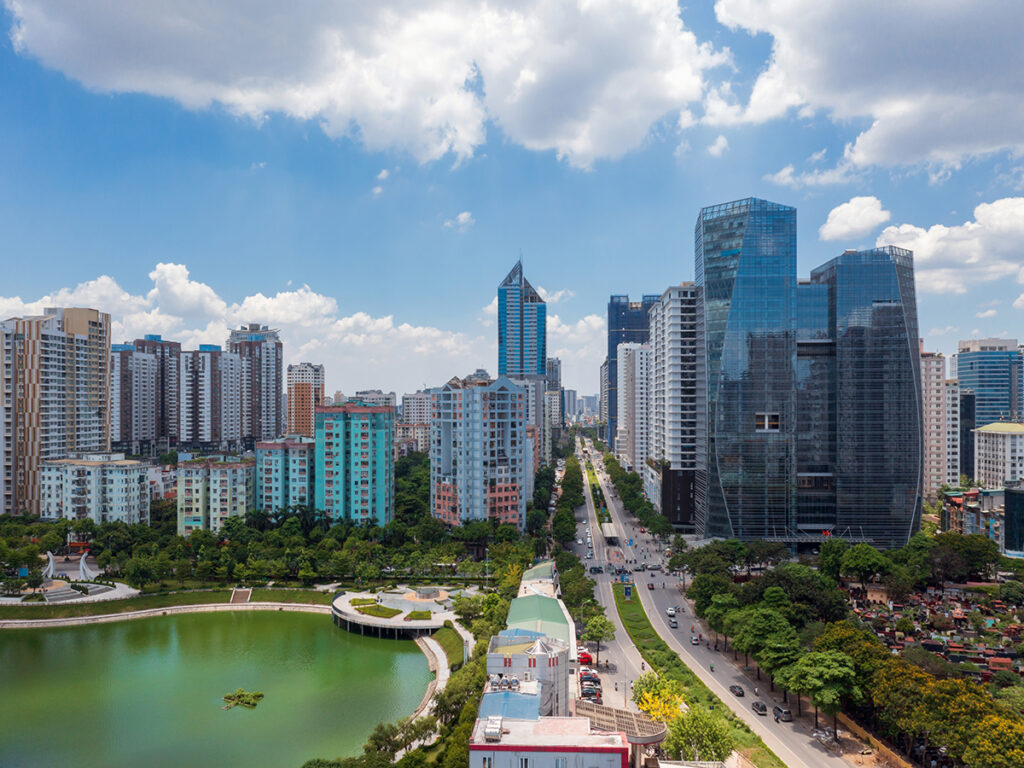
By Shin Ji-min (General Director, RSQUARE Vietnam).
In this written interview, Mr. Shin Ji-min, General Director of RSQUARE Vietnam, reviews Vietnam’s commercial real estate market in 2026 and shares the outlook for 2027. The article covers five areas:
1. New manufacturing FDI slowed this year, while Chinese companies remain the dominant investors.
2. Ho Chi Minh City’s office market favors landlords, and Hanoi’s favors tenants.
3. The northern high-tech industrial belt around Bac Ninh and Hai Phong keeps expanding, and the labor shortage there is growing.
4. Industrial parks and permitting are adjusting after the 2025 administrative merger.
5. Korean companies are shifting their investment strategy.
Looking ahead to 2027, the article points to southeast Hanoi and the Long Thanh airport area as promising locations. It closes with practical advice for Korean companies planning to enter Vietnam.
Q1. NOTABLE MARKET CHANGES IN 2026
The three keywords that defined the 2026 market were “a slower pace of new manufacturing entry”, “Chinese companies still in the driver’s seat” and “the rise of Vietnamese startups”.
① A slower pace of new manufacturing entry. New FDI, which surged after COVID-19, has slowed its pace this year. On paper, registered FDI for January–October reached USD 54.85 billion, up 74%, but this figure was driven by a handful of mega-projects together with capital increases and equity investments. The number of newly licensed projects was 3,478, up only 4.7% (VIR), and on the ground, the flow of new entrants has been slower than last year. We believe high market interest rates and uncertainty over tariffs and geopolitics have led companies to postpone investment decisions.
② Chinese companies remain in the driver’s seat; Korean suppliers follow their partners in. Even Chinese companies, the most active in manufacturing entry, paused this year. New registered capital from China for January–October was USD 2.77 billion, down from USD 3.21 billion in the same period last year (VIR, VNA). Even so, the reasons for Chinese companies to come to Vietnam remain intact: proximity to China, supply chain connectivity and demand for diversifying country of origin. We therefore believe the initiative in the manufacturing market still lies with Chinese companies.
New manufacturing entry by Korean companies has declined. However, in market-leading sectors such as electronics, semiconductors, automotive and shipbuilding, suppliers continue to enter Vietnam in step with the expansion of large conglomerates’ existing operations. This expansion-driven investment is also what kept Korea in second place for new registered capital this year (USD 5.81 billion).
③ The rise of Vietnamese startups and a lively coworking market. Outside manufacturing, local startups have flourished in AI, robotics, fintech and cultural content, backed by government policies to foster startups, such as Resolution 57 (December 2024), which made science and technology, innovation and digital transformation a core national strategy, and Resolution 68 (May 2025), which named the private economy the most important driver of growth. As a result, demand for small spaces on short-term leases has grown, energizing the coworking market.
Korean ICT companies are still entering Vietnam, but a shake-out has begun among those already here. We are seeing cases on the ground where companies that failed to build competitiveness in the domestic market have closed down or returned to Korea.
Compared with 2025, if 2025 was the year everyone looked at Vietnam, 2026 was a year of selection, when only well-prepared and competitive companies made a move.
Q2. THE HANOI AND HO CHI MINH CITY OFFICE MARKETS
This year, Ho Chi Minh City was a landlord’s market and Hanoi a tenant’s market. The difference came from “shifting supply” in Hanoi and “constrained supply” in Ho Chi Minh City.
① Hanoi, a tenant’s market: the center of gravity shifts west to Starlake. With the opening of IFC Hanoi (about 60,000 m²), the Q2 vacancy rate rose to 26.2% (JLL). 85% of new supply in 2027–2030 (about 260,000 m²) will be concentrated in Starlake. Grade A occupancy in the city center remains tight at 95%, while non-CBD areas reach only 81% (Savills, Q2), a clear gap between the center and the periphery. Competition among new buildings has increased rent-free periods and fit-out support, and negotiating leverage has passed to tenants.
② Ho Chi Minh City, a landlord’s market: supply constrained by permitting. Grade A rent in District 1 (including maintenance fee, about USD 64.7) is on par with Gangnam, Seoul (about USD 70), where incomes are 7–9 times higher. Stringent permitting procedures have limited supply, so the only new Grade A building in 2026 is The Kross. Grade A vacancy, which rose as high as 20% in 2024, is coming down to 13–17%. Prime buildings with high occupancy are holding rents and setting lease terms.
③ Thu Thiem breaks the “new buildings stay empty” myth. Since 2023, 90% of new Grade A supply in Ho Chi Minh City has come from Thu Thiem. The four Grade A buildings completed in 2023 are all around 95% occupied, and The METT went from 10% to 97% in just two years (RSQUARE internal DB, August 2026). The Vietnam International Financial Centre (VIFC), launched in February this year, is adding momentum to this trend.
This picture will continue in 2027. In Hanoi, new buildings in Starlake will keep coming, giving tenants facing renewal even more bargaining power; in Ho Chi Minh City, new supply remains blocked, so the landlord’s market will persist.
Reference 1: Hanoi and Ho Chi Minh City office indicators
| Item | Hanoi | Ho Chi Minh City |
|---|---|---|
| Grade A rent | About USD 29/m²/month, down QoQ (Avison Young, Q3). CBD net rent USD 32.7, flat (JLL, Q2) | District 1 CBD: USD 64.7, +1.1% YoY (JLL, Q1). By C&W’s count, -5.6% YoY in VND terms (Q3) |
| Grade A occupancy | CBD 95%, non-CBD 81% (Savills, Q2). Overall market vacancy 26.2% (JLL, Q2) | 89.8%, +3.6 pp YoY (C&W, Q3) |
| Grade B rent and occupancy | About USD 18, 84% (Avison Young, Q3) | About USD 33.5 (Avison Young), occupancy 92.0% (C&W, Q3) |
| Upcoming supply | H2 2026–2028: about 207,000 m² of Grade A, mostly in Tay Ho Tay (CBRE) | Only one new Grade A building in 2026, The Kross (RSQUARE). About 165,000 m² of Grade A over the next three years (CBRE) |
| Tenant bargaining power | Strong: competition among new Grade A buildings | Weak: landlords hold the upper hand in prime buildings |
Reference 2: Offices in Thu Thiem and nearby competing areas (RSQUARE internal DB, August 2026)
| Building | Grade | Completed | Rent + maintenance fee (USD/m²/month) | Occupancy |
|---|---|---|---|---|
| The HallMark | A | 2023 | 58.5 | 98.5% |
| The METT | A | 2023 | 53.2–55.2 | 97.4% |
| The Nexus | A | 2023 | 63.9–76.9 | 97.1% |
| Riverfront Financial Centre | A | 2023 | 64–65 | 94.9% |
| Sonatus Building | A | 2019 | 51.0 | 93.4% |
| IFC One Saigon | A | 2025 | 61–68 | About 50% (completed 2025, leasing in progress) |
| The Waterfront Saigon | B+ | 2017 | 42–47 | 100% |
| CJ Building | B+ | 2008 | 35.5 | 99.4% |
| Lim Tower 1 | B+ | 2013 | 31.5–46.5 | 89.2% |
Q3. INDUSTRIAL REAL ESTATE: THE REGIONS AND SECTORS THAT LED GROWTH
The biggest change in industrial real estate this year was the further expansion of the northern high-tech ecosystem centered on Bac Ninh.
① The North: a massive high-tech belt centered on Bac Ninh. The clustering of semiconductor and electronics companies in Bac Ninh, extending to Thai Nguyen, Vinh Phuc, Phu Tho and Bac Giang, has grown stronger. Bac Ninh hosts Amkor, Hana Micron, ITM Semiconductor and Foxconn; Bac Giang has Luxshare; Thai Nguyen has Samsung Electro-Mechanics; Vinh Phuc has ISC; and Phu Tho has BYD Electronics. Thai Nguyen ranked first nationwide in new FDI attraction for January–July this year (about USD 5.8 billion). As suppliers followed, ready-built factory rent in Bac Ninh reached USD 5.5/m², the highest in the North (RSQUARE survey, Q2). However, industrial land supply also grew 15.7% in a year, pulling occupancy down to 64% (C&W, Q2).
② Hai Phong: a standalone market distinct from Bac Ninh. Hai Phong should be seen as a standalone market rather than an extension of Bac Ninh. LG Display, LG Electronics and LG Innotek occupy 25% of Trang Due Industrial Park and have invested more than USD 10.6 billion in Hai Phong alone, while tech companies such as Pegatron, Lite-On and USI have formed a separate ecosystem around them. H1 FDI reached USD 3.1 billion, 1.75 times the same period last year, and a new LG Innotek semiconductor substrate plant was approved. Backed by demand from these two hubs, net absorption of industrial land in the North’s key localities exceeded 217 ha in H1, the highest since Q1 2024 (CBRE), and industrial land rent rose 2.7% YoY to USD 137.7/m² (C&W).
Where to be cautious. Places where new supply floods in all at once. About 965,000 m² of northern ready-built factory supply in 2026–2028 is concentrated in Bac Ninh and Hai Phong (C&W), so absorption speeds will diverge even within the same ecosystem. For new industrial parks, the completion timeline of infrastructure such as power and roads must be verified on site.
The labor shortage is getting worse. With investment pouring into Bac Ninh and Hai Phong at the same time, the biggest bottleneck for northern manufacturing is no longer land but people. Bac Ninh needs to hire more than 230,000 new workers this year, and Hai Phong’s industrial parks and economic zones need about 120,000, of which 55,000 are concentrated in H2. With both localities competing for the same labor pool, Foxconn and Luxshare have offered signing bonuses worth two months’ salary, and Hai Phong has pledged to build 15,000 rental housing units for workers by 2030. Skilled workers in semiconductors, automation and quality control are even scarcer than production workers. When choosing a factory location, companies should now check the surrounding labor pool, dormitories and commuting conditions before rent and logistics.
Q4. CHANGES IN INDUSTRIAL PARKS AND PERMITTING AFTER THE ADMINISTRATIVE MERGER
The administrative merger of July 2025 simplified investment contact points, while permitting on the ground is still going through an adjustment period. The lag between new rules and their implementation was a hidden variable in this year’s market.
① Streamlined contact points, procedures still adjusting. With 63 provinces and cities reduced to 34 and the district level abolished, investors now deal with fewer contact points. During the transition, 41% of businesses in Ho Chi Minh City reported longer processing times than before the merger (Ho Chi Minh City Business Association, HUBA), mainly for construction permits, business registration changes and land use right certificates. The reasons cited include data migration, staff reassignments and the reorganization of duties among agencies. Our own experience is similar. Companies in industrial parks whose managing authority changed after the merger have had to re-establish working channels with the new province’s industrial park management board, and responses to petitions are also taking longer than before. While staff assignments and responsibilities are being finalized, applications that require careful review or are more complex tend to take longer to process.
② The bottleneck in industrial park investment is “land”. Half of the companies that went through land procedures postponed or cancelled their business plans (VCCI). Phu Tho, merged with Vinh Phuc and Hoa Binh, saw H1 FDI rise 4.86 times, yet newly handed-over industrial park land was only 18.63 ha, and more than 3,000 ha of industrial land has yet to complete compensation. The structure in which investment approval, land, design, environment and fire safety reviews run separately, forcing repeated document submissions, also remains unchanged.
③ The rules have become faster; enforcement is the key. The new Investment Law, effective March 2026, allows a company to be established before obtaining an Investment Registration Certificate (IRC) and expands simplified procedures for projects inside industrial parks. Ho Chi Minh City has also merged the industrial park management boards of Ho Chi Minh City, Binh Duong and Ba Ria – Vung Tau into one. However, procedures such as environmental impact assessments have been deferred rather than waived, so actual speed depends on enforcement on the ground.
④ How companies should respond: confirm “in writing” before signing. Before signing a land or factory lease, companies should submit a written inquiry to the industrial park management board or competent authority on whether the planned production activities can legally operate in that industrial park, and proceed only after receiving an official reply. This leaves a basis even if the person in charge changes or interpretations differ. For complex cases, we recommend a preliminary legal review through a law firm.
Q5. CHANGES IN KOREAN COMPANIES’ DEMAND AND STRATEGY
Overall demand from Korean companies to enter Vietnam has declined. Instead, the market has been supported by the expansion of companies already here and by entry from specific industries within large conglomerates’ supply chains.
① New entry: “selection” over “volume”. Korea held second place with USD 5.81 billion in new registered capital for January–October, but this figure was driven by a few large projects such as the USD 2.3 billion Quynh Lap LNG power plant by an SK Innovation-led consortium. Amid high interest rates and tariff uncertainty, new-entry inquiries from small, medium and mid-sized manufacturers have fallen from last year, and more companies are “still reviewing but holding off on a decision”.
② Existing companies: expansion and restructuring. In Q1, Korea ranked first by country in capital increases for existing projects (20.7%). Inquiries centered on suppliers expanding factories in line with capacity increases by Samsung, LG and other conglomerates, as well as consolidating and relocating scattered sites into one location. Because start-of-operation timing matters, ready-built factories that allow immediate move-in are considered first.
③ Specific industries keep coming. Suppliers in semiconductors (Hana Micron, ITM Semiconductor, ISC, Seoul Semiconductor), electronic components, auto parts and shipbuilding continue to arrive along conglomerates’ supply chains. Semiconductor and electronics suppliers in particular mostly head to the Bac Ninh belt and Hai Phong. The shift in Korean investment from simple assembly to high-tech manufacturing and R&D is also clear.
In the end, Vietnam has sorted the strong from the weak. The era of looking for cheap, spacious production bases is over; only the industries and companies that are part of conglomerates’ supply chains or have proven their competitiveness in the local market are growing selectively. Vietnam is no longer “a market everyone goes to” but “a market where well-prepared companies grow”.
Q6. MARKET OUTLOOK FOR 2027
2027 will be a market where companies must choose between “established hubs with complete infrastructure” and “new areas where labor is easier to find”. This is because the labor shortage mentioned in Q3 is intensifying and changing the very criteria for choosing a location.
① The North: the market expands southeast of Hanoi. Key hubs such as Bac Ninh and Hai Phong have good infrastructure, but hiring is getting harder. Investment is therefore spreading to satellite localities southeast of Hanoi, such as Hung Yen (merged with Thai Binh) and Ninh Binh. Ninh Binh has 5,000 ha of industrial land with another 3,000 ha planned, and Hung Yen attracted 40 new FDI projects through August this year. Their strengths are relatively low rents and a wide labor catchment area.
② The South: a relatively healthy labor market and renewed growth expected. The South, centered on Ho Chi Minh City and former Binh Duong, has a long-established labor base and migrant workers from the Mekong Delta, so competition for hiring is less intense than in the North, where electronics companies arrived all at once. We expect the southern market, after catching its breath, to re-emerge as an alternative for companies looking for labor.
③ Where investment is expected to concentrate: the Long Thanh airport area. Once Long Thanh International Airport begins commercial operations on December 1, 2026 as planned, Dong Nai, home to the airport, and former Ba Ria – Vung Tau will become the center of growth in the South. Dong Nai has allocated more than 1,900 ha for new industrial parks near the airport, and ready-built factory occupancy is high, in the 94% range. Former Ba Ria – Vung Tau continues to attract large manufacturing investments such as Hyosung, BOE and Tokuyama, centered on the Cai Mep – Thi Vai deep-water port and the Phu My industrial parks. These two areas, where airport, seaport and expressways converge in one region, deserve close attention.
Reference: Promising investment areas for 2027
| Area | Strengths | Points to check |
|---|---|---|
| Dong Nai (near Long Thanh Airport) | Long Thanh Airport targeting commercial operations from December 1, 2026; more than 1,900 ha of new industrial parks near the airport; ready-built factory occupancy 94.3% | Airport construction also faced labor shortages; infrastructure completion timeline of new industrial parks |
| Former Ba Ria – Vung Tau (now part of Ho Chi Minh City) | Cai Mep – Thi Vai deep-water port; large chemical, materials and electronics investments in Phu My industrial parks; Bien Hoa – Vung Tau Expressway | Small local workforce, heavy reliance on migrant labor |
| Hung Yen, Ninh Binh (southeast of Hanoi) | Low rents, large industrial land bank and wide labor catchment area; Hung Yen has more than 200 Japanese investment projects | Access to seaports and airports is weaker than at key hubs |
Q7. ADVICE FOR KOREAN COMPANIES PREPARING TO ENTER VIETNAM
Success in Vietnam is now determined less by land and rent than by people and institutions. I would like to offer five pieces of advice.
① Survey the labor market first and prepare with automation. Before choosing a location, check the surrounding labor pool and hiring competition. Production facilities should incorporate as much automation as possible from the outset, designed to rely less on people.
② All else being equal, choose a location with tax incentives. Investment incentives such as corporate income tax reductions vary by locality and industrial park. If location conditions are similar, simply choosing a locality and industrial park that qualify for tax incentives can make a big difference to long-term profit and loss.
③ Build in buffers for time and funding. Permitting involves multiple steps, so projects often do not go according to plan. Enter with ample time and financial buffers.
④ Factor in rising costs for professional staff. Labor costs for professionals in Vietnam are rising steeply. Salaries in AI, data and fintech are forecast to rise 15–25% in 2026 (Robert Walters). Non-manufacturing companies should also study the labor market thoroughly before entering.
⑤ Make active use of local support organizations. Many organizations, such as KOTRA, help companies enter Vietnam. We recommend gathering information and seeking advice through them.
RSQUARE Vietnam milestones
RSQUARE Vietnam is the Vietnam entity of RSQUARE, Korea’s No. 1 commercial real estate proptech company. With Hanoi and Ho Chi Minh City as its main bases, RSQUARE Vietnam provides one-stop services across key provinces and cities nationwide, covering office, factory and industrial park leasing, sales advisory, and interior design and fit-out.
| Year | Key milestones |
|---|---|
| 2021 | RSQUARE enters Vietnam |
| 2022 | Completed a nationwide office and factory database; signed an MOU with Shinhan Bank Vietnam |
| 2023 | Launched interior design and fit-out services; signed a brokerage service agreement with VTK Hung Yen Industrial Park; signed an MOU with Korea Investment & Securities |
| 2024 | Surpassed 100 clients; hosted a seminar on Vietnam industrial real estate; signed MOUs with Samsung Electronics, Hangshin and Konet Express |
| 2025 | Interior fit-out for B3CC1, the largest plot in Starlake, Hanoi |
| 2026 | Built a database of 26,400 office buildings, 12,700 factories and more than 600 industrial parks; surpassed 300 clients |